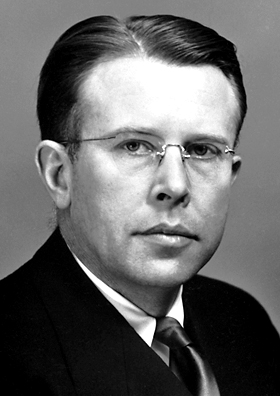
File:Ernest_Lawrence.jpg · Wikimedia Commons · See Wikimedia Commons
Ernest Lawrence
Sign in to saveAlso known as Ernest Orlando Lawrence
American nuclear physicist (1901–1958)
Ernest Lawrence was an American nuclear physicist who invented the cyclotron, a machine that accelerated particles to high speeds for scientific research. His work was foundational to nuclear physics and led to important discoveries about the atom, making him one of the most influential scientists of the 20th century.
AI-generated from the Wikipedia summary — may contain errors.
Nobel Prize
- The Nobel Prize in Physics1939
“for the invention and development of the cyclotron and for results obtained with it, especially with regard to artificial radioactive elements”
Wikidata facts
- Instance of
- human
- Given name
- Orlando
- Family name
- Lawrence
- Gender
- male
- Citizenship
- United States
- Place of birth
- Canton
- Place of death
- Palo Alto
- Sibling
- John H. Lawrence
- Occupation
- university teacher
- Languages spoken
- English language
- Participant in
- Manhattan Project
- Doctoral advisor
- William Francis Gray Swann
- Field of work
- physics
- Image
- Ernest Lawrence.jpg
- Residence
- United States
Show 13 more facts
- Erdős number
- 6
- Commons category
- Ernest O. Lawrence
- date of birth
- 1901-08-08
- date of death
- 1958-08-27
- Commons gallery
- Ernest O. Lawrence
- member of
- American Philosophical Society
- topic's main category
- Category:Ernest Lawrence
- nominated for
- Nobel Prize in Physics
- name in native language
- Ernest Orlando Lawrence
- birth name
- Ernest Orlando Lawrence
- on focus list of Wikimedia project
- Wikipedia:Vital articles/Level/4
- maintained by WikiProject
- WikiProject Mathematics
- interested in
- physics
Sources (15)
via Wikidata · CC0
~38 min read
Encyclopedic overview
Ernest Orlando Lawrence (August 8, 1901 – August 27, 1958) was an American physicist who received the Nobel Prize in Physics in 1939 for his invention of the cyclotron. He is known for his work on uranium-isotope separation for the Manhattan Project, as well as for founding the Lawrence Berkeley National Laboratory and the Lawrence Livermore National Laboratory.
A graduate of the University of South Dakota and University of Minnesota, Lawrence obtained a PhD in physics at Yale in 1925. In 1928, he was hired as an associate professor of physics at the University of California, Berkeley, becoming the youngest full professor there two years later. In its library one evening, Lawrence was intrigued by a diagram of an accelerator that produced high-energy particles. He contemplated how it could be made compact, and came up with an idea for a circular accelerating chamber between the poles of an electromagnet. The result was the first cyclotron.
Excerpted from Wikipedia’s “Ernest Lawrence” article, available under the CC BY-SA 4.0 licence.
Gallery (8)
Available in 91 languages
- Español
- Français
- Deutsch
- 中文
- 日本語
- Русский
- Português
- Italiano
- العربية
- हिन्दी
- Afrikaans
- Armenian
- Asturian
- azb
- Azerbaijani
- Bahasa Indonesia
- Balinese
- Bangla
Show 72 more
- Basque
- Belarusian
- Bosnian
- Bulgarian
- Burmese
- Catalan
- Central Kurdish
- Croatian
- Czech
- Danish
- Egyptian Arabic
- Esperanto
- Estonian
- Finnish
- Galician
- Georgian
- Greek
- Haitian Creole
- Hakka Chinese
- Hebrew
- Hungarian
- Ido
- Iloko
- Irish
- Javanese
- Kazakh
- Kurdish
- Latin
- Latvian
- Lithuanian
- Macedonian
- Malagasy
- Malay
- Malayalam
- Marathi
- Mazanderani
- Mingrelian
- Nederlands
- Newari
- Norwegian
- Norwegian Nynorsk
- Occitan
- Pashto
- Piedmontese
- Polski
- Punjabi
- Romanian
- Sanskrit
- Scots
- Serbian
- Serbian (Latin)
- simple
- Slovak
- Slovenian
- Svenska
- Swahili
- Tamil
- Tatar
- Tiếng Việt
- Türkçe
- Ukrainian
- Urdu
- Uzbek
- Waray
- Western Panjabi
- Wu Chinese
- Yoruba
- zh_min_nan
- zh_yue
- فارسی
- ไทย
- 한국어
via Wikidata sitelinks · CC0