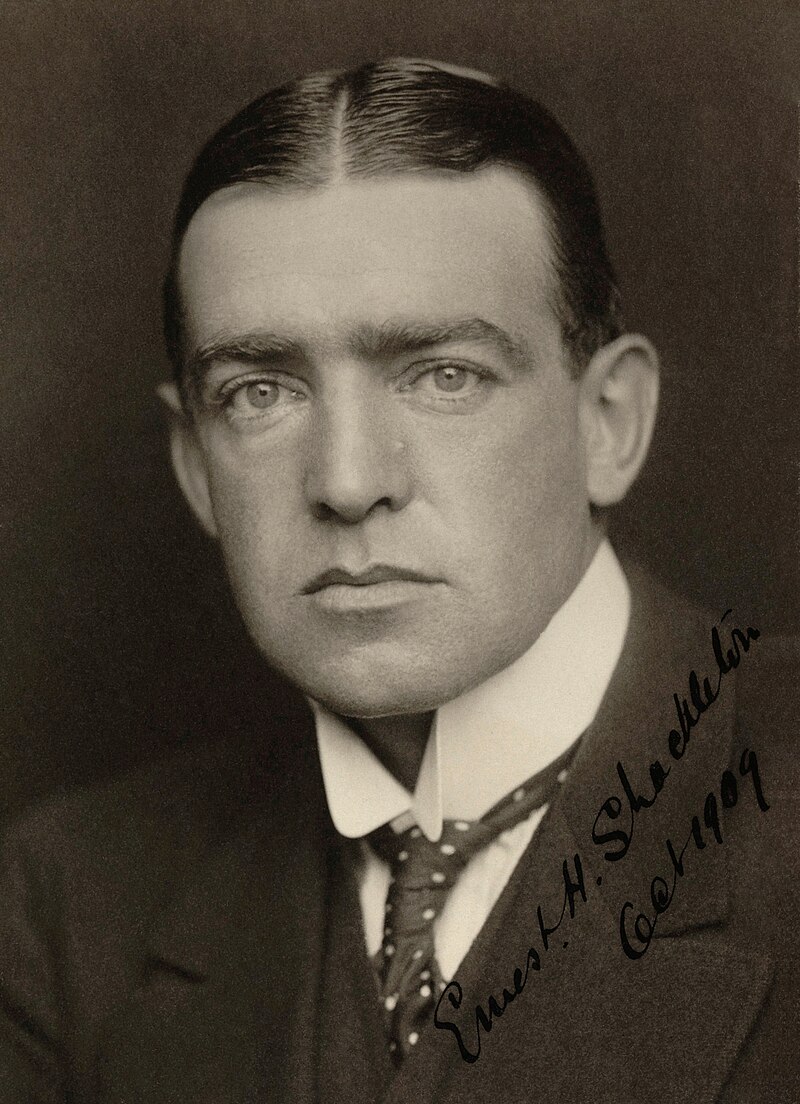
File:Ernest_Shackleton_before_1909.jpg · Wikimedia Commons · See Wikimedia Commons
Ernest Shackleton
Sign in to saveAlso known as Sir Ernest Henry Shackleton
Anglo-Irish Antarctic explorer (1874–1922)
OverviewAI-generated
Ernest Henry Shackleton was a British explorer, military officer, and traveler born in 1874 at Kilkea Castle. Educated at Dulwich College, he served as a lieutenant in the Royal Navy. His career included participation in the Discovery Expedition, the British Antarctic Expedition, the Expedition Endurance, and the Shackleton–Rowett Expedition. He also took part in World War I and the Russian Civil War.
Shackleton held the record for Farthest South and was a member of the Royal Geographical Society. He received several awards, including the Officer of the Order of the British Empire, the Officer of the Legion of Honour, the Order of the Iron Crown, and the Order of Saint Anna. He was employed by the Royal Scottish Geographical Society. He died of a myocardial infarction in 1922 at Grytviken.
Synthesized by Vinony from 23 facts across 2 sources: Wikidata, TMDb. Generated from structured data (not the Wikipedia text) and checked against those facts — may still contain errors.
Film & TV
Sir Ernest Henry Shackleton was an Anglo-Irish Antarctic explorer who led three British expeditions to the Antarctic. He was one of the principal figures of the period known as the Heroic Age of Antarctic Exploration.
Known for
- Endurance — Self (archive footage)2024
- Shackleton: The Greatest Story of Survival — Self2023
- Encounters at the End of the World — Self - (archive footage)2007
- Southward on the Quest — himself1922
- South — Leader of the Expedition (as Sir Ernest Shackleton)1919
- Departure of the British Antarctic Expedition from Lyttelton, New Zealand, 1st January, 1908 — Self1908
- Shackleton and Scott: Rivals for the Pole — Self
via TMDB
Wikidata facts
- Instance of
- human
- Given name
- Henry
- Gender
- male
- Citizenship
- United Kingdom of Great Britain and Ireland
- Place of birth
- Kilkea Castle
- Place of death
- Grytviken
- Languages spoken
- English language
- Participant in
- Shackleton–Rowett Expedition
- Noble title
- Knight Bachelor
- Conflict
- Russian Civil War
- Military branch
- Royal Navy
- Military rank
- lieutenant
- Image
- Ernest Henry Shackleton Nadar.jpg
Show 17 more facts
- Commons category
- Ernest Shackleton
- cause of death
- myocardial infarction
- date of birth
- 1874-02-15
- date of death
- 1922-01-05
- topic's main category
- Category:Ernest Shackleton
- manner of death
- natural causes
- Commons gallery
- Ernest Henry Shackleton
- member of
- Royal Geographical Society
- record held
- Farthest South
- writing language
- English language
- P6944
- Ernest Shackleton
- date of burial or cremation
- 1922-03-05
- name in native language
- Ernest Shackleton
- P12749
- The Upside of Anger
- honorific prefix
- Sir
- Commons Creator page
- Ernest Shackleton
- collection items at
- Natural History Museum
Sources (14)
via Wikidata · CC0
~40 min read
Encyclopedic overview
Sir Ernest Henry Shackleton (15 February 1874 – 5 January 1922) was an Anglo-Irish Antarctic explorer who led three British expeditions to the Antarctic. He was one of the principal figures of the period known as the Heroic Age of Antarctic Exploration.
Born in Kilkea, County Kildare , Ireland , Shackleton and his Anglo-Irish family moved to Sydenham in suburban south London when he was ten. Shackleton's first experience of the polar regions was as third officer on Captain Robert Falcon Scott's Discovery expedition of 1901–1904, from which he was sent home early on health grounds, after he and his companions Scott and Edward Adrian Wilson set a new southern record by marching to latitude 82° S. During the Nimrod Expedition of 1907–1909, he and three companions established a new record Farthest South latitude of 88°23′ S, only 97 geographical miles (112 statute miles or 180 kilometres) from the South Pole, the largest advance to the pole in exploration history. Also, members of his team climbed Mount Erebus, the most active Antarctic volcano. On returning home, Shackleton was knighted for his achievements by King Edward VII.
Excerpted from Wikipedia’s “Ernest Shackleton” article, available under the CC BY-SA 4.0 licence.
Gallery (13)
Available in 63 languages
- Español
- Français
- Deutsch
- 中文
- 日本語
- Русский
- Português
- Italiano
- العربية
- Armenian
- Asturian
- Azerbaijani
- Bahasa Indonesia
- Basque
- Belarusian
- Bulgarian
- Burmese
- Catalan
Show 44 more
- Croatian
- Czech
- Danish
- Esperanto
- Estonian
- Filipino
- Finnish
- Galician
- Georgian
- Greek
- Hebrew
- Hungarian
- Ido
- Irish
- Kazakh
- Kotava
- Latvian
- Lithuanian
- Low German
- Macedonian
- Manx
- Marathi
- Nederlands
- Norwegian
- Norwegian Nynorsk
- Occitan
- Pampanga
- Pashto
- Piedmontese
- Polski
- Romanian
- Serbian
- simple
- Slovak
- Slovenian
- Svenska
- Tiếng Việt
- Türkçe
- Ukrainian
- Welsh
- Wu Chinese
- zh_yue
- فارسی
- 한국어
via Wikidata sitelinks · CC0