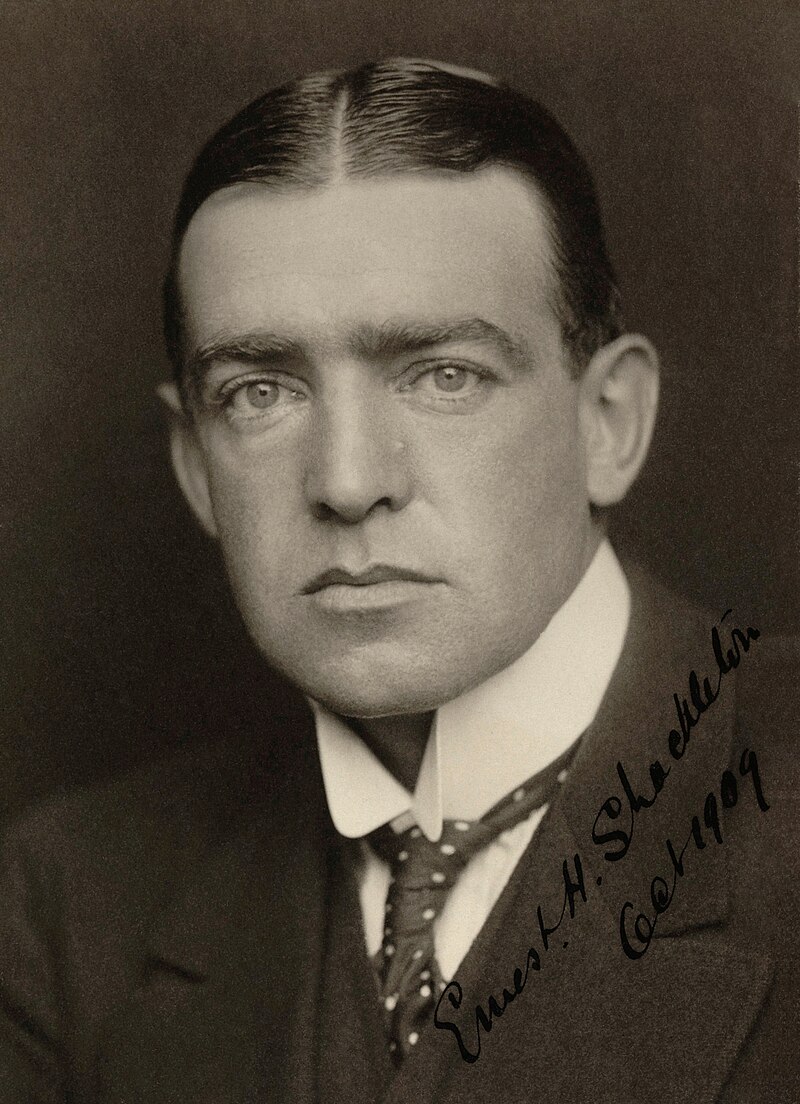
File:Ernest_Shackleton_before_1909.jpg · Wikimedia Commons · See Wikimedia Commons
OverviewAI-generated
Ernest Henry Shackleton was a British explorer, military officer, and traveler born in 1874 at Kilkea Castle. Educated at Dulwich College, he served as a lieutenant in the Royal Navy. His career included participation in the Discovery Expedition, the British Antarctic Expedition, the Expedition Endurance, and the Shackleton–Rowett Expedition. He also took part in World War I and the Russian Civil War.
Shackleton held the record for Farthest South and was a member of the Royal Geographical Society. He received several awards, including the Officer of the Order of the British Empire, the Officer of the Legion of Honour, the Order of the Iron Crown, and the Order of Saint Anna. He was employed by the Royal Scottish Geographical Society. He died of a myocardial infarction in 1922 at Grytviken.
Synthesized by Vinony from 23 facts across 2 sources: Wikidata, TMDb. Generated from structured data (not the Wikipedia text) and checked against those facts — may still contain errors.
Film & TV
Sir Ernest Henry Shackleton was an Anglo-Irish Antarctic explorer who led three British expeditions to the Antarctic. He was one of the principal figures of the period known as the Heroic Age of Antarctic Exploration.
Known for
- Endurance — Self (archive footage)2024
- Shackleton: The Greatest Story of Survival — Self2023
- Encounters at the End of the World — Self - (archive footage)2007
- Southward on the Quest — himself1922
- South — Leader of the Expedition (as Sir Ernest Shackleton)1919
- Departure of the British Antarctic Expedition from Lyttelton, New Zealand, 1st January, 1908 — Self1908
- Shackleton and Scott: Rivals for the Pole — Self
via TMDB
Wikidata facts
- Instance of
- human
- Given name
- Henry
- Gender
- male
- Citizenship
- United Kingdom of Great Britain and Ireland
- Place of birth
- Kilkea Castle
- Place of death
- Grytviken
- Languages spoken
- English language
- Participant in
- Shackleton–Rowett Expedition
- Noble title
- Knight Bachelor
- Conflict
- Russian Civil War
- Military branch
- Royal Navy
- Military rank
- lieutenant
- Image
- Ernest Henry Shackleton Nadar.jpg
Show 17 more facts
- Commons category
- Ernest Shackleton
- cause of death
- myocardial infarction
- date of birth
- 1874-02-15
- date of death
- 1922-01-05
- topic's main category
- Category:Ernest Shackleton
- manner of death
- natural causes
- Commons gallery
- Ernest Henry Shackleton
- member of
- Royal Geographical Society
- record held
- Farthest South
- writing language
- English language
- P6944
- Ernest Shackleton
- date of burial or cremation
- 1922-03-05
- name in native language
- Ernest Shackleton
- P12749
- The Upside of Anger
- honorific prefix
- Sir
- Commons Creator page
- Ernest Shackleton
- collection items at
- Natural History Museum
Sources (14)
via Wikidata · CC0
Article · Italiano
Ernest Henry Shackleton (Athy, Kilkea House, 15 febbraio 1874 – Grytviken, 5 gennaio 1922) è stato un esploratore britannico di origine irlandese. Ernest Shackleton partecipò alla spedizione Discovery, partita dall'Inghilterra il 6 agosto 1901 e comandata da Robert Falcon Scott. Shackleton era terzo ufficiale, responsabile dei magazzini e delle provviste. Venne organizzata una spedizione al Polo Sud con Scott, Wilson e Shackleton che lasciarono il campo base il 2 novembre 1902 con cani e gruppi di supporto. Il 30 dicembre, dopo aver lasciato il debilitato Shackleton indietro con il grosso dei rifornimenti, Scott e Wilson non raggiunsero il Polo Sud ma stabilirono un nuovo Furthest South a 82°17'S. Durante il viaggio di ritorno Shackleton collassò per lo scorbuto e giunti al campo base, venne rimpatriato da Scott per motivi di salute. La prima spedizione antartica di cui Shackelton ebbe il comando, la Nimrod (British Antarctic Expedition 1907-1909), fallì il suo obiettivo di raggiungere a piedi il Polo Sud, per appena 280 km, perché Shackleton non si era portato dietro abbastanza viveri. Al ritorno fu nominato cavaliere (Sir) e gli furono conferiti i titoli di comandante dell'Ordine reale vittoriano (CVO) e ufficiale dell'Ordine dell'Impero Britannico (OBE). A conquistare il Polo Sud fu Roald Amundsen il 14 dicembre 1911 con un gruppo dei cinque norvegesi, nell'omonima spedizione. Scott morì di fame durante il ritorno della conquista del Polo Sud nella spedizione Terra Nova, il 29 marzo 1912, a soli 20 km dal deposito di rifornimenti più vicino.La fama giunse a Shackleton in seguito alla seconda spedizione (Imperial Trans-Antarctic Expedition 1914-1916), nel corso della quale fallì l'attraversamento del continente antartico, che non fu neppure cominciato, a causa dello schiacciamento della nave Endurance per opera del pack e successivo inabissamento. La fama è dovuta al fatto che Shackleton riuscì avventurosamente a portare in salvo tutti i membri della ciurma, dopo 9 mesi dall'affondamento: il gruppo sopravvisse sul pack per 5 mesi e poi raggiunse in barca Elephant Island, dove resse alle condizioni avverse per ulteriori 4 mesi prima che Shackleton, insieme ad altri 5 membri del suo equipaggio, intraprendesse una traversata di 1.600 km, in 16 giorni su una scialuppa di 7 metri attraverso l'Oceano Atlantico Meridionale, fino all'Isola della Georgia del Sud. Una volta raggiunta questa isola, Shackleton attraversò montagne sconosciute e mai mappate, trovando finalmente aiuto e riuscendo a organizzare una spedizione di soccorso, che dopo 4 mesi riuscì a recuperare i naufraghi rimasti a Elephant Island.Terza e ultima spedizione: prima dell'inizio vero e proprio della Spedizione Quest Shackleton morì a 47 anni, di infarto, a bordo della nave, poco dopo aver raggiunto le isole sub-antartiche della Georgia del Sud.
Abstract from DBpedia / Wikipedia · CC BY-SA
Gallery (13)
Available in 63 languages
- Español
- Français
- Deutsch
- 中文
- 日本語
- Русский
- Português
- Italiano
- العربية
- Armenian
- Asturian
- Azerbaijani
- Bahasa Indonesia
- Basque
- Belarusian
- Bulgarian
- Burmese
- Catalan
Show 44 more
- Croatian
- Czech
- Danish
- Esperanto
- Estonian
- Filipino
- Finnish
- Galician
- Georgian
- Greek
- Hebrew
- Hungarian
- Ido
- Irish
- Kazakh
- Kotava
- Latvian
- Lithuanian
- Low German
- Macedonian
- Manx
- Marathi
- Nederlands
- Norwegian
- Norwegian Nynorsk
- Occitan
- Pampanga
- Pashto
- Piedmontese
- Polski
- Romanian
- Serbian
- simple
- Slovak
- Slovenian
- Svenska
- Tiếng Việt
- Türkçe
- Ukrainian
- Welsh
- Wu Chinese
- zh_yue
- فارسی
- 한국어
via Wikidata sitelinks · CC0