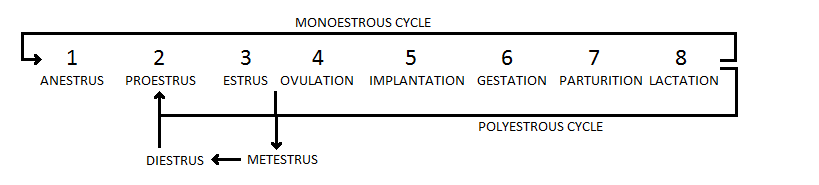
File:Estrous_cycle.png · Wikimedia Commons · See Wikimedia Commons
estrous cycle
Sign in to saveAlso known as GO:0044849, estrus, oestrous cycle, estrus cycle, estrous, Sexual instinct in animals
type of ovulation cycle
Research
31,453 papers- Vaginal Cytology of the Laboratory Rat and Mouse: Review and Criteria for the Staging of the Estrous Cycle Using Stained Vaginal Smears.Toxicologic pathology · 2015
- Mouse estrous cycle identification tool and images.PloS one · 2012
- Estrous Cycle Manipulation in Dogs.The Veterinary clinics of North America. Small animal practice · 2018
- Neural basis for estrous cycle-dependent control of female behaviors.Neuroscience research · 2022
- Estradiol-dependent hypocretinergic/orexinergic behaviors throughout the estrous cycle.Psychopharmacology · 2023
via PubMed
Wikidata facts
- Instance of
- biological process
- Subclass of
- instinct
- Image
- Gazelle Checking Estrus.jpg
Show 3 more facts
- exact match
- purl.obolibrary.org/obo/GO_0044849
- Commons category
- Estrous cycle
- described by source
- Granat Encyclopedic Dictionary
via Wikidata · CC0
~17 min read
Encyclopedic overview
The estrous cycle (US-EN; /ˈɛstrəs/) or oestrous cycle (UK-EN; /ˈiːstrəs/) (from Latin oestrus 'frenzy', originally from Ancient Greek οἶστρος (oîstros) 'gadfly') is a set of recurring physiological changes induced by reproductive hormones in females of mammalian subclass Theria. Estrous cycles start after sexual maturity in females and are interrupted by anestrous phases, otherwise known as "rest" phases, or by pregnancies. Typically, estrous cycles repeat until death. These cycles are widely variable in duration and frequency depending on the species. Some animals may display bloody vaginal discharge, often mistaken for menstruation.
Many mammals used in commercial agriculture, such as cattle and sheep, may have their estrous cycles artificially controlled with hormonal medications for optimum productivity. The male equivalent, seen primarily in ruminants, is called rut.
Excerpted from Wikipedia’s “estrous cycle” article, available under the CC BY-SA 4.0 licence.