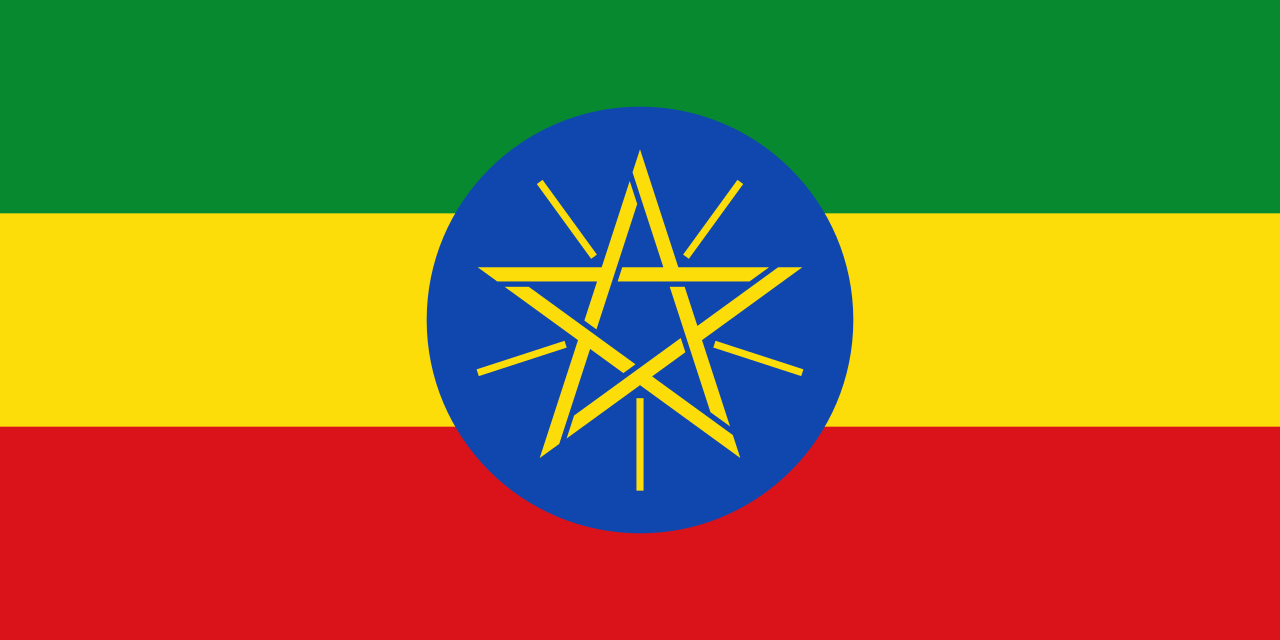
اتیوپی
Sign in to saveAlso known as Federal Democratic Republic of Ethiopia, et
کشوری در شرق قارهٔ آفریقا
OverviewAI-generated
Ethiopia, officially the Federal Democratic Republic of Ethiopia, is a landlocked sovereign state located in Eastern Africa. Its capital is Addis Ababa, and it shares borders with Sudan, South Sudan, Kenya, and Somalia. The country is situated in the East Africa Time zone (UTC+03:00). Its highest point is Ras Dashen. The population is recorded as 111,652,998, with an additional total population figure of 132,059,767.
Ethiopia is home to ethnic groups including the Oromo people, Amhara people, Somalis, and Tigray people. Languages used include Anuak, Zayse-Zergulla, Maale, and Seze. The head of state is Taye Atske Selassie, while heads of government have included Hailemariam Desalegn, Meles Zenawi, and Abiy Ahmed. The country contains administrative entities such as the Afar Region and Amhara Region. It has diplomatic relations with Canada, Germany, Djibouti, and Israel. The top-level Internet domain is .et, and the telephone country code is +251.
Synthesized by Vinony from 67 facts across 9 sources: Wikidata, REST Countries, Open Meteo, Openweathermap, World Bank, OpenStreetMap, PubMed, Vinony graph, Geo. Generated from structured data (not the Wikipedia text) and checked against those facts — may still contain errors.
Weather now
7-day forecast
via Open-Meteo
Country


- Capital
- Addis Ababa
- Population
- 111,652,998
- Region
- Africa · Eastern Africa
- Demonym
- Ethiopian
- Currencies
- ETB (Br)
- Languages
- Amharic
- Calling code
- +251
- Drives on
- Right
- Gini
- 35 (2015)
- FIFA code
- ETH
- TLD
- .et
- Timezones
- UTC+03:00
- Borders
- DJI, ERI, KEN, SOM, SSD, SDN
via REST Countries
Indicators · World Bank
- GDP
- $149.7B(2024)
- Population
- 132,059,767(2024)
- Life expectancy
- 67.6 yrs(2024)
- Unemployment
- 3.3 %(2025)
- Urban population
- 23.6 %(2024)
- Internet users
- 21.9 %(2024)
- Forest area
- 14.9 %(2023)
- Renewable energy
- 90.6 %(2021)
via World Bank Open Data · CC BY 4.0
Place details
- Region
- ኦሮሚያ ክልል Oromia أوروميا
- Country
- ኢትዮጵያ
- Population
- 109,224,559
- Timezone
- Africa/Addis_Ababa
via OpenStreetMap · GeoNames
Wikipedia views (30d)
184,032 totalvia Wikimedia Pageviews API
Key facts
- Country.GDP_PPP
- $434.44 billion
- Country.GDP_PPP_year
- 2024
- Country.GDP_PPP_rank
- 55th
- Country.GDP_PPP_per_capita
- $4,050
- Country.GDP_PPP_per_capita_rank
- 159th
- Country.GDP_nominal
- $145.03 billion
- Country.GDP_nominal_year
- 2024
- Country.GDP_nominal_rank
- 59th
- Country.GDP_nominal_per_capita
- $1,350
- Country.GDP_nominal_per_capita_rank
- 159th
- Country.Gini
- 35.0
- Country.Gini_year
- 2015
- Country.Gini_change
- increase
- Country.HDI_change
- increase
- Country.HDI_rank
- 176th
- Country.currency
- Birr
- Country.currency_code
- ETB
- Country.time_zone
- EAT
via Wikipedia infobox
Research
60,498 papers- Ethiopia's quest to champion emergency care systems.Bulletin of the World Health Organization · 2019Hagos AA, Firew T, Gebreyesus A et al.DOI: 10.2471/BLT.19.240440
- Prospects for tuberculosis elimination in Ethiopia: feasibility, challenges, and opportunities.ReviewThe Pan African medical journal · 2022Agizew TB, Dememew ZG, Leta T et al.DOI: 10.11604/pamj.2022.43.146.35557
- Institutionalizing health technology assessment in Ethiopia: seizing the window of opportunity.ReviewInternational journal of technology assessment in health care · 2023Erku D, Walker D, Caruso AA et al.DOI: 10.1017/S0266462323000454
- Drivers of stunting reduction in Ethiopia: a country case study.The American journal of clinical nutrition · 2020Tasic H, Akseer N, Gebreyesus SH et al.DOI: 10.1093/ajcn/nqaa163
- National Healthcare System Development of Ethiopia: A Systematic Narrative Review.Hospital topics · 2020Tiruneh BT, McLelland G, Plummer VDOI: 10.1080/00185868.2020.1750323
- Endemic medicinal plants of Ethiopia: Ethnomedicinal uses, biological activities and chemical constituents.ReviewJournal of ethnopharmacology · 2022Ayalew H, Tewelde E, Abebe B et al.DOI: 10.1016/j.jep.2022.115307
- Inequalities of Infant Mortality in Ethiopia.International journal of environmental research and public health · 2023Ebrahim NB, Atteraya MSDOI: 10.3390/ijerph20126068
- Municipal solid waste management in Ethiopia - Physical and chemical compositions and generation rate: Systematic review.Journal of the Air & Waste Management Association (1995) · 2024Gebrekidan TK, Gebremedhin GG, Weldemariam AK et al.DOI: 10.1080/10962247.2024.2416588
via PubMed
Wikidata facts
- Instance of
- landlocked country
- Official name
- la République démocratique fédérale d’Éthiopie
- Demonym
- Aetópach
- Country
- Ethiopia
- Contains
- Amhara Region
- Continent
- Africa
- Capital
- Addis Ababa
- Official language
- Amharic
- Currency
- bir
- Population
- 128691692
- Area
- 1104300
- Head of government
- Abiy Ahmed
- Head of state
- Taye Atske Selassie
- Form of government
- federal republic
- Legislature
- Federal Parliamentary Assembly
- Shares border with
- Somaliland
- Highest point
- Ras Dashen
- Image
- Ethiopia in its region.svg
- Life expectancy
- 65.475
- Nominal GDP
- 126783472501
- Unemployment rate
- 5
- Calling code
- +251
- Licence plate code
- ETH
Show 61 more facts
- Mains voltage
- 220
- Motto
- Gwlad y tarddu
- Flag
- flag of Ethiopia
- Coat of arms
- Emblem of Ethiopia
- Patron saint
- Saint George
- language used
- Gumuz
- geography of topic
- Geography of Ethiopia
- category for people who died here
- Category:Deaths in Ethiopia
- ethnic group
- Kafficho people
- diplomatic relation
- Poland
- marriageable age
- 18
- office held by head of government
- Prime Minister of Ethiopia
- IPA transcription
- ɛtɪˈuːpɪɑ
- top-level Internet domain
- .et
- category of associated people
- Category:Ethiopian people
- office held by head of state
- President of Ethiopia
- topic's main Wikimedia portal
- Portal:Ethiopia
- driving side
- right
- total fertility rate
- 4.395
- member of
- African Continental Free Trade Area
- number of out-of-school children
- 12891902
- category for people born here
- Category:Births in Ethiopia
- mobile country code
- 636
- maritime identification digits
- 624
- topic's main category
- Category:Ethiopia
- executive body
- Government of Ethiopia
- history of topic
- history of Ethiopia
- on focus list of Wikimedia project
- Wikipedia:Vital articles/Level/4
- trunk prefix
- 0
- Commons category
- Ethiopia
- Commons gallery
- ኢትዮጵያ
- lowest point
- Danakil Depression
- category for films shot at this location
- Category:Films shot in Ethiopia
- central bank
- National Bank of Ethiopia
- suicide rate
- 8
- culture
- culture of Ethiopia
- VAT rate
- 15
- BTI Status Index
- 3.57
- BTI Governance Index
- 4.26
- economy of topic
- economy of Ethiopia
- demographics of topic
- demographics of Ethiopia
- P8168
- Laguiole knife
- Democracy Index
- 3.38
- native label
- Toophphiya Federaalle Dimokkiraatike Ripaabilike
- topic has template
- Template:First-level administrative divisions of Ethiopia
- Human Development Index
- 0.498
- P11012
- carbon
- hashtag
- Ethiopia
- inception
- 1974-09-12
- Gini coefficient
- 35
- Happy Planet Index score
- 41.7
- Inequality-adjusted Human Development Index
- 0.363
- P12749
- Chennai
- located in/on physical feature
- East Africa
- birth rate
- 31.835
- male population
- 61980175
- death rate
- 6.497
- rural population
- 95420799
- female population
- 61399749
- urban population
- 27959125
- Unicode character
- 🇪🇹
Sources (15)
via Wikidata · CC0
Travel guide
Get in
thumb|375px|A map showing the visa requirements of Ethiopia
See
thumb|Tomb of Adam, [[Lalibela]] Huge obelisks in Axum Historic routes, churches and mosques Lalibela, Axum, Gondar, Harar Volcanic lake Danakil Depression and Erta Ale Rift Valley lakes Wonchi crater lake, Langano, Tana National Parks such as Menengesha Churches, including many beautiful ones in Addis Ababa Rock-hewn churches in Lalibela Castles in Gondar
Do
Tribal region safari in the Lower Omo Valley Trekking in Dodolla, Bale Siemien Mountains National Park Bird watching in Rift Valley lakes See the gelada ("baboons") at Debre Sina near Addis Ababa White water rafting in the Omo River Attend a traditional coffee ceremony. Visit an azmari bet (azmari bar) to listen to azmari musicians and singers. For where to go to see Ethiopia's wildlife, all images taken by Wikimedia Commons user Charlesjsharp have precise geolocation information [1].
The images can be found in galleries of mammals [2] and birds [3] etc.
Eat
thumb|Injera with various kinds of stews
Injera is ubiquitous in Ethiopia. It is a spongy, tangy-tasting bread made from the grain teff, which grows in the highlands of Ethiopia. It looks and feels akin to a crepe or pancake. It's eaten with wot (or wat), traditional stews made with spices and meat or legumes. Popular wats are doro (chicken) wat, yebeg (lamb) wat and asa (fish) wat. Pork is rare in Ethiopia as both the Ethiopian Church and Islam prohibit the consumption of pork by their followers.
The injera sits directly on a large round plate or tray and is covered with wat placed symmetrically around a central item. The various wats are eaten with other pieces of injera, which are served on a side plate. Injera is eaten with the right hand - rip a large piece of injera from the side plate and use it to scoop up one of the flavours of wat on the main platter. Eating with the left hand is considered disrespectful, as it is the hand traditionally used for personal hygiene and is thus considered unclean. Another popular injera dish is firfir: fried, shredded injera. It can be served with or without meat or with all sorts of veggies.
If you prefer vegetarian food, try the shiro wat, which is an oily bean stew served with injera. Shiro is common on Ethiopian "fasting days", in which devout Ethiopians eat an essentially vegetarian diet.
One of Ethiopia's most famous dishes is tibbs or tibs, spicy beef or lamb fried in butter (nitre kibbeh). Tibs comes in several styles, most …
Sleep
There is a wide range of accommodation in Ethiopia. Staying in tourist areas generally results in a broader range of choices, but watch out for tourist prices. It is acceptable to bargain with the hotel owner, for they usually tend to charge you "faranji" (foreigner) prices at first, which are often twenty times the local rate. You won't be able to bargain down to local prices (close to nothing) but you can bargain down a lot. This is not true at the government run "Ghion" chain, and the fancier private chains as well, where prices for foreigners are fixed. (Bekale Mola, for example).
Guest houses are common in Ethiopia. These vary from large homes with a number of bedrooms to small hotels and essentially operate as a "Bed and Breakfast". Some have shared baths, other have private baths. The best ones have generators available to deal with power outages as well as internet service and satellite TV. The good ones tend to be clean and they treat you like family. They are much cheaper than the brand name hotels and you will get more exposure to the local culture. If you tip well you will be treated like royalty.
In the north, in every city (Axum, Lalibela, Bahir Dar, Gondar) one can find hotels, from overpriced ones such as the government-run Ghion chain hotels to cheaper ones. Smaller places on the major roads offer cheap places if you do not mind the most basic rooms. A tourist town like Debark that serves for trekking the Simien Mountains also offers a range of rooms, with …
Stay safe
There are many ongoing inter-ethnic conflicts. Borders between ethnic regions tend to be high-risk areas. In addition, many groups are in conflict with the government.
Due to the general security situation, expect a heightened security presence. Be prepared for checkpoints, having your identity and travel documents with you. As anywhere, take care to respect road blocks (even if they appear unattended), remain calm and follow instructions.
Communications and availability of food, water and other necessities can be disrupted. Have a contingency plan.
Landmines are a threat in some regions.
See also War zone safety.
Stay healthy
thumb|Gelada baboons Don't drink the tap water. It's full of parasites, and hotels generally recommend guests not to drink it, nor to eat salads and uncooked foodstuffs that are usually washed in tap water. This applies to ice as well – unless it is distilled, or you are at a reputable Western hotel like the Sheraton, Radisson Blu, or Hilton. Bottled water for drinking is available almost everywhere in small, medium and big bottles – popular brands are Yes (flat water) and Ambo (sparkling water). Make sure you drink enough, especially when the weather is hot.
Consult a doctor before going to Ethiopia about what vaccinations against infectious diseases you should consider. The risk of malaria is low to non-existent in the capital and the highlands, but high in the lake regions and lowlands. Doxycycline for malaria prevention is cheap in Addis.
If you get sick, go to one of the big private hospitals, e.g., Korean, Hayat, St Gabriels.
A large part of Ethiopia is at a high elevation. In those areas, people unaccustomed to breathing in thinner air may have a hard time moving around at first. It is advised to allow yourself a few days to acclimatize to the air. See altitude sickness.
Respect
Ethiopians are very proud of their culture, identity, and country. Avoid criticizing their cultural lifestyle, especially their brand of Christianity (Ethiopian Orthodox). Avoid all contentious religious discussion, or you may risk all good will and hospitality you could have been afforded. Rather than argue about the merits of Orthodoxy or Islam, it's best to ask friends to explain their customs, festivals and beliefs and to listen with respect.
The Ethiopians' relationship with the Westerners is generally free of racial animosity. However, there is considerable suspicion and even xenophobia toward foreigners in the countryside. Ethiopians can be short-fused if they feel they are not treated as equals.
It is a sign of respect for men to avoid eye contact with women. If you are a foreign man, maintaining a formal distance from women will be seen as good manners. If you meet a woman who is with a man, ask the man's permission before talking to her. Likewise, if you're a foreign woman in public with a man, don't be upset if Ethiopian men address all questions to him. They will do this not to slight you but to show respect. This will be the case on public transport and in restaurants.
It is very important to remove your shoes when entering a home.
Travel guide from Wikivoyage (CC BY-SA 4.0)
Gallery (59)
On the map
6 mapped locations
Available in 288 languages
- Español
- Français
- Deutsch
- 中文
- 日本語
- Русский
- Português
- Italiano
- العربية
- हिन्दी
- Abkhazian
- abstract
- Achinese
- Adyghe
- Afrikaans
- Albanian
- Albanian
- Amharic
Show 269 more
- ami
- Angika
- Aragonese
- Aramaic
- Armenian
- Arpitan
- Assamese
- Asturian
- Avaric
- Aymara
- azb
- Azerbaijani
- Bahasa Indonesia
- Balinese
- Bambara
- Bangla
- Banjar
- Bashkir
- Basque
- bat_smg
- Batak Toba
- Bavarian
- be_x_old
- Belarusian
- Betawi
- Bhojpuri
- Bikol
- Bishnupriya
- Bislama
- Bosnian
- Breton
- btm
- Bulgarian
- Buriat
- Burmese
- Catalan
- cbk_zam
- cdo
- Cebuano
- Central Kurdish
- Chechen
- Cherokee
- Church Slavic
- Chuvash
- Cornish
- Corsican
- Crimean Tatar
- Croatian
- Czech
- dag
- Danish
- Dinka
- Divehi
- dty
- Dzongkha
- Egyptian Arabic
- Erzya
- Esperanto
- Estonian
- Ewe
- Extremaduran
- Faroese
- Fiji Hindi
- Filipino
- Finnish
- fiu_vro
- Frafra
- Fula
- Gagauz
- Galician
- Gan Chinese
- Ganda
- gcr
- Georgian
- Gilaki
- Goan Konkani
- gpe
- Greek
- Guarani
- Gujarati
- Haitian Creole
- Hakka Chinese
- Hausa
- Hawaiian
- Hebrew
- Hungarian
- hyw
- Iban
- Icelandic
- Ido
- Igbo
- Iloko
- Inari Sami
- Ingush
- Interlingua
- Interlingue
- Irish
- Jamaican Creole English
- Javanese
- Jju
- Kabyle
- kai
- Kannada
- Kanuri
- Kara-Kalpak
- Karachay-Balkar
- Kashmiri
- Kashubian
- Kazakh
- kbp
- kge
- Khmer
- Kikuyu
- Kinyarwanda
- Komi
- Komi-Permyak
- Kongo
- Kotava
- Kurdish
- Kyrgyz
- Ladino
- Lao
- Latin
- Latvian
- Lezghian
- Ligurian
- Limburgish
- Lingala
- Lingua Franca Nova
- Lithuanian
- lld
- Lojban
- Lombard
- Low German
- Lower Sorbian
- Luxembourgish
- Macedonian
- Madurese
- Maithili
- Malagasy
- Malay
- Malayalam
- Maltese
- Manipuri
- Manx
- Māori
- map_bms
- Marathi
- Mari
- Mazanderani
- Minangkabau
- Mingrelian
- Mirandese
- mnw
- Moksha
- Mongolian
- Moroccan Arabic
- N’Ko
- Navajo
- nds_nl
- Nederlands
- Nepali
- Newari
- Nigerian Pidgin
- Northern Frisian
- Northern Sami
- Northern Sotho
- Norwegian
- Norwegian Nynorsk
- Novial
- nup
- Obolo
- Occitan
- Odia
- Old English
- olo
- Oromo
- Ossetic
- Pampanga
- Papiamento
- Pashto
- Piedmontese
- Polski
- Punjabi
- pwn
- Quechua
- roa_tara
- Romanian
- Romansh
- Rusyn
- Samoan
- Sango
- Sanskrit
- Santali
- Sardinian
- Saterland Frisian
- Scots
- Scottish Gaelic
- Serbian
- Serbian (Latin)
- Shan
- Shona
- Sicilian
- Silesian
- simple
- Sindhi
- Sinhala
- Slovak
- Slovenian
- Somali
- Southern Sotho
- Sranan Tongo
- Standard Moroccan Tamazight
- Sundanese
- Svenska
- Swahili
- Swati
- szy
- Tachelhit
- Tajik
- Talysh
- Tamil
- Taroko
- Tatar
- tay
- Telugu
- Tibetan
- Tiếng Việt
- Tigrinya
- Toki Pona
- Tongan
- Tsonga
- Tswana
- Tumbuka
- Türkçe
- Turkmen
- Tyap
- Udmurt
- Ukrainian
- Upper Sorbian
- Urdu
- Uyghur
- Uzbek
- Venetian
- Veps
- Volapük
- Walloon
- Waray
- Welsh
- West Flemish
- Western Frisian
- Western Mari
- Western Panjabi
- Wolof
- Wu Chinese
- Xhosa
- Yakut
- Yiddish
- Yoruba
- Zaza
- Zeelandic
- zh_classical
- zh_min_nan
- zh_yue
- Zhuang
- Zulu
- فارسی
- ไทย
- 한국어
via Wikidata sitelinks · CC0