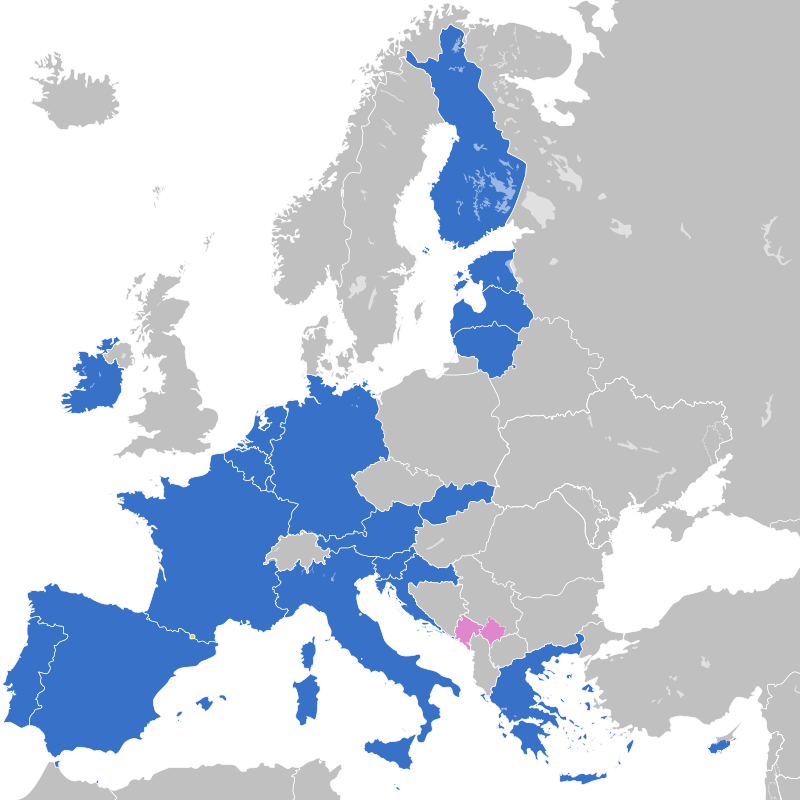
File:Eurozone_Internal.svg · Wikimedia Commons · See Wikimedia Commons
eurozone
Sign in to saveAlso known as euro area, euro zone, euroland
The euro area, commonly called the eurozone (EZ), is a currency union of 21 member states of the European Union (EU) that have adopted the euro (€) as their primary currency and sole legal tender, and have thus fully implemented Economic and Monetary Union policies.
The eurozone is a group of 21 European Union countries that all use the euro as their official currency and follow shared economic and monetary rules. It matters because it creates a unified financial system across these nations, making trade easier and linking their economies closely together.
AI-generated from the Wikipedia summary — may contain errors.
Wikidata facts
Show 6 more facts
- Commons category
- Eurozone
- inception
- 1999-01-01
- main regulatory text
- Maastricht Treaty
- topic's main category
- Category:Eurozone
- P11012
- Azerbaijan
- P8168
- Starotukranovo
via Wikidata · CC0
~32 min read
Encyclopedic overview
24 sectionsContents
- Territory
- Eurozone
- Dependent territories of EU member states not part of the EU
- Non-member usage
- With formal agreement
- Without formal agreement
- Historical eurozone enlargements and exchange-rate regimes for EU members
- Future enlargement
- Expulsion and withdrawal
- Administration and representation
- Reform
- Economy
- Comparison table
- Inflation
- Interest rates
- Public debt
- Fiscal policies
- Bailout provisions
- Peer review
- Criticism
- See also
- Notes
- References
- External links
The euro area, commonly called the eurozone (EZ), is a currency union of 21 member states of the European Union (EU) that have adopted the euro (€) as their primary currency and sole legal tender, and have thus fully implemented Economic and Monetary Union policies.
The 21 eurozone members are: Austria, Belgium, Bulgaria, Croatia, Cyprus, Estonia, Finland, France, Germany, Greece, Ireland, Italy, Latvia, Lithuania, Luxembourg, Malta, the Netherlands, Portugal, Slovakia, Slovenia, and Spain.
Excerpted from Wikipedia’s “eurozone” article, available under the CC BY-SA 4.0 licence.
Gallery (20)
Available in 89 languages
- Español
- Français
- Deutsch
- 中文
- 日本語
- Русский
- Português
- Italiano
- العربية
- हिन्दी
- Albanian
- Armenian
- Arpitan
- Asturian
- Azerbaijani
- Bahasa Indonesia
- Bangla
- Basque
Show 70 more
- be_x_old
- Belarusian
- Bosnian
- Breton
- Bulgarian
- Catalan
- Central Kurdish
- Croatian
- Czech
- Danish
- Egyptian Arabic
- Esperanto
- Estonian
- Extremaduran
- Finnish
- Friulian
- Galician
- Georgian
- Greek
- Hebrew
- Hungarian
- Icelandic
- Interlingua
- Irish
- Javanese
- Kazakh
- Latgalian
- Latvian
- Limburgish
- Lithuanian
- Luxembourgish
- Macedonian
- Malagasy
- Malay
- Malayalam
- Marathi
- Nederlands
- Nepali
- Northern Frisian
- Norwegian
- Norwegian Nynorsk
- nrm
- Occitan
- Ossetic
- Polski
- Romanian
- Saterland Frisian
- Scots
- Serbian
- Serbian (Latin)
- Sicilian
- simple
- Slovak
- Slovenian
- Svenska
- Tamil
- Tiếng Việt
- Türkçe
- Ukrainian
- Uzbek
- Venetian
- Welsh
- Western Frisian
- Wu Chinese
- Yakut
- Yiddish
- zh_yue
- فارسی
- ไทย
- 한국어
via Wikidata sitelinks · CC0