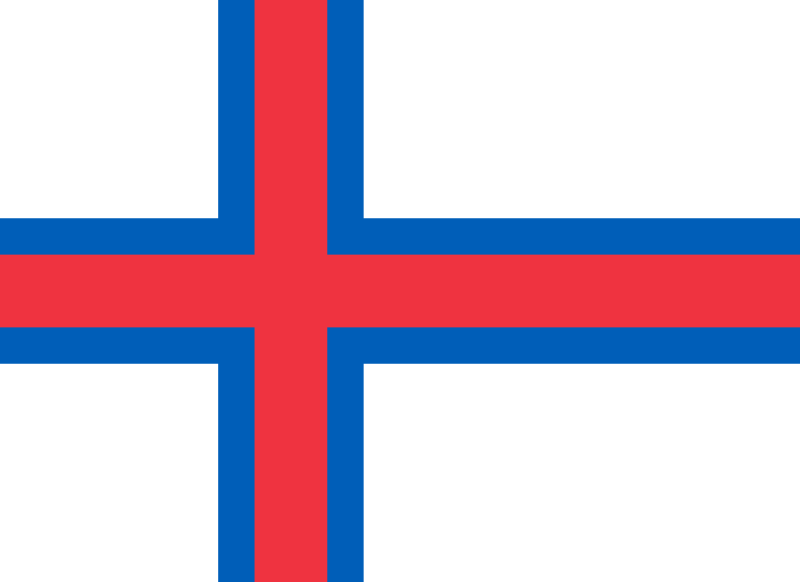
File:Flag_of_the_Faroe_Islands.svg · Wikimedia Commons · See Wikimedia Commons
Faroe Islands
Sign in to saveAlso known as Faeroe Islands, Atlantic/Faroe, Fareo islands, Faeroyene, Far Oer, Faeroerne, Faer Oer, Faroe Isles
North Atlantic archipelago organized as an autonomous constituent country of the Kingdom of Denmark
The Faroe Islands are a group of islands located in the North Atlantic Ocean that form an autonomous country within the Kingdom of Denmark. They matter as a distinct self-governing region with its own political system while remaining part of the larger Danish realm.
AI-generated from the Wikipedia summary — may contain errors.
Wikidata facts
- Instance of
- electoral unit
- Part of
- Northern Europe
- Has part
- Slættaratindur
- Official name
- Færøerne
- Demonym
- Ynysoedd Ffaro
- Country
- Denmark
- Located in
- Danish Realm
- Continent
- Europe
- Capital
- Tórshavn
- Official language
- Danish
- Currency
- Faroese króna
- Population
- 54149
- Area
- 1399.0
- Time zone
- UTC±00:00
- Body of water
- Norwegian Sea
- Head of government
- Aksel V. Johannesen
- Head of state
- Frederik X of Denmark
- Legislature
- Løgting
- Anthem
- Tú alfagra land mítt
- Shares border with
- Iceland
- Highest point
- Slættaratindur
- Image
- Faroe Islands by Sentinel-2.jpg
- Perimeter
- 1117
- Life expectancy
- 82.24146
Show 38 more facts
- Nominal GDP
- 3649878680
- GDP per capita
- 3000000000
- Calling code
- +298
- Licence plate code
- FO
- Mains voltage
- 230
- Coat of arms
- coat of arms of the Faroe Islands
- Significant event
- British occupation of the Faroe Islands
- top-level Internet domain
- .fo
- Commons category
- Faroe Islands
- member of
- UNESCO
- topic's main category
- Category:Faroe Islands
- category of associated people
- Category:Faroese people
- Commons gallery
- Føroyar
- topic's main Wikimedia portal
- Portal:Faroe Islands
- geography of topic
- geography of the Faroe Islands
- category for people born here
- Category:Births in the Faroe Islands
- category for people who died here
- Q16887593
- driving side
- right
- emergency phone number
- 112
- history of topic
- history of the Faroe Islands
- inception
- 1948-04-01
- diplomatic relation
- European Union
- total fertility rate
- 2.6
- maritime identification digits
- 231
- topic has template
- Template:Faroe Islands topics
- native label
- Føroyar
- language used
- Faroese
- GS1 country code
- 570-579
- VAT rate
- 25
- different from
- Fair Isle
- Unicode character
- 🇫🇴
- economy of topic
- economy of the Faroe Islands
- demographics of topic
- demographics of the Faroe Islands
- related category
- Category:Faroe Islands-related lists
- office held by head of government
- Prime Minister of the Faroe Islands
- P11012
- dinosaur
- P12749
- Bad Kreuznach
Sources (15)
via Wikidata · CC0
~40 min read
Encyclopedic overview
The Faroe Islands (/ˈfɛəroʊ/ FAIR-oh), also known as the Faroes, are an archipelago in the North Atlantic Ocean and a rigsdel ('autonomous territory') of the Kingdom of Denmark. Located between Iceland, Norway, and the Hebrides and Shetland isles of Scotland, the islands have a population of 54,870 as of November 2025 and a land area of 1,393 km (538 sq mi). The official language is Faroese, which is partially mutually intelligible with Icelandic. The terrain is rugged, dominated by fjords and cliffs with sparse vegetation and few trees. As a result of their proximity to the Arctic Circle, the islands experience perpetual civil twilight during summer nights and very short winter days; nevertheless, they experience a subpolar oceanic climate and mild temperatures year-round due to the Gulf Stream. The capital, Tórshavn, receives the fewest recorded hours of sunshine of any city in the world at only 840 per year.
Færeyinga saga and the writings of Dicuil place initial Norse settlement in the early 9th century, with Grímur Kamban recorded as the first permanent settler. As with the subsequent settlement of Iceland, the islands were mainly settled by Norwegians and Norse-Gaels who also brought thralls (i.e. slaves or serfs) of Gaelic origin. However, a 2024 study found that Viking colonizers of the Faroe Islands and nearby Iceland had different origins.
Excerpted from Wikipedia’s “Faroe Islands” article, available under the CC BY-SA 4.0 licence.
Gallery (12)
On the map
Available in 185 languages
- Español
- Français
- Deutsch
- 中文
- 日本語
- Русский
- Português
- Italiano
- العربية
- हिन्दी
- Achinese
- Afrikaans
- Albanian
- Albanian
- Amharic
- Angika
- Aragonese
- Armenian
Show 166 more
- Arpitan
- Asturian
- azb
- Azerbaijani
- Bahasa Indonesia
- Balinese
- Bangla
- Bashkir
- Basque
- bat_smg
- Bavarian
- be_x_old
- Belarusian
- Betawi
- Bishnupriya
- Bislama
- Bosnian
- Breton
- Bulgarian
- Buriat
- Catalan
- cdo
- Central Kurdish
- Chechen
- Cornish
- Croatian
- Czech
- Danish
- Divehi
- Dzongkha
- Egyptian Arabic
- Erzya
- Esperanto
- Estonian
- Ewe
- Extremaduran
- Faroese
- Fiji Hindi
- Filipino
- Finnish
- fiu_vro
- Gagauz
- Galician
- gcr
- Georgian
- Gilaki
- Goan Konkani
- Greek
- Guarani
- Gujarati
- Haitian Creole
- Hakka Chinese
- Hebrew
- Hungarian
- Icelandic
- Ido
- Inari Sami
- Interlingua
- Interlingue
- Irish
- Javanese
- Kabyle
- Kara-Kalpak
- Karachay-Balkar
- Kazakh
- Kinyarwanda
- Komi
- Kurdish
- Kyrgyz
- Latin
- Latvian
- Ligurian
- Limburgish
- Lingua Franca Nova
- Lithuanian
- lld
- Lombard
- Low German
- Lower Sorbian
- Luxembourgish
- Macedonian
- Malay
- Malayalam
- Maltese
- Manx
- Māori
- Marathi
- Mazanderani
- Mingrelian
- Mongolian
- Moroccan Arabic
- nds_nl
- Nederlands
- Nepali
- Northern Frisian
- Northern Sami
- Norwegian
- Norwegian Nynorsk
- Novial
- Occitan
- Odia
- Old English
- Ossetic
- Pampanga
- Papiamento
- Pashto
- Piedmontese
- Polski
- Punjabi
- Quechua
- Romanian
- Romansh
- Romany
- Rusyn
- Sardinian
- Saterland Frisian
- Scots
- Scottish Gaelic
- Serbian
- Serbian (Latin)
- Shan
- Sicilian
- simple
- Sindhi
- Sinhala
- Slovak
- Slovenian
- Somali
- Sundanese
- Svenska
- Swahili
- Tajik
- Tamil
- Tatar
- Telugu
- Tetum
- Tiếng Việt
- Toki Pona
- Tumbuka
- Türkçe
- Udmurt
- Ukrainian
- Upper Sorbian
- Urdu
- Uzbek
- Venetian
- Veps
- Volapük
- Waray
- Welsh
- West Flemish
- Western Frisian
- Western Panjabi
- Wolof
- Wu Chinese
- Xhosa
- Yakut
- Yoruba
- Zaza
- Zeelandic
- zh_classical
- zh_min_nan
- zh_yue
- فارسی
- ไทย
- 한국어
via Wikidata sitelinks · CC0