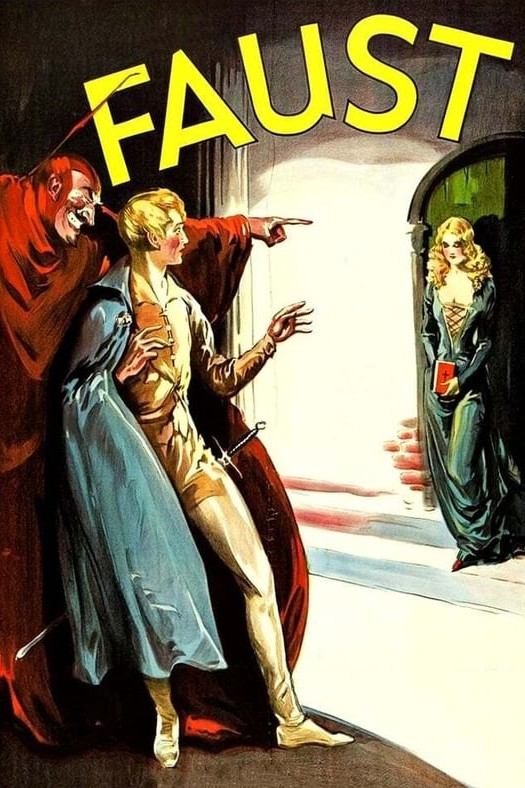
Poster from TMDB
OverviewAI-generated
Faust – eine deutsche Volkssage is a 1926 German silent drama and fantasy film directed by F. W. Murnau. Produced by Erich Pommer for UFA, the black-and-white movie was distributed by UFA and Netflix. The cast features Gösta Ekman, Emil Jannings, Camilla Horn, and William Dieterle, with a screenplay by Gerhart Hauptmann and music by Werner R. Heymann. Carl Hoffmann served as the director of photography.
The narrative, set in Germany, involves God and Satan wagering on the soul of a learned alchemist. Key themes include the sale of a soul, a pact with the devil, eternal youth, and romance. The film has a runtime of 116 minutes according to one source and 107 minutes according to another. It was released in October 1926 and carries a tagline describing the voice of the tempter.
Critical reception includes a TMDb vote average of 7.9 and an IMDb rating of 8.1. The production cost was 2,000,000. It is available via video on demand through providers such as Kino Film Collection. The film was originally in German and has an aspect ratio of 4:3.
Synthesized by Vinony from 35 facts across 3 sources: Wikidata, TMDb, IMDb. Generated from structured data (not the Wikipedia text) and checked against those facts — may still contain errors.
Film · TMDB
7.9God and Satan wager on the soul of a learned and prayerful alchemist as part of their eternal war over Earth.
Cast
- Gösta Ekman as Faust
- Emil Jannings as Mephisto
- Camilla Horn as Gretchen Marguerite
- Frida Richard as Gretchens's Mother
- William Dieterle as Valentin
- Werner Fuetterer as Erzengel
Themes
- based on novel or book
- sale of soul
- pact with the devil
- eternal youth
- romance
- faust
- love
- death
- silent film
- based on myths, legends or folklore
This product uses the TMDB API but is not endorsed or certified by TMDB.
Key facts
- Directed by
- F. W. Murnau
- Written by
- Hans Kyser
- Produced by
- Erich Pommer
- Starring
- Gösta Ekman , Emil Jannings , Camilla Horn , Wilhelm Dieterle , Frida Richard , Yvette Guilbert
- Cinematography
- Carl Hoffmann
- Music by
- Werner Richard Heymann (in the premiere) , William Axt (U.S., uncredited)
- Distributed by
- Ufa (Germany), Metro-Goldwyn-Mayer (U.S.)
- Release dates
- 14 October 1926 ( 1926-10-14 ) (Berlin, Germany ) 5 December 1926 ( 1926-12-05 ) (U.S.)
- Running time
- 106 minutes
- Country
- Germany
- Languages
- Silent film , German intertitles
- Budget
- 2 million ℛ ︁ ℳ ︁ (equivalent to €8 million in 2021)
- Box office
- 1 million ℛ ︁ ℳ ︁ (equivalent to €4 million in 2021)
via Wikipedia infobox
Wikidata facts
- Instance of
- film
- Genre
- fantasy film
- Country of origin
- Weimar Republic
- Director
- F. W. Murnau
- Screenwriter
- Gerhart Hauptmann
- Cast member
- Hans Rameau
- Composer
- Werner R. Heymann
- Producer
- Erich Pommer
- Production company
- UFA
- Cinematographer
- Carl Hoffmann
- Narrative location
- Germany
- Duration
- 106
- FilmAffinity ID
- 486931
- Distribution format
- video on demand
- Image
- Film, SFA022827628.jpg
Show 7 more facts
- publication date
- 1926-12-06
- title
- Faust – eine deutsche Volkssage
- distributed by
- Netflix
- aspect ratio (W:H)
- 4:3
- color
- black-and-white
- Commons category
- Faust (1926 film)
- capital cost
- 2000000
via Wikidata · CC0
~14 min read
Encyclopedic overview
Faust – A German Folktale (German: Faust – Eine deutsche Volkssage) is a 1926 silent fantasy film, produced by Ufa, directed by F. W. Murnau, starring Gösta Ekman as Faust, Emil Jannings as Mephisto, Camilla Horn as Gretchen/Marguerite, Frida Richard as her mother, Wilhelm Dieterle as her brother, and Yvette Guilbert as Marthe Schwerdtlein, her aunt. Murnau's film draws on older traditions of the legendary tale of Faust as well as on Goethe's classic 1808 version. Ufa wanted Ludwig Berger to direct Faust, as Murnau was engaged with Variety; Murnau pressured the producer and, backed by Jannings, eventually persuaded Erich Pommer to let him direct the film.
Faust was Murnau's last German film, and directly afterward he moved to the United States under contract to William Fox to direct Sunrise: A Song of Two Humans (1927); when the film premiered in the Ufa-Palast am Zoo in Berlin, Murnau was already shooting in Hollywood. Faust has been praised for its special effects and is regarded as an example of German expressionist film.
Excerpted from Wikipedia’s “Faust” article, available under the CC BY-SA 4.0 licence.