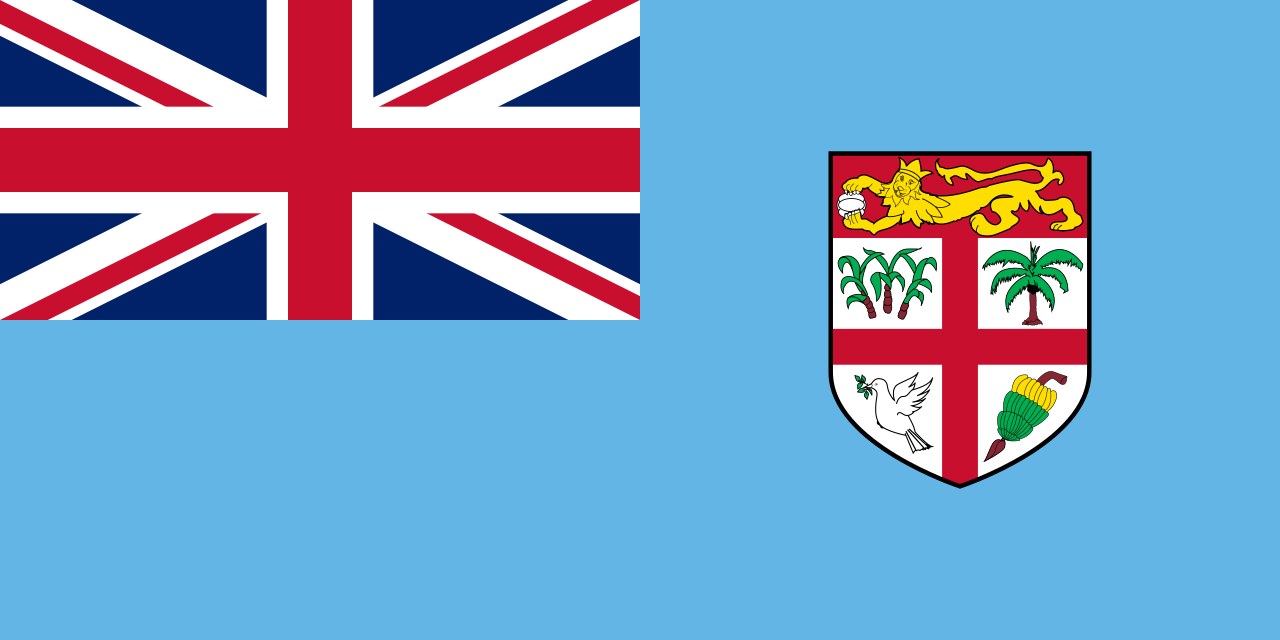
Fiji
Sign in to saveAlso known as Republic of Fiji, fj, FIJ, Republic of the Fiji Islands, Viti, Fijī, Matanitu Tugalala o Viti, Fijī Gaṇarājya
Fiji, officially the Republic of Fiji, is an island country in Melanesia, part of Oceania in the South Pacific Ocean. It lies about north-northeast of New Zealand. Fiji consists of an archipelago of more than 330 islands—of which about 110 are permanently inhabited—and more than 500 islets, amounting to a total land area of about . The most outlying island group is Ono-i-Lau. About 87% of the total population live on the two major islands, Viti Levu and Vanua Levu. About three-quarters of Fijians live on Viti Levu's coasts, either in the capital city of Suva, or in smaller urban centres such a
OverviewAI-generated
Fiji, officially the Republic of Fiji, is a country located in Oceania, specifically within the Melanesia subregion. Its capital is Suva. The nation gained independence on 1970-01-01, replacing the Dominion of Fiji and the Colony of Fiji. The head of state is Wiliame Katonivere, who holds the office of President of Fiji, while the head of government serves as Prime Minister of Fiji. The legislative body is the Parliament of Fiji.
The country has a population of approximately 926,276 to 928,784 people. English, Fijian, and Fiji Hindi are the official languages. The currency includes the Fijian dollar and the Fijian pound. Fiji maintains diplomatic relations with Australia, China, the United States, and Russia. The emergency phone number is 911, and the licence plate code is FJI. The native label for the country is Republic of Fiji, Matanitu Tugalala o Viti, Fidźi Ganaradźja, or Viti.
Synthesized by Vinony from 67 facts across 9 sources: Wikidata, REST Countries, Openweathermap, Open Meteo, World Bank, OpenStreetMap, PubMed, Vinony graph, Geo. Generated from structured data (not the Wikipedia text) and checked against those facts — may still contain errors.
In the Vinony graph
Vinony catalogs Fiji in its Countries collection (215 entries).
Within Vinony's link graph, Fiji is referenced by 14,444 other articles, and connects out to French Polynesia, Muslim and Fiji Hindi.
The entry is geolocated on the map in city, across 6 mapped points.
Vinony files it under 1970 establishments in Oceania, British Western Pacific Territories and Countries and territories where English is an official language.
Weather now
cached 5h ago7-day forecast
via Open-Meteo
Country
- Capital
- Suva
- Population
- 900,869
- Region
- Oceania · Melanesia
- Demonym
- Fijian
- Currencies
- FJD ($)
- Languages
- English, Fijian, Fiji Hindi
- Calling code
- +679
- Drives on
- Left
- Gini
- 36.7 (2013)
- FIFA code
- FIJ
- TLD
- .fj
- Timezones
- UTC+12:00
via REST Countries
Indicators · World Bank
- GDP
- $6B(2024)
- Population
- 928,784(2024)
- Life expectancy
- 67.5 yrs(2024)
- Unemployment
- 5.3 %(2025)
- Urban population
- 59.1 %(2024)
- Internet users
- 74.7 %(2024)
- Forest area
- 63.5 %(2023)
- Renewable energy
- 28.4 %(2022)
via World Bank Open Data · CC BY 4.0
Wikipedia views (30d)
134,329 totalvia Wikimedia Pageviews API
Key facts
- Country.Gini_year
- 2019
- Country.flag_type
- Flag
- Country.conventional_long_name
- Republic of Fiji
- Country.native_name
- फ़िजी गणराज्य; (Fiji Hindi)
- Country.common_name
- Fiji
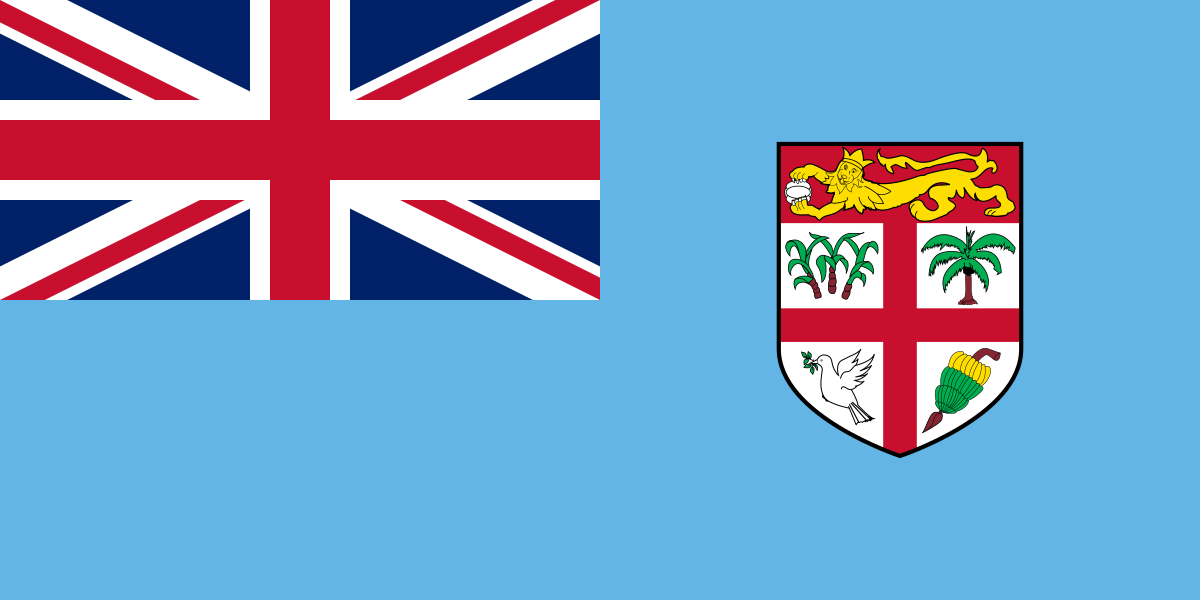
- Country.image_flag
- Flag of Fiji.svg
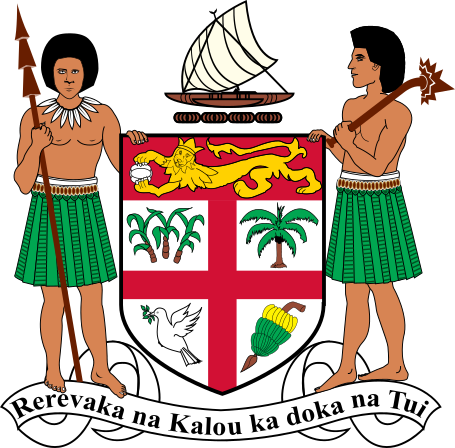
- Country.image_coat
- Coat of arms of Fiji.svg
- Country.flag
- Flag of Fiji
- Country.symbol
- Coat of arms of Fiji
- Country.symbol_type
- Coat of arms
- Country.image_map
- Fiji on the globe (small islands magnified) (Polynesia centered).svg
- Country.national_motto
- "Fear God and honour the King"
- Country.national_anthem
- "God Bless Fiji"
- Country.regional_languages
- Rotuman
- Country.demonym
- Fijian
- Country.capital
- Suva
- Country.largest_city
- capital
- Country.government_type
- Unitary parliamentary republic
via Wikipedia infobox
Research
4,291 papers- Fiji.Department of State publication. Background notes series · 1985United States. Department of State. Bureau of Public Affairs
- Suicide in Fiji: a review of the literature.ReviewAsia-Pacific journal of public health · 2000Morris P, Maniam TDOI: 10.1177/101053950001200110
- Fiji.Bulletin of the Unesco Regional Office for Education in Asia and the Pacific · 1982UNESCO. Regional Office for Education in Asia and the Pacific
- Exploring the Nutrition-Related Health of the Ageing Population in Fiji: A Narrative Review.ReviewInquiry : a journal of medical care organization, provision and financing · 2024Naliva S, Kruger M, Havea P et al.DOI: 10.1177/00469580241292433
- Global Dialysis Perspective: Fiji.Kidney360 · 2022Talbot B, Fijian Dialysis Registry CollaborationDOI: 10.34067/KID.0005652021
- Fiji-Based Tool for Rapid and Unbiased Analysis of SA-β-Gal Activity in Cultured Cells.Biomolecules · 2023Krzystyniak A, Gluchowska A, Mosieniak G et al.DOI: 10.3390/biom13020362
- Overview of trends in cardiovascular and diabetes risk factors in Fiji.ReviewAnnals of human biology · 2018Taylor R, Lin S, Linhart C et al.DOI: 10.1080/03014460.2018.1465122
- End-stage kidney disease in Fiji.Internal medicine journal · 2019Krishnan A, Chandra Y, Malani J et al.DOI: 10.1111/imj.14108
via PubMed
Wikidata facts
- Instance of
- sovereign state
- Part of
- Melanesia
- Official name
- République des Fidji
- Demonym
- Fidsíoch
- Country
- Fiji
- Contains
- Rotuma
- Continent
- Insular Oceania
- Capital
- Suva
- Official language
- Fiji Hindi
- Currency
- Fijian pound
- Population
- 926276
- Area
- 18274
- Head of government
- Sitiveni Rabuka
- Head of state
- Wiliame Katonivere
- Legislature
- Parliament of Fiji
- Anthem
- God Bless Fiji
- Shares border with
- Solomon Islands
- Highest point
- Mount Tomanivi
- Official website
- www.fiji.gov.fj/Home
- Image
- Куинс-роуд, город Нанди (Queens Rd., Nadi).jpg
- Life expectancy
- 68
- Nominal GDP
- 4943248200
- Unemployment rate
- 8
- Calling code
- +679
Show 59 more facts
- Licence plate code
- FJI
- Mains voltage
- 240
- Motto
- Y Fan lle mae Hapusrwydd yn eich Canfod
- Flag
- flag of Fiji
- Coat of arms
- coat of arms of Fiji
- topic's main Wikimedia portal
- Portal:Fiji
- Unicode character
- 🇫🇯
- category of associated people
- Category:Fijian people
- geography of topic
- geography of Fiji
- office held by head of government
- Prime Minister of Fiji
- number of out-of-school children
- 33888
- diplomatic relation
- Kosovo
- office held by head of state
- President of Fiji
- Commons gallery
- Fiji / Viti
- inception
- 1970-01-01
- history of topic
- history of Fiji
- replaces
- Colony of Fiji
- native label
- Viti
- marriageable age
- 18
- mobile country code
- 542
- total fertility rate
- 2.564
- maritime identification digits
- 520
- topic's main category
- Category:Fiji
- age of majority
- 18
- member of
- World Customs Organization
- located in/on physical feature
- Melanesia
- category for films shot at this location
- Category:Films shot in Fiji
- category for people who died here
- Category:Death in Fiji
- Commons category
- Fiji
- top-level Internet domain
- .fj
- category for people born here
- Category:Births in Fiji
- short name
- Viti
- driving side
- left
- lowest point
- Pacific Ocean
- IPA transcription
- ˈfɪdʂɪ
- language used
- Fijian
- described by source
- Encyclopædia Britannica 11th edition
- central bank
- Reserve Bank of Fiji
- suicide rate
- 4.3
- culture
- culture of Fiji
- VAT rate
- 15
- economy of topic
- economy of Fiji
- demographics of topic
- demographics of Fiji
- Democracy Index
- 5.72
- Human Development Index
- 0.730
- hashtag
- Fiji
- on focus list of Wikimedia project
- Wikipedia:Vital articles/Level/4
- Gini coefficient
- 30.7
- Inequality-adjusted Human Development Index
- 0.608
- P12749
- Rhineland-Palatinate
- birth rate
- 19.131
- male population
- 466140
- death rate
- 8.235
- rural population
- 388373
- female population
- 463626
- urban population
- 541393
- Commonwealth Sport country code
- FIJ
Sources (15)
via Wikidata · CC0
Travel guide
Understand
Fiji is the product of volcanic mountains and warm tropical waters. Its majestic and varied coral reefs today draw tourists from around the world, but were the nightmare of European mariners until well into the 19th century because of brutal tribal warfare and cannibalism. As a result, Fijians have retained their land and often much of the non-commercial, sharing attitude of people who live in vast extended families with direct access to natural resources. When it came, European involvement and cession to Britain was marked by the conversion to Anglicanism, the cessation of animist beliefs, and the immigration of a large number of indentured Indian labourers, whose descendants now represent nearly half of the population, and there are smaller numbers of Europeans and other Asians. Today, Fiji is a land of tropical rain forests, coconut plantations, fine beaches, and fire-cleared hills. For the casual tourist it is blessedly free of evils such as malaria, landmines, or terrorism that attend many similarly lovely places in the world.
Internal political unrest since 2005 has reduced tourism. The Fiji tourism industry has responded by lowering prices and increasing promotion of the main resort areas that are far removed from the politics in and around the capital, Suva.
While the 180-degree longitude line crosses through Fiji, the international date line passes east of all of Fiji, making it one of the first countries to enter every new day.
Get around
Fiji has a variety of public transport options, including buses, share taxis, and private taxis. Rates are very cheap: $1-2 (Fiji dollars) from Colo-i-Suva to Suva bus station by bus, $17 from Nadi bus station to Suva by share-taxi (share-taxis are usually white mini-vans that congregate and set-off when they reach their capacity of 6-8), or approximately $80 from Suva airport to Sigatoka by private taxi. On the main road circling Viti Levu buses run every half hour and taxis are a substantial proportion of traffic, while on western Taveuni buses make only a few runs per day and very little traffic is present. If the taxi has a meter, ask the driver to switch it on - the ride will be lot cheaper than with the negotiated price.
The rate from resorts on Nadi beach to Nadi downtown is $8 per passenger, and $12 to the airport -- you should be able to negotiate this price reasonably easily.
While there is rarely much traffic, most vehicles run on diesel and pollution on major roadways can be severe. A national speed limit of 80 km/h is usually observed; village speed limits are all but entirely ignored, but drivers slow down for several speed humps distributed within each village. Seat belts are advised on taxis but are rarely evident and apparently never used.
Road travel tends to be more dangerous than many people are used to, and many embassies advise their citizens to avoid pretty much any form of road travel. Pot holes, washouts and dilapidated bridges are commonplace. Bus…
See
thumb|A beach at Nanuya Lailai, a smaller island in the [[Yasawa Islands|Yasawa chain]]
thumb|Orchids in the Garden of the sleeping giant In short, the natural treasures alone are worth the trip, but this island nation does have a number of cultural sights to offer. There's the beautiful Garden of the Sleeping Giant on Nadi, once owned by famous actor Raymond Burr who lived here. It holds over 20 hectares full of orchids native to Fiji, many cultivated and exotic plants plus a lovely lily pond. Make a trip to one of the many villages to take part in a kava-ceremony or to see one of the many other remaining cultural traditions. Navala village (on Viti Levu) still maintains its traditional bures, making it an excellent pick. For a deeper insight in the country's history and culture, the Fiji Museum on Suva is an excellent addition to your trip.
Eat
thumb|Taro and coconuts at a market in Nadi thumb|Cooking on a lovo
Drink
thumbnail|A faikava (kava drinking ceremony) A very popular drink in Fiji is yaqona ("yang-go-na"), also known as "kava" and sometimes referred to as "grog" by locals. Kava is a peppery, earthy tasting drink made from the root of the pepper plant (piper methysticum). Its effects include a numbed tongue and lips (usually lasting only about 5-10 minutes) and relaxed muscles. Kava is mildly intoxicating, especially when consumed in large quantities or on a regular basis and you should avoid taxi and other drivers who have been drinking. It should not be consumed alongside alcohol.
Kava drinking in Fiji became popular during the fall of cannibalism, and originated as a way to resolve conflict and facilitate peaceful negotiations between villages. If you are invited to a Fijian village or household, it is the most common gift (sevusevu) offering to bring.
Beer is also popular, particularly the ubiquitous Fiji Bitter. While a fairly new development, some of those sugarcane fields are now put to good use by distilling rum, and the Rum Company of Fiji has a nice range under the brands Bati and Ratu.
Sleep
See towns in Fiji for detailed hotel listings.
Fiji is a popular tourist destination and has plenty of accommodation in all price brackets. Most resorts are near the main airport at Nadi or the nearby Mamanuca Islands. Nadi has backpacker-friendly lodges, while the international big brands are mostly nearby at Denarau Island. Hotels in the capital Suva are geared more towards business travellers.
Most Fiji travel agents will take a commission of 15 and 20% along with your booking, which may be called a "deposit". Since this is an up-front payment, it is often beneficial to only book one night, and then you may be able to negotiate a lesser rate for subsequent nights (if space is available).
Many smaller and simpler accommodations have "local rates" and can give discounts that are simply huge if you can book a room in person (or have a local do it for you) and give a legitimate local address and phone number. In the Suva area, the Raffles Tradewinds is nice and quiet and about a dollar by frequently running buses from central down town. Sometimes upon arrival at the airport in Nadi, you can stop at the Raffles Gateway across from the airport entrance and book a room at the Tradewinds at a good local rate if business is slow.
thumb|The 180th meridian crosses Taveuni
Connect
There are two mobile phone companies operating on the island (Vodafone, Digicel) as well as an MVNO (Inkk) which resells Vodafone's network. Tourists are invited to use prepaid sim chips which can be found free or cheap in the mobile operator kiosks in the Nadi airport. You can top-up the balance online with a credit card, or by visiting a retail store that advertises top ups. The phone number is required to top up and is provided when signing up for the sim chip so please make a note of it.
Buying a SIM chip gives access to cheap data packages for easy internet access using your phone as a hot-spot. It is generally cheaper than resort Wi-Fi, and speed is reasonable with the connections in the tourist areas (1-8Mbps with an objective 2.5Mbps average based on use in Nadi). You can request a data-only sim to get access to cheaper data packages. Some plans offer free social media data. Be sure to ask the sales agent about promotions. Both networks use 900Mhz for GSM and a mix of 800/1800/2100Mhz for 3G/4G.
Vodafone offers a battery powered portable wifi device for $59 branded as "Pocket WiFi". The device can be unlocked for use in other countries by contacting support via email or using the online chat feature on the website. In October 2021 a $15 prepaid plan grants 100GB of data. Digicel offers prepaid "Digimodem" plans. The sim card must be converted to a data sim by the sales rep only after inserting it into a modem. Digicel offers a portable battery powered dual-band Wi-F…
Travel guide from Wikivoyage (CC BY-SA 4.0)
~40 min read
Encyclopedic overview
53 sectionsContents
- History
- Early settlement
- Early interaction with Europeans
- Cakobau and the wars against Christian infiltration
- Cotton, confederacies and the Kai Colo
- Kingdom of Fiji (1871–1874)
- Blackbirding and slavery in Fiji
- British annexation
- Measles epidemic of 1875
- Sir Arthur Gordon and the Little War
- Indian indenture system in Fiji
- Tuka rebellions
- World War I and II
- Responsible government and independence
- Independence
- 1987 coups d'état
- 2000 coup d'état
- 2006 coup d'état
- 2009 transfer of power
- Since 2014
- Geography
- Climate
- Government and politics
- Armed forces and law enforcement
- Administrative divisions
- Economy
- Tourism
- Transport
- Science and technology
- Society
- Demographics
- Ethnic groups
- Demonym
- Languages
- Religion
- Education
- Primary education
- Secondary education
- Tertiary education
- Culture
- Sport
- Rugby union
- Rugby league
- Association football
- See also
- Notes
- References
- Cited sources
- Further reading
- Sources
- External links
- Government
- General information
Fiji, officially the Republic of Fiji, is an archipelagic country in Melanesia, part of Oceania in the South Pacific Ocean. It lies about 1,100 nautical miles (2,000 km; 1,300 mi) north-northeast of New Zealand. Fiji consists of an archipelago of more than 330 islands—of which about 110 are permanently inhabited—and more than 500 islets, amounting to a total land area of about 18,300 square kilometres (7,100 sq mi). The most outlying island group is Ono-i-Lau. About 87% of the total population live on the two major islands, Viti Levu and Vanua Levu. About three-quarters of Fijians live on Viti Levu's coasts, either in the capital city of Suva, or in smaller urban centres such as Nadi (where tourism is the major local industry) or Lautoka (where the sugar-cane industry is dominant). The interior of Viti Levu is sparsely inhabited because of its terrain.
The majority of Fiji's islands were formed by volcanic activity starting around 150 million years ago. Some geothermal activity still occurs today on the islands of Vanua Levu and Taveuni. The geothermal systems on Viti Levu are non-volcanic in origin and have low-temperature surface discharges (of between roughly 35 and 60 degrees Celsius (95 and 140 °F).
Excerpted from Wikipedia’s “Fiji” article, available under the CC BY-SA 4.0 licence.
Gallery (59)
On the map
6 mapped locations
Available in 232 languages
- Español
- Français
- Deutsch
- 中文
- 日本語
- Русский
- Português
- Italiano
- العربية
- हिन्दी
- Abkhazian
- abstract
- Achinese
- Afrikaans
- Albanian
- Albanian
- Amharic
- ami
Show 213 more
- Angika
- Aragonese
- Armenian
- Arpitan
- Assamese
- Asturian
- azb
- Azerbaijani
- Bahasa Indonesia
- Balinese
- Bangla
- Bashkir
- Basque
- bat_smg
- be_x_old
- Belarusian
- Betawi
- Bhojpuri
- Bikol
- Bishnupriya
- Bislama
- Bosnian
- Breton
- Bulgarian
- Buriat
- Burmese
- Catalan
- cbk_zam
- cdo
- Cebuano
- Central Dusun
- Central Kurdish
- Chechen
- Cheyenne
- Chuvash
- Cornish
- Crimean Tatar
- Croatian
- Czech
- dag
- Danish
- Divehi
- dty
- Dzongkha
- Egyptian Arabic
- Esperanto
- Estonian
- Extremaduran
- Faroese
- Fiji Hindi
- Fijian
- Filipino
- Finnish
- fiu_vro
- Fula
- Gagauz
- Galician
- gcr
- Georgian
- Goan Konkani
- Gothic
- Greek
- Guarani
- Haitian Creole
- Hakka Chinese
- Hausa
- Hebrew
- Hungarian
- hyw
- Iban
- Icelandic
- Ido
- Iloko
- Inari Sami
- Interlingua
- Interlingue
- Inuktitut
- Irish
- Jamaican Creole English
- Javanese
- kai
- Kannada
- Kara-Kalpak
- Karachay-Balkar
- Kashmiri
- Kashubian
- Kazakh
- kge
- Khmer
- Kinyarwanda
- Kotava
- Kurdish
- Kyrgyz
- Ladino
- Lao
- Latin
- Latvian
- Ligurian
- Limburgish
- Lingua Franca Nova
- Lithuanian
- lld
- Lombard
- Low German
- Lower Sorbian
- Luxembourgish
- Macedonian
- Maithili
- Malagasy
- Malay
- Malayalam
- Maltese
- Manipuri
- Manx
- Māori
- map_bms
- Marathi
- Mazanderani
- Minangkabau
- Mingrelian
- mnw
- Mongolian
- Moroccan Arabic
- Navajo
- Nederlands
- Nepali
- Newari
- Northern Frisian
- Northern Sami
- Norwegian
- Norwegian Nynorsk
- Novial
- nup
- Occitan
- Old English
- olo
- Ossetic
- Pampanga
- Papiamento
- Pashto
- Piedmontese
- Polski
- Punjabi
- Quechua
- Romanian
- Samoan
- Sango
- Sanskrit
- Santali
- Sardinian
- Scots
- Scottish Gaelic
- Serbian
- Serbian (Latin)
- Shan
- Shona
- Sicilian
- Silesian
- simple
- Sindhi
- Sinhala
- Slovak
- Slovenian
- Somali
- Sundanese
- Svenska
- Swahili
- syl
- szy
- Tachelhit
- Tahitian
- Tajik
- Tamil
- Taroko
- Tatar
- tay
- Telugu
- Tibetan
- Tiếng Việt
- Tok Pisin
- Toki Pona
- Tongan
- Türkçe
- Turkmen
- Udmurt
- Ukrainian
- Upper Sorbian
- Urdu
- Uyghur
- Uzbek
- Venetian
- Veps
- Volapük
- Waray
- Welsh
- Western Frisian
- Western Mari
- Western Panjabi
- Wolof
- Wu Chinese
- Yakut
- Yiddish
- Yoruba
- Zaza
- Zeelandic
- zh_classical
- zh_min_nan
- zh_yue
- Zhuang
- Zulu
- فارسی
- ไทย
- 한국어
via Wikidata sitelinks · CC0