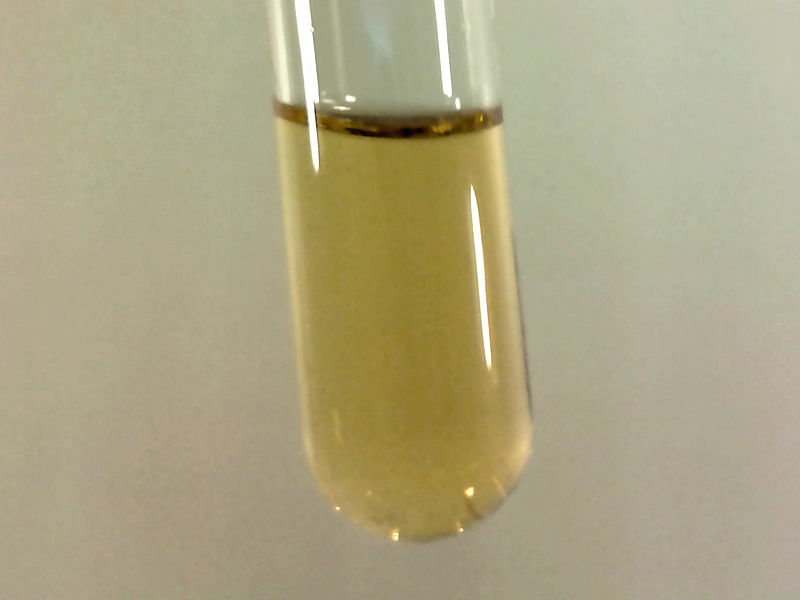
File:Fluoro_liquido_a_-196°C_1.jpg · Wikimedia Commons · See Wikimedia Commons
fluorine
Sign in to saveAlso known as element 9, ₉F
Fluorine is a chemical element; it has symbol F and atomic number 9. It is the lightest halogen and exists at standard conditions as pale yellow diatomic gas. Fluorine is extremely reactive as it reacts with all other elements except for the light noble gases. In its elemental form it is highly toxic.
OverviewAI-generated
Fluorine is a chemical element with the symbol F and atomic number 9. Its mass is 18.998403162, and it has an electron configuration of 1s² 2s² 2p⁵, or [He] 2s² 2p⁵. The element exhibits an oxidation state of -1 and an electronegativity of 3.98. Its ionization energy is 15.7, and its ionic radius is 1.33.
Fluorine was discovered in 1810. It has a melting point of -363 and a boiling point of -307. The vapor pressure is 1. The substance is immediately dangerous to life or health at a level of 38.75. The time-weighted average exposure limit is 0.2. The NIOSH Pocket Guide ID is 0289.
Synthesized by Vinony from 32 facts across 4 sources: Wikidata, PubChem, PubMed, Vinony graph. Generated from structured data (not the Wikipedia text) and checked against those facts — may still contain errors.
Chemical data
- Formula
- F
- Molecular weight
- 18.99840316 g/mol
- IUPAC name
- fluorane
- SMILES
- [F]
- InChIKey
- YCKRFDGAMUMZLT-UHFFFAOYSA-N
- XLogP
- 0.6
- Polar surface area
- 0 Ų
- H-bond donors
- 0
- H-bond acceptors
- 0
- Formal charge
- 0
via PubChem
Research
64,795 papers- Fluorine biocatalysis.ReviewCurrent opinion in chemical biology · 2020Wu L, Maglangit F, Deng HDOI: 10.1016/j.cbpa.2020.01.004
- Drug Discovery Based on Fluorine-Containing Glycomimetics.ReviewMolecules (Basel, Switzerland) · 2023Wei X, Wang P, Liu F et al.DOI: 10.3390/molecules28186641
- Fluorine in psychedelic phenethylamines.ReviewDrug testing and analysis · 2012Trachsel DDOI: 10.1002/dta.413
- Fluorine-Directed Automated Mannoside Assembly.Angewandte Chemie (International ed. in English) · 2023Teschers CS, Gilmour RDOI: 10.1002/anie.202213304
- Fluorine and Fluorinated Motifs in the Design and Application of Bioisosteres for Drug Design.ReviewJournal of medicinal chemistry · 2018Meanwell NADOI: 10.1021/acs.jmedchem.7b01788
- The Role of Fluorine in Glycomimetic Drug Design.ReviewChemistry (Weinheim an der Bergstrasse, Germany) · 2021Hevey RDOI: 10.1002/chem.202003135
- Applications of Fluorine in Medicinal Chemistry.ReviewJournal of medicinal chemistry · 2015Gillis EP, Eastman KJ, Hill MD et al.DOI: 10.1021/acs.jmedchem.5b00258
- Modulating the Efficacy of Carbonic Anhydrase Inhibitors through Fluorine Substitution.ReviewAngewandte Chemie (International ed. in English) · 2021Berrino E, Michelet B, Martin-Mingot A et al.DOI: 10.1002/anie.202103211
via PubMed
Wikidata facts
- Instance of
- lithophile
- Subclass of
- halogens
- Part of
- halogens
- Named after
- hydrofluoric acid
- Followed by
- neon
- Mass
- 18.998403162
- Image
- Liquid fluorine tighter crop.jpg
Show 25 more facts
- immediately dangerous to life or health
- 38.75
- Commons gallery
- Fluorine
- melting point
- -363
- oxidation state
- -1
- element symbol
- F
- Commons category
- Fluorine
- topic's main category
- Category:Fluorine
- electronegativity
- 3.98
- atomic number
- 9
- NIOSH Pocket Guide ID
- 0289
- discoverer or inventor
- André-Marie Ampère
- boiling point
- -307
- vapor pressure
- 1
- ionization energy
- 15.7
- described by source
- Encyclopædia Britannica 11th edition
- time-weighted average exposure limit
- 0.2
- time of discovery or invention
- 1810-00-00
- location of discovery
- France
- Unicode character
- 氟
- different from
- fluorene
- electron configuration
- [He] 2s² 2p⁵
- chemical formula
- F
- ionic radius
- 0.08
- on focus list of Wikimedia project
- Wikipedia:Vital articles/Level/4
- maintained by WikiProject
- WikiProject Elements
via Wikidata · CC0
~51 min read
Encyclopedic overview
49 sectionsContents
- Characteristics
- Electron configuration
- Reactivity
- Phases
- Isotopes
- Occurrence
- Universe
- Earth
- History
- Early discoveries
- Isolation
- Later uses
- Compounds
- Oxidation states
- Metals
- Hydrogen
- Other reactive nonmetals
- Noble gases
- Organic compounds
- Discrete molecules
- Polymers
- Production
- Industrial routes to F<sub>2</sub>
- Laboratory routes
- Industrial applications
- Inorganic fluorides
- Organic fluorides
- Refrigerant gases
- Polymers
- Surfactants
- Agrichemicals
- Medicinal applications
- Dental care
- Pharmaceuticals
- PET scanning
- Oxygen carriers
- Biological role
- Toxicity
- Hydrofluoric acid
- Fluoride ion
- Environmental concerns
- Atmosphere
- Biopersistence
- See also
- Notes
- Sources
- Citations
- Indexed references
- External links
Fluorine is a chemical element; it has symbol F and atomic number 9. It is the lightest halogen and exists at standard conditions as pale yellow diatomic gas. Fluorine is extremely reactive as it reacts with all other elements except for the light noble gases. In its elemental form it is highly toxic.
Among the elements, fluorine ranks 24th in cosmic abundance and 13th in crustal abundance. Fluorite, the primary mineral source of fluorine, which gave the element its name, was first described in 1529; as it was added to metal ores to lower their melting points for smelting, the Latin verb meaning gave the mineral its name. Proposed as an element in 1810, fluorine proved difficult and dangerous to separate from its compounds, and several early experimenters died or sustained injuries from their attempts. Only in 1886 did French chemist Henri Moissan isolate elemental fluorine using low-temperature electrolysis, a process still employed for modern production. Industrial production of fluorine gas for uranium enrichment, its largest application, began during the Manhattan Project in World War II.
Excerpted from Wikipedia’s “fluorine” article, available under the CC BY-SA 4.0 licence.
Gallery (33)
Available in 172 languages
- Español
- Français
- Deutsch
- 中文
- 日本語
- Русский
- Português
- Italiano
- العربية
- हिन्दी
- abstract
- Afrikaans
- Albanian
- Amharic
- Angika
- Aragonese
- Armenian
- Asturian
Show 153 more
- Awadhi
- Azerbaijani
- Bahasa Indonesia
- Balinese
- Bangla
- Bashkir
- Basque
- be_x_old
- Belarusian
- Bhojpuri
- Bikol
- blk
- Bosnian
- Breton
- Bulgarian
- Burmese
- Catalan
- cdo
- Cebuano
- Central Kurdish
- Cherokee
- Chuvash
- Cornish
- Corsican
- Croatian
- Czech
- Danish
- Egyptian Arabic
- Erzya
- Esperanto
- Estonian
- Extremaduran
- Faroese
- Fiji Hindi
- Filipino
- Finnish
- Friulian
- Galician
- Gan Chinese
- Ganda
- Georgian
- Greek
- Gujarati
- Haitian Creole
- Hakka Chinese
- Hawaiian
- Hebrew
- Hungarian
- hyw
- Icelandic
- Ido
- Inari Sami
- Interlingua
- Irish
- Javanese
- Kalmyk
- Kannada
- Kazakh
- kbp
- Komi
- Kurdish
- Kyrgyz
- Lao
- Latin
- Latvian
- Ligurian
- Limburgish
- Lingala
- Lithuanian
- Lojban
- Lombard
- Low German
- Luxembourgish
- Macedonian
- Malay
- Malayalam
- Manipuri
- Manx
- Māori
- Marathi
- Mongolian
- Moroccan Arabic
- Nederlands
- Nepali
- Newari
- Northern Frisian
- Norwegian
- Norwegian Nynorsk
- Novial
- Occitan
- Odia
- olo
- Oromo
- Ossetic
- Papiamento
- Pashto
- Piedmontese
- Polski
- Punjabi
- Quechua
- roa_rup
- Romanian
- Sanskrit
- Santali
- Saterland Frisian
- Scots
- Scottish Gaelic
- Serbian
- Serbian (Latin)
- Shona
- Sicilian
- Silesian
- simple
- Sindhi
- Sinhala
- Slovak
- Slovenian
- Somali
- Standard Moroccan Tamazight
- Sundanese
- Svenska
- Swahili
- Tajik
- Tamil
- Tatar
- Telugu
- Tibetan
- Tiếng Việt
- Toki Pona
- Tumbuka
- Türkçe
- Ukrainian
- Urdu
- Uyghur
- Uzbek
- Veps
- Volapük
- Walloon
- Waray
- Welsh
- Western Frisian
- Western Mari
- Western Panjabi
- Wu Chinese
- Yiddish
- Yoruba
- zh_classical
- zh_min_nan
- zh_yue
- Zulu
- فارسی
- ไทย
- 한국어
via Wikidata sitelinks · CC0