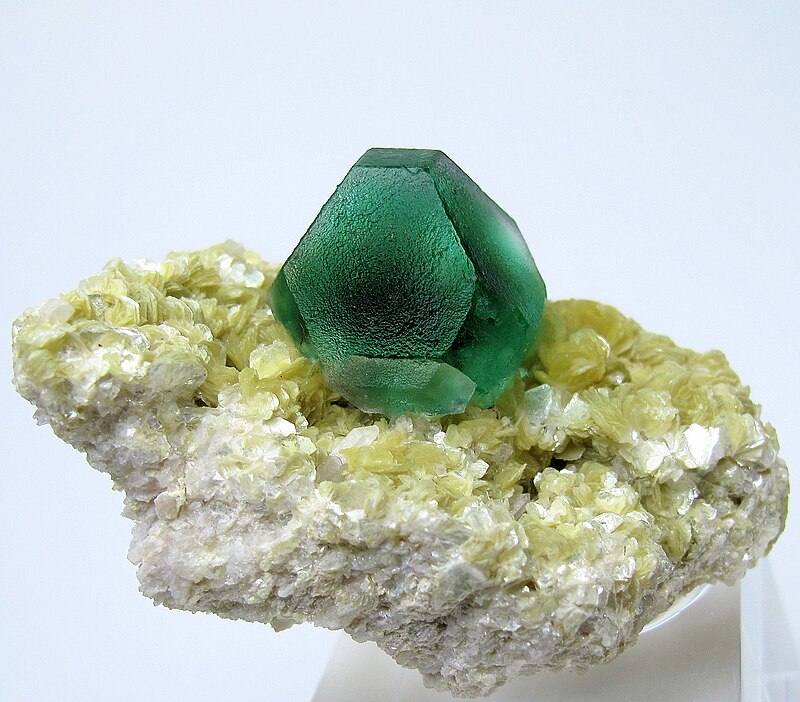
File:3192M-fluorite1.jpg · Wikimedia Commons · See Wikimedia Commons
fluorite
Sign in to saveAlso known as fluorspar, CaF2
Fluorite (also called fluorspar) is the mineral form of calcium fluoride, CaF2. It belongs to the halide minerals. It crystallizes in isometric cubic habit, although octahedral and more complex isometric forms are not uncommon.
Fluorite is a naturally occurring mineral made of calcium and fluoride that typically forms cube-shaped crystals. It's used in various industrial applications and is valued by collectors and scientists for its distinct crystalline structure.
AI-generated from the Wikipedia summary — may contain errors.
Key facts
- Mineral.name
- Fluorite
- Mineral.category
- Halide mineral
- Mineral.boxbgcolor
- 305c3c
- Mineral.boxtextcolor
- fff
- Mineral.image
- 3192M-fluorite1.jpg
- Mineral.imagesize
- 260px
- Mineral.caption
- Deep green isolated fluorite crystal resembling a truncated octahedron, set upon a micaceous matrix, from Erongo Mountain, Erongo Region, Namibia (overall size: 50 mm × 27 mm, crystal size: 19 mm wide, 30 g)
- Mineral.formula
- CaF2
- Mineral.IMAsymbol
- Flr
- Mineral.strunz
- 3.AB.25
- Mineral.system
- Isometric
- Mineral.class
- Hexoctahedral (mm) H–M symbol: (4/m 2/m) (cF12)
- Mineral.symmetry
- Fmm (No. 225)
- Mineral.unit cell
- a = 5.4626 Å; Z = 4
- Mineral.color
- Colorless, although samples are often deeply colored owing to impurities; Purple, lilac, golden-yellow, green, blue, pink, champagne, brown.
- Mineral.habit
- Well-formed coarse sized crystals; also nodular, botryoidal, rarely columnar or fibrous; granular, massive
- Mineral.twinning
- Common on {111}, interpenetrant, flattened
- Mineral.cleavage
- Octahedral, perfect on {111}, parting on {011}
via Wikipedia infobox
Wikidata facts
- Subclass of
- halide class of minerals
- Has part
- calcium fluoride
- Named after
- fluid flow
- Image
- Fluorite crystals 270x444.jpg
Show 13 more facts
- color
- gold
- Mohs' hardness
- 4
- Commons category
- Fluorite
- streak color
- white
- crystal system
- cubic crystal system
- chemical formula
- CaF₂
- Nickel-Strunz 9th edition (updated 2009)
- 3.AB.25
- Nickel-Strunz '10th ed', review of (9th ed/ 2009 update)
- 3.AB.25
- topic's main category
- Category:Fluorite
- type locality (geology)
- Jáchymov
- described by source
- Encyclopædia Britannica 11th edition
- Strunz 8th edition (series ID, updated)
- III/A.07
- IMA Mineral Symbol
- Flr
via Wikidata · CC0
~22 min read
Encyclopedic overview
15 sectionsContents
- History and etymology
- Structure
- Occurrence and mining
- Fluorescence
- Color
- Uses
- Source of fluorine and fluoride
- Niche uses
- Lapidary uses
- Optics
- Source of fluorine gas in nature
- Gallery
- See also
- References
- External links
{{Infobox mineral | name = Fluorite | category = Halide mineral | boxwidth = | boxbgcolor =#305c3c | boxtextcolor = #fff | image = 3192M-fluorite1.jpg | imagesize = 260px | caption = Deep green isolated fluorite crystal resembling a truncated octahedron, set upon a micaceous matrix, from Erongo Mountain, Erongo Region, Namibia (overall size: 50 mm × 27 mm, crystal size: 19 mm wide, 30 g) | formula = CaF2 | IMAsymbol = Flr | molweight = | strunz = 3.AB.25 | system = Isometric | class = Hexoctahedral (mm) H–M symbol: (4/m 2/m) (cF12) | symmetry = Fmm (No. 225) | unit cell = a = 5.4626 Å; Z = 4 | color = Colorless, although samples are often deeply colored owing to impurities; Purple, lilac, golden-yellow, green, blue, pink, champagne, brown. | habit = Well-formed coarse sized crystals; also nodular, botryoidal, rarely columnar or fibrous; granular, massive | twinning = Common on {111}, interpenetrant, flattened | cleavage = Octahedral, perfect on {111}, parting on {011} | fracture = Subconchoidal to uneven | tenacity = Brittle | mohs = 4 (defining mineral) | luster = Vitreous | refractive = 1.433–1.448 | opticalprop = Isotropic; weak anomalous anisotropism; moderate relief | birefringence = | pleochroism = | streak = White | gravity = 3.175–3.184; to 3.56 if high in rare-earth elements | melt = | fusibility = 3 | diagnostic = | solubility = slightly water soluble and in hot hydrochloric acid | diaphaneity = Transparent to translucent | other = May be fluorescent, phosphorescent, thermoluminescent, and/or triboluminescent | references= }}
Fluorite (also called fluorspar) is the mineral form of calcium fluoride, CaF2. It belongs to the halide minerals. It crystallizes in isometric cubic habit, although octahedral and more complex isometric forms are not uncommon.
Excerpted from Wikipedia’s “fluorite” article, available under the CC BY-SA 4.0 licence.
Gallery (24)
Available in 64 languages
- Español
- Français
- Deutsch
- 中文
- 日本語
- Русский
- Português
- Italiano
- العربية
- हिन्दी
- Afrikaans
- Armenian
- Asturian
- Azerbaijani
- Bahasa Indonesia
- Bangla
- Basque
- be_x_old
Show 45 more
- Belarusian
- Bosnian
- Breton
- Bulgarian
- Catalan
- Croatian
- Czech
- Esperanto
- Estonian
- Finnish
- Galician
- Georgian
- Greek
- Hebrew
- Hungarian
- Icelandic
- Ido
- Irish
- Kazakh
- Kyrgyz
- Latvian
- Lithuanian
- Low German
- Macedonian
- Mongolian
- Nederlands
- Norwegian
- Norwegian Nynorsk
- Polski
- Romanian
- Scots
- Serbian
- Serbian (Latin)
- simple
- Slovak
- Slovenian
- Svenska
- Tiếng Việt
- Türkçe
- Ukrainian
- Uzbek
- Wu Chinese
- zh_yue
- فارسی
- 한국어
via Wikidata sitelinks · CC0