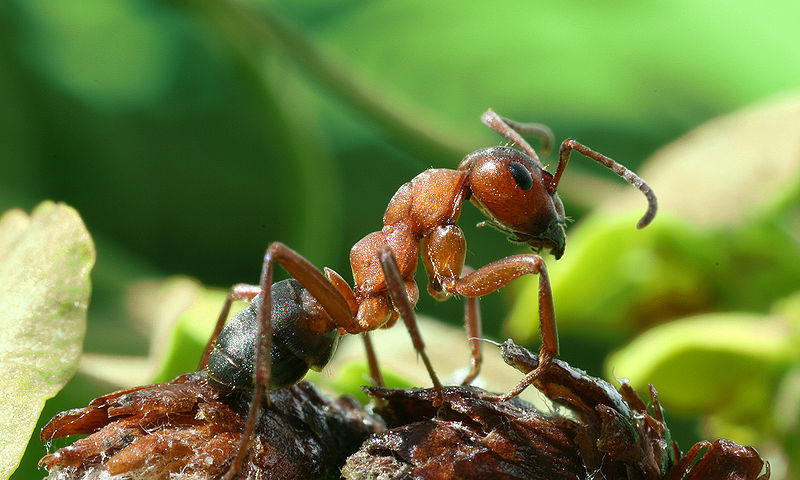
File:A_Formica_rufa_sideview.jpg · Wikimedia Commons · See Wikimedia Commons
Formica rufa
Sign in to saveAlso known as Southern wood ant, red wood ant, horse ant
species of insect
OverviewAI-generated
Formica rufa, commonly known as the Southern wood ant, Red wood ant, or Rote Waldameise, is a species of ant within the family Formicidae. Classified under the order Hymenoptera and class Insecta, it belongs to the phylum Arthropoda and kingdom Animalia. The species is part of the genus Formica and was described by Linnaeus in 1761. It exhibits diurnal activity patterns.
The IUCN Red List assessed the species as Near Threatened in 1996. Records of Formica rufa have been documented in Belgium and the United States, with collections held by institutions including RBINS-SCIENTIFIC HERITAGE, UMNH, USNM, and SBMNH.
Synthesized by Vinony from 26 facts across 6 sources: Wikidata, GBIF, Gbif Occ, IUCN Red List, iDigBio, Vinony graph. Generated from structured data (not the Wikipedia text) and checked against those facts — may still contain errors.
Species
LR/ntSPECIES
- KingdomAnimalia
- PhylumArthropoda
- ClassInsecta
- OrderHymenoptera
- FamilyFormicidae
Комплекс муравейников Formica rufa с добычей Матка рыжего лесного муравья Formica rufa Крылатая молодая самка рыжего лесного муравья Formica rufa Голова спереди Рыжий лесной муравей (лат. Formica rufa) — вид средних по размеру муравьёв рода формика (Formica) из подсемейства формицины (Formicinae) семейства Formicidae.
via GBIF
Museum specimens
- Specimen records
- 1,980
- With media
- 87
- Family
- Formicidae
- Collections
- RBINS-SCIENTIFIC HERITAGE, UMNH, USNM, SBMNH
- Recorded in
- Belgium, United States
Wikidata facts
- Instance of
- taxon
- Parent taxon
- Formica
- Image
- Hormiga roja de la madera (Formica rufa), Hartelholz, Múnich, Alemania, 2020-06-28, DD 72-83 FS.jpg
Show 9 more facts
- taxon rank
- species
- IUCN conservation status
- Near Threatened
- taxon name
- Formica rufa
- Commons category
- Formica rufa
- Commons gallery
- Formica rufa
- taxon common name
- 홍개미
- diel cycle
- diurnality
- short name
- F. rufa
- taxon author citation
- Linnaeus, 1761
Sources (3)
via Wikidata · CC0
~14 min read
Encyclopedic overview
Formica rufa, also known as the red wood ant, southern wood ant, or horse ant, is a boreal member of the Formica rufa group of ants, and is the type species for that group, being described by Linnaeus. It is native to Eurasia, with a recorded distribution stretching from the middle of Scandinavia to northern Iberia and Anatolia, and from Great Britain to Lake Baikal, with unconfirmed reports of it in the Russian Far East. There are claims that it can be found in North America, but this is not confirmed in specialised literature, and no recent publication where North American wood ants are listed mentions it as present, while records from North America are all listed as dubious or unconfirmed in a record compilation. The workers' heads and thoraces are colored red and the abdomen brownish-black, usually with dark patches on the head and promesonotum, although some individuals may be more uniformly reddish and even have some red on the part of the gaster facing the body. In order to separate them from closely related species, specimens needs to be inspected under magnification, where difference in hairiness is among the telling characteristics, with Formica rufa being hairier than, for example, Formica polyctena but less hairy than Formica lugubris. Workers are polymorphic, measuring 4.5–9 mm in length. They have large mandibles and, like many other ant species, they are able to spray formic acid from their abdomens as a defence. Formic acid was first extracted in 1671 by the English naturalist John Ray, by distilling a large number of crushed ants of this species. Adult wood ants primarily feed on honeydew from aphids. Some F. rufa colonies are large networks of connected nests with multiple queens, while others have a single queen.
Description
Excerpted from Wikipedia’s “Formica rufa” article, available under the CC BY-SA 4.0 licence.
Gallery (10)
Available in 39 languages
- Español
- Français
- Deutsch
- 中文
- Русский
- Português
- Italiano
- العربية
- Azerbaijani
- Bahasa Indonesia
- Basque
- Belarusian
- Bulgarian
- Catalan
- Cebuano
- Czech
- Egyptian Arabic
- Estonian
Show 20 more
via Wikidata sitelinks · CC0