File:Fossil_Diversity.png · Wikimedia Commons · See Wikimedia Commons
fossil
Sign in to saveAlso known as zoolite, fossils, fossil find
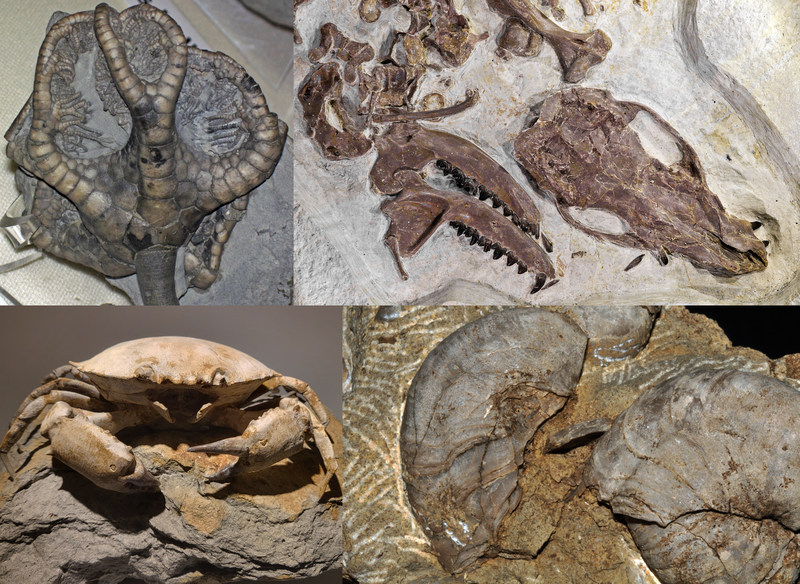
thumb|300px|Examples of animal fossils. Clockwise from top left: Onychocrinus, [[Palaeosinopa, Gryphaea, and Harpactocarcinus]]
A fossil is the preserved remains or traces of an ancient organism, such as bones, shells, or imprints left in rock. Fossils matter because they provide evidence of past life on Earth and help scientists understand how organisms and environments have changed over time.
AI-generated from the Wikipedia summary — may contain errors.
Research
44,736 papers- Fungal-induced fossil biomineralization.Current biology : CB · 2023Luo M, Li Z, Su M et al.DOI: 10.1016/j.cub.2023.04.067
- Fossil Crustaceans as Parasites and Hosts.ReviewAdvances in parasitology · 2015Klompmaker AA, Boxshall GADOI: 10.1016/bs.apar.2015.06.001
- Ants and the fossil record.ReviewAnnual review of entomology · 2013LaPolla JS, Dlussky GM, Perrichot VDOI: 10.1146/annurev-ento-120710-100600
- The fossil record of fish ontogenies: insights into developmental patterns and processes.ReviewSeminars in cell & developmental biology · 2010Cloutier RDOI: 10.1016/j.semcdb.2009.11.004
- Aestivation in the fossil record: evidence from ichnology.ReviewProgress in molecular and subcellular biology · 2010Hembree DIDOI: 10.1007/978-3-642-02421-4_12
- Unlocking the early fossil record of the arthropod central nervous system.ReviewPhilosophical transactions of the Royal Society of London. Series B, Biological sciences · 2015Edgecombe GD, Ma X, Strausfeld NJDOI: 10.1098/rstb.2015.0038
- Combining fossil taxa with and without morphological data improves dated phylogenetic analyses.Biology letters · 2025Nikolic MC, Warnock RCM, Hopkins MJDOI: 10.1098/rsbl.2025.0205
- 110-million-years-old fossil suggests early parasitism in shrimps.Scientific reports · 2023Lima D, Alencar DR, Santana W et al.DOI: 10.1038/s41598-023-40554-2
via PubMed
Wikidata facts
- Image
- Perisphinctes wartae - Museum fur Naturkunde, Berlin - DSC00011.JPG
Show 10 more facts
- different from
- pseudofossil
- topic has template
- Template:Infobox fossil
- Commons category
- Fossils
- topic's main category
- Category:Fossils
- Commons gallery
- Fossil
- has cause
- fossilization
- fabrication method
- fossilization
- P8168
- Moulicent
- on focus list of Wikimedia project
- Wikipedia:Vital articles/Level/4
- exact match
- purl.obolibrary.org/obo/ENVO_00002164
via Wikidata · CC0
~51 min read
Encyclopedic overview
45 sectionsContents
- History of study
- Ancient civilizations
- Early modern explanations
- Linnaeus and Darwin
- After Darwin
- Modern era
- Dating/Age
- Stratigraphy and estimations
- Limitations <span class="anchor" id="Fossil record limitations"></span>
- Sites
- Lagerstätten
- Fossilization processes
- Recrystallization
- Replacement
- Permineralization
- Phosphatization
- Pyritization
- Silicification
- Casts and molds
- Authigenic mineralization
- Adpression (compression-impression)
- Carbonization and coalification
- Soft tissue, cell and molecular preservation
- Bioimmuration
- Types
- Index
- Trace
- Transitional
- Microfossils
- Resin
- {{anchor|derived|reworked}}Derived or reworked
- Wood
- Subfossil
- Chemical fossils
- Stromatolites
- Pseudofossils
- Astrobiology
- Art
- Trading and collecting
- As medicine
- Gallery
- See also
- References
- Further reading
- External links
thumb|300px|Examples of animal fossils. Clockwise from top left: Onychocrinus, [[Palaeosinopa, Gryphaea, and Harpactocarcinus]]
A fossil (from Classical Latin , ) is any preserved remains, impression, or trace of any once-living thing from a past geological age. Examples include bones, shells, exoskeletons, stone imprints of animals or microbes, objects preserved in amber, hair, petrified wood and DNA remnants. The totality of fossils is known as the fossil record. Though the fossil record is incomplete, numerous studies have demonstrated that there is enough information available to give a good understanding of the pattern of diversification of life on Earth. In addition, the record can predict and fill gaps such as the discovery of Tiktaalik in the arctic of Canada.
Excerpted from Wikipedia’s “fossil” article, available under the CC BY-SA 4.0 licence.
Gallery (46)
Available in 115 languages
- Español
- Français
- Deutsch
- 中文
- 日本語
- Русский
- Português
- Italiano
- العربية
- हिन्दी
- Afrikaans
- Albanian
- Albanian
- ami
- Armenian
- Asturian
- azb
- Azerbaijani
Show 96 more
- Bahasa Indonesia
- Bangla
- Basque
- Belarusian
- Bhojpuri
- blk
- Bosnian
- Breton
- Bulgarian
- Burmese
- Catalan
- cdo
- Central Kurdish
- Cherokee
- Chuvash
- Croatian
- Czech
- Danish
- Esperanto
- Estonian
- Extremaduran
- Filipino
- Finnish
- Galician
- Georgian
- Greek
- Haitian Creole
- Hebrew
- Hungarian
- Icelandic
- Ido
- Irish
- Javanese
- Kabyle
- Kannada
- Kazakh
- kge
- Khmer
- Ladino
- Lao
- Latin
- Latvian
- Limburgish
- Lithuanian
- Low German
- Luxembourgish
- Macedonian
- Malagasy
- Malay
- Malayalam
- map_bms
- Marathi
- mnw
- Nederlands
- Nepali
- Norwegian
- Norwegian Nynorsk
- Occitan
- Odia
- Papiamento
- Polski
- Punjabi
- Quechua
- Romanian
- Serbian
- Serbian (Latin)
- simple
- Sindhi
- Sinhala
- Slovak
- Slovenian
- Sundanese
- Svenska
- Swahili
- Tamil
- Telugu
- Tiếng Việt
- Türkçe
- Turkmen
- Ukrainian
- Urdu
- Volapük
- Waray
- Welsh
- West Flemish
- Western Frisian
- Western Panjabi
- Wu Chinese
- Yiddish
- zh_classical
- zh_min_nan
- zh_yue
- Zulu
- فارسی
- ไทย
- 한국어
via Wikidata sitelinks · CC0