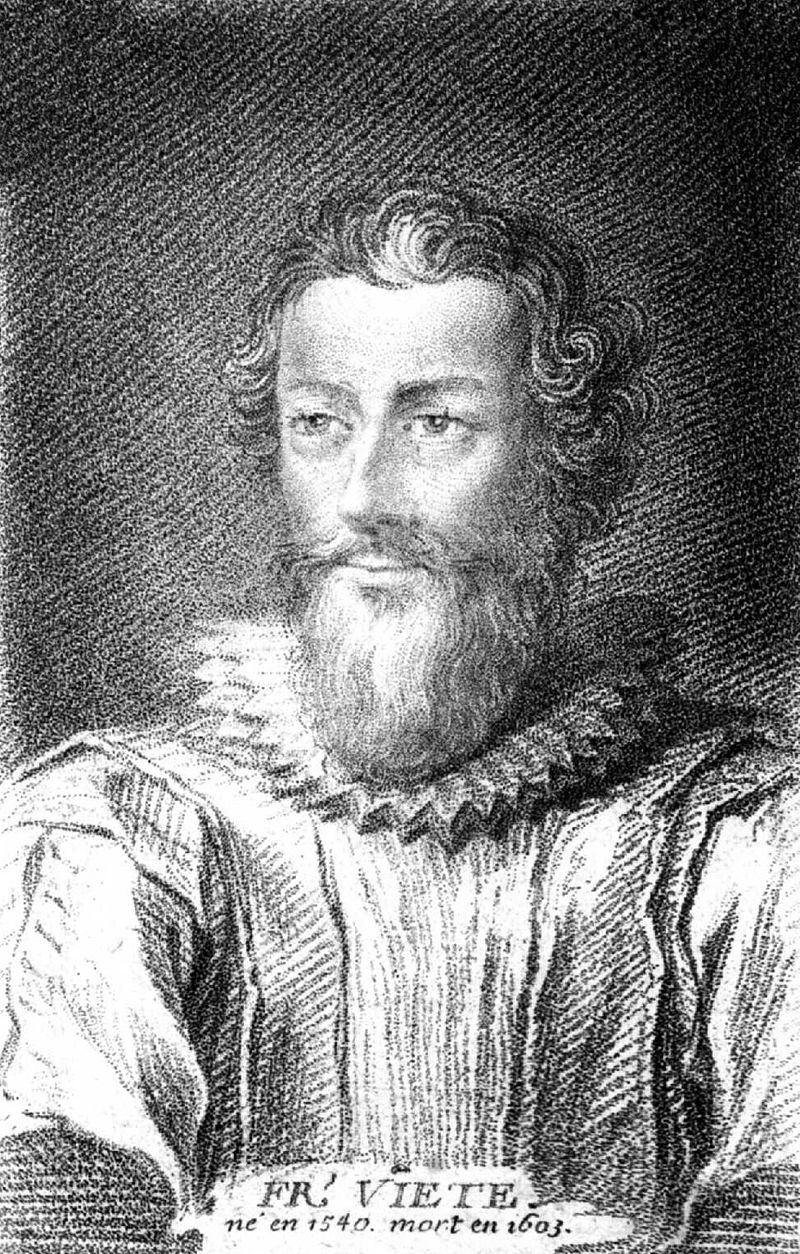
File:Francois_Viete.jpg · Wikimedia Commons · See Wikimedia Commons
François Viète
Sign in to saveAlso known as Franciscus Vieta, Francois Viete, François Viette
French mathematician (*1540 – †1603)
François Viète was a French mathematician from the 16th century who made important contributions to algebra and trigonometry. His work helped develop modern mathematical notation and methods, making mathematics more systematic and easier to use for later generations of mathematicians and scientists.
AI-generated from the Wikipedia summary — may contain errors.
Wikidata facts
- Instance of
- human
- Given name
- François
- Gender
- male
- Citizenship
- France
- Place of birth
- Fontenay-le-Comte
- Place of death
- Paris
- Occupation
- lawyer
- Educated at
- University of Poitiers
- Employer
- Henry IV of France
- Languages spoken
- Middle French
- Academic degree
- Bachelor of Laws
- Field of work
- mathematics
- Image
- Francois Viete.jpeg
Show 10 more facts
- Commons category
- François Viète
- date of birth
- 1540-00-00
- date of death
- 1603-02-23
- described by source
- The Catholic Encyclopedia
- student
- Alexander Anderson
- name in native language
- François Viète
- archives at
- Archives nationales
- influenced by
- Petrus Ramus
- writing language
- Latin
- maintained by WikiProject
- WikiProject Mathematics
Sources (7)
via Wikidata · CC0
~34 min read
Encyclopedic overview
François Viète ( French: [fʁɑ̃swa vjɛt]; 1540 – 23 February 1603), known in Latin as Franciscus Vieta, was a French mathematician whose work on new algebra was an important step towards modern algebra, due to his innovative use of letters as parameters in equations. Because of this, Viète is sometimes called "the father of modern algebraic notation". He was a lawyer by trade, and served as a privy councillor to both Henry III and Henry IV of France.
Biography
Excerpted from Wikipedia’s “François Viète” article, available under the CC BY-SA 4.0 licence.
Gallery (5)
Available in 62 languages
- Español
- Français
- Deutsch
- 中文
- 日本語
- Русский
- Português
- Italiano
- العربية
- Armenian
- azb
- Azerbaijani
- Bahasa Indonesia
- Basque
- be_x_old
- Belarusian
- Bulgarian
- Catalan
Show 43 more
- Croatian
- Czech
- Danish
- Egyptian Arabic
- Esperanto
- Estonian
- Finnish
- Galician
- Georgian
- Greek
- Haitian Creole
- Hebrew
- Hungarian
- Ido
- Kazakh
- Latin
- Latvian
- Lithuanian
- Macedonian
- Malayalam
- Nederlands
- Norwegian
- Norwegian Nynorsk
- Occitan
- Piedmontese
- Polski
- Romanian
- rsk
- Scots
- Serbian
- Slovak
- Slovenian
- Svenska
- Tajik
- Tiếng Việt
- Türkçe
- Ukrainian
- Uzbek
- Wu Chinese
- Yakut
- zh_classical
- فارسی
- 한국어
via Wikidata sitelinks · CC0