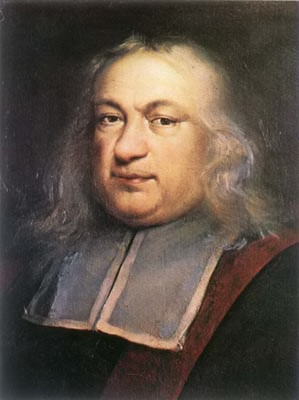
File:Pierre_de_Fermat.jpg · Wikimedia Commons · See Wikimedia Commons
Pierre de Fermat was a French mathematician and lawyer who made significant contributions to mathematics during the 17th century. He is most famous for Fermat's Last Theorem, a mathematical conjecture he wrote about that remained unproven for over 350 years and became one of the most important problems in mathematics.
AI-generated from the Wikipedia summary — may contain errors.
Wikidata facts
- Instance of
- human
- Given name
- Pierre
- Gender
- male
- Citizenship
- France
- Place of birth
- Beaumont-de-Lomagne
- Place of death
- Castres
- Occupation
- jurist
- Employer
- Parliament of Toulouse
- Languages spoken
- French
- Notable work
- Fermat number
- Academic degree
- Bachelor of Laws
- Field of work
- Fermat's Last Theorem
- Image
- Capitole Toulouse - Salle Henri-Martin - Buste de Pierre de Fermat.jpg
- Number of children
- 5
- Significant event
- cremation
Show 13 more facts
- topic's main category
- Category:Pierre de Fermat
- Commons category
- Pierre de Fermat
- date of birth
- 1607-00-00
- date of death
- 1665-01-12
- Commons gallery
- Pierre de Fermat
- name in native language
- Pierre de Fermat
- influenced by
- François Viète
- writing language
- French
- ethnic group
- French
- on focus list of Wikimedia project
- Wikipedia:Vital articles/Level/4
- Stack Exchange tag
- hsm.stackexchange.com/tags/fermat
- maintained by WikiProject
- WikiProject Mathematics
- place of burial
- Castres
Sources (10)
via Wikidata · CC0
~11 min read
Encyclopedic overview
Pierre de Fermat (/fɜːrˈmɑː/; French: [pjɛʁ də fɛʁma]; 17 August 1601 – 12 January 1665) was a French magistrate, polymath, and above all, a mathematician who is given credit for early developments that led to infinitesimal calculus, including his technique of adequality. In particular, he is recognized for his discovery of an original method of finding the greatest and the smallest ordinates of curved lines, which is analogous to that of differential calculus, then unknown, and his research into number theory. He made notable contributions to analytic geometry, probability, and optics. He is best known for his Fermat's principle for light propagation and his Fermat's Last Theorem in number theory, which he described in a note at the margin of a copy of Diophantus' Arithmetica. He was also a lawyer at the parlement of Toulouse, France, a poet, a skilled Latinist, and a Hellenist.
Biography
Excerpted from Wikipedia’s “Pierre de Fermat” article, available under the CC BY-SA 4.0 licence.
Gallery (7)
Available in 97 languages
- Español
- Français
- Deutsch
- 中文
- 日本語
- Русский
- Português
- Italiano
- العربية
- हिन्दी
- Afrikaans
- Albanian
- Aragonese
- Armenian
- Assamese
- Asturian
- azb
- Azerbaijani
Show 78 more
- Bahasa Indonesia
- Bangla
- Bashkir
- Basque
- be_x_old
- Belarusian
- Bikol
- Breton
- Bulgarian
- Burmese
- Catalan
- Central Kurdish
- Chuvash
- Croatian
- Czech
- Danish
- Egyptian Arabic
- Esperanto
- Estonian
- Filipino
- Finnish
- Galician
- Georgian
- Greek
- Haitian Creole
- Hebrew
- Hungarian
- Icelandic
- Ido
- Irish
- Javanese
- Kannada
- Kazakh
- Latin
- Latvian
- Lithuanian
- Macedonian
- Malagasy
- Malay
- Malayalam
- Marathi
- Mingrelian
- Mirandese
- Mongolian
- Nederlands
- Norwegian
- Norwegian Nynorsk
- Occitan
- Piedmontese
- Polski
- Punjabi
- Romanian
- Scots
- Serbian
- Serbian (Latin)
- Sicilian
- simple
- Slovak
- Slovenian
- Svenska
- Swahili
- Tamil
- Telugu
- Tiếng Việt
- Türkçe
- Ukrainian
- Urdu
- Uzbek
- Waray
- Welsh
- Western Frisian
- Wu Chinese
- Yiddish
- Zaza
- zh_yue
- فارسی
- ไทย
- 한국어
via Wikidata sitelinks · CC0