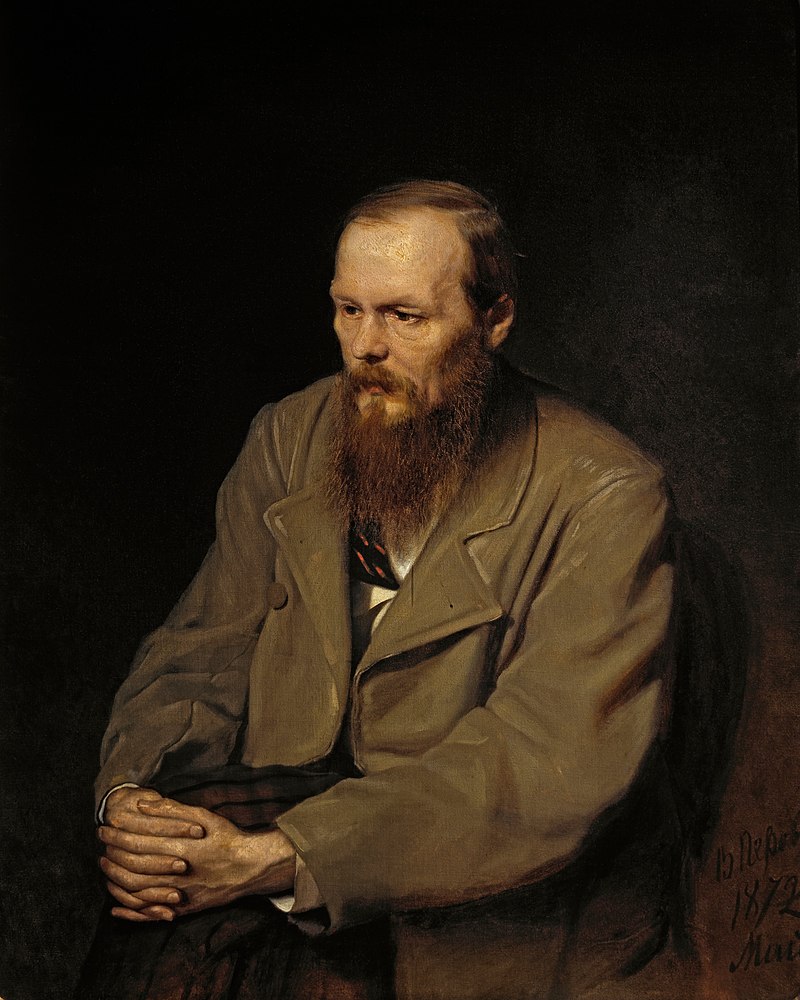
File:Vasily_Perov_-_Портрет_Ф.М.Достоевского_-_Google_Art_Project.jpg · Wikimedia Commons · See Wikimedia Commons
Fyodor Dostoyevsky
Sign in to saveAlso known as Dostoievski, Fyodor Dostoievski, Fyodor Mikhaylovich Dostoievski, Fyodor Mikhaylovich Dostoyevsky, Fyodor Mikhailovich Dostoevsky, F.M. Dostoiewski, Fyodor Dostoevsky
Russian novelist (1821–1881)
OverviewAI-generated
Fyodor Dostoyevsky was a Russian novelist, essayist, poet, and translator born in Moscow in 1821. He was educated at the Military Engineering-Technical University and served as a member of the Saint Petersburg Academy of Sciences. His literary output included notable works such as *Notes from Underground*, *Crime and Punishment*, *The Idiot*, and *Demons*. He was associated with the literary realism movement and wrote in the Russian language.
Dostoyevsky suffered from epilepsy and died in Saint Petersburg in 1881. His cause of death was attributed to epilepsy and pulmonary emphysema. He is buried at Tikhvin Cemetery. He was married to Anna Dostoyevskaya, and they had a child named Lyubov Dostoevskaya. He was influenced by Alexander Pushkin, Mikhail Lermontov, Nikolai Gogol, and Vladimir Solovyov. He was a member of the Russian Orthodox Church.
Synthesized by Vinony from 35 facts across 4 sources: Wikidata, Europeana Sparql, TMDb, VIAF. Generated from structured data (not the Wikipedia text) and checked against those facts — may still contain errors.
Film & TV
Moscow, Russian Empire [now Russia]
Fyodor Mikhailovich Dostoevsky (UK: /ˌdɒstɔɪˈɛfski/, US: /ˌdɒstəˈjɛfski, ˌdʌs-/; Russian: Фёдор Михайлович Достоевский, tr. Fyódor Mikháylovich Dostoyévskiy, IPA: [ˈfʲɵdər mʲɪˈxajləvʲɪdʑ dəstɐˈjefskʲɪj] (listen); 11 November 1821 – 9 February 1881), sometimes transliterated as Dostoyevsky, was a Russian novelist, short story writer, essayist and journalist. Dostoevsky's literary works explore the…
via TMDB
Authority record · VIAF
- Lifespan
- 1821–1881
- Nationality
- RU, RUS
- Role / Field
- Short story writer, Philosophers, Novelists, Novelist, Essayists, Short stories
- Language
- rus
- Gender
- Male
Recorded by 48 libraries
via VIAF · OCLC
Wikidata facts
- Instance of
- human
- Gender
- male
- Citizenship
- Russian Empire
- Place of birth
- Moscow
- Place of death
- Saint Petersburg
- Child
- Lyubov Dostoevskaya
- Languages spoken
- Russian
- Native language
- Russian
- Religion
- Russian Orthodox Church
- Notable work
- Notes from Underground
- Movement
- literary realism
- Image
- Vasily Perov - Портрет Ф.М.Достоевского - Google Art Project.jpg
Show 26 more facts
- place of burial
- Tikhvin Cemetery
- Commons category
- Fyodor Dostoyevsky
- date of birth
- 1821-01-01
- date of death
- 1881-01-01
- topic's main category
- Category:Fyodor Dostoyevsky
- Commons gallery
- Fyodor Dostoyevsky
- medical condition
- epilepsy
- Commons Creator page
- Fyodor Dostoyevsky
- member of
- Saint Petersburg Academy of Sciences
- cause of death
- pulmonary emphysema
- influenced by
- Nikolai Gogol
- pseudonym
- N.N.
- start of work period
- 1844-00-00
- end of work period
- 1880-00-00
- name in native language
- Фёдор Михайлович Достоевский
- date of burial or cremation
- 1881-02-02
- on focus list of Wikimedia project
- Wikipedia:Vital articles/Level/4
- allegiance
- Russian Empire
- writing language
- Russian
- topic has template
- Template:Fyodor Dostoevsky
- P8168
- Bożenna Bukiewicz
- has works in the collection
- Anne Frank House
- maintained by WikiProject
- WikiProject Literature
- list of works
- Fyodor Dostoyevsky bibliography
- P12749
- UEFA Euro 1988
- manner of death
- natural causes
Sources (8)
via Wikidata · CC0
Works in European collections
30 objects attributed to Fyodor Dostoyevsky, held across European museums, libraries & archives · via Europeana

Feljegyzések az egérlyukból

77.

Bűn és bűnhődés

Egy játékos naplója ; A szelíd asszony

Nagyváros homályából ; A kis hős és egyéb elbeszélések

A kamasz

Karamazov testvérek

Regény

A félkegyelmű

Regény

Bűn és bűnhődés

A félkegyelmű

Megalázottak és megszomorítottak ; Feljegyzések a holtak házából

Sztyepancsikovo and its inhabitants

Az örök férj ; Netocska

Ördögök
Briefe Mit Porträts, Faksimiles und Ansichten
Der Jüngling. Roman in zwei Bänden Mit einer Einleitung von Dmitri Mereschkowski
Autobiographische Schriften
Die Beichte Stawrogins. Drei unveröffentlichte Kapitel aus dem Roman „Die Teufel"
Erniedrigte und Beleidigte [I] Roman
Der Spieler. Der ewige Gatte. Zwei Romane
Die Brüder Karamasoff. Roman
Onkelchens Traum und andere Humoresken
Der Jüngling. Roman in zwei Bänden Mit einer Einleitung von Dmitri Mereschkowski
Untitled
Untitled
Untitled
Untitled
Untitled
~40 min read
Encyclopedic overview
Fyodor Mikhailovich Dostoevsky (11 November [O.S. 30 October] 1821 – 9 February [O.S. 28 January] 1881) was a Russian philosopher, novelist, short story writer, essayist and journalist. He is regarded as one of the greatest novelists in both Russian and world literature, and many of his works are considered highly influential masterpieces. Dostoevsky's literary works explore the human condition in the troubled political, social and spiritual atmospheres of 19th-century Russia, and engage with a variety of philosophical and religious themes. His most acclaimed novels include Crime and Punishment (1866), The Idiot (1869), Demons (1872), The Adolescent (1875) and The Brothers Karamazov (1880). His Notes from Underground, a novella published in 1864, is considered one of the first works of existentialist literature.
Born in Moscow in 1821, Dostoevsky was introduced to literature at an early age through fairy tales and legends and through books by Russian and foreign authors. His mother died in 1837, and around the same time, he left school to enter the Nikolayev Military Engineering Institute (later renamed the Military Engineering-Technical University). After graduating, he worked as an engineer and briefly enjoyed a lavish lifestyle, translating books to earn extra money. In the mid-1840s, he wrote his first novel, Poor Folk, which gained him entry into Saint Petersburg's literary circles. However, he was arrested in 1849 for belonging to a literary group, the Petrashevsky Circle, that discussed banned books critical of Tsarist Russia. Dostoevsky was sentenced to death, but the sentence was commuted at the last moment. He spent four years in a Siberian hard labour camp, which inspired him to write The House of the Dead (1860–1862). Aside from the labour camp also followed six years of compulsory military service in exile. In the following years, Dostoevsky worked as a journalist, publishing and editing several magazines of his own and later A Writer's Diary, a collection of his writings. He began to travel around Western Europe and developed a gambling addiction, which led to financial hardship. For a time, he had to beg for money, but he eventually became one of the most widely read and highly regarded Russian writers.
Excerpted from Wikipedia’s “Fyodor Dostoyevsky” article, available under the CC BY-SA 4.0 licence.
Gallery (13)
Available in 184 languages
- Español
- Français
- Deutsch
- 中文
- 日本語
- Русский
- Português
- Italiano
- العربية
- हिन्दी
- Abkhazian
- abstract
- Afrikaans
- Albanian
- Albanian
- Amharic
- Aragonese
- Armenian
Show 165 more
- Assamese
- Asturian
- azb
- Azerbaijani
- Bahasa Indonesia
- Bangla
- Bashkir
- Basque
- bat_smg
- Bavarian
- be_x_old
- Belarusian
- Bhojpuri
- Bikol
- Bislama
- Bosnian
- Breton
- btm
- Bulgarian
- Buriat
- Burmese
- Catalan
- cdo
- Cebuano
- Central Kurdish
- Chechen
- Church Slavic
- Chuvash
- Cornish
- Crimean Tatar
- Croatian
- Czech
- Danish
- Egyptian Arabic
- Erzya
- Esperanto
- Estonian
- Extremaduran
- Faroese
- Fiji Hindi
- Filipino
- Finnish
- fiu_vro
- Galician
- Gan Chinese
- gcr
- Georgian
- Gilaki
- Greek
- Guarani
- Haitian Creole
- Hakka Chinese
- Hausa
- Hebrew
- Hungarian
- hyw
- Icelandic
- Ido
- Igbo
- Iloko
- Inari Sami
- Interlingua
- Interlingue
- Irish
- Jamaican Creole English
- Javanese
- Jju
- Kabardian
- Kabyle
- Kanuri
- Kara-Kalpak
- Kazakh
- kbp
- Kurdish
- Kyrgyz
- Latin
- Latvian
- Lezghian
- Limburgish
- Lithuanian
- lld
- Lombard
- Low German
- Lower Sorbian
- Luxembourgish
- Macedonian
- Malagasy
- Malay
- Malayalam
- Marathi
- Mari
- Mazanderani
- Minangkabau
- Mingrelian
- Mirandese
- Mongolian
- Moroccan Arabic
- Nederlands
- Nepali
- Newari
- Northern Frisian
- Norwegian
- Norwegian Nynorsk
- nrm
- Occitan
- olo
- Ossetic
- Pashto
- Picard
- Piedmontese
- Polski
- ppl
- Punjabi
- Quechua
- roa_rup
- Romanian
- rsk
- Rusyn
- Sardinian
- Scots
- Scottish Gaelic
- Serbian
- Serbian (Latin)
- Sicilian
- simple
- Sindhi
- Slovak
- Slovenian
- Somali
- Southern Altai
- Standard Moroccan Tamazight
- Svenska
- Swahili
- Tajik
- Tamil
- Tatar
- Telugu
- Tiếng Việt
- Tumbuka
- Türkçe
- Turkmen
- Tuvinian
- Ukrainian
- Upper Sorbian
- Urdu
- Uzbek
- Venetian
- Veps
- Volapük
- Walloon
- Waray
- Welsh
- Western Frisian
- Western Panjabi
- Wu Chinese
- Yakut
- Yiddish
- Yoruba
- Zaza
- zh_classical
- zh_min_nan
- zh_yue
- فارسی
- ไทย
- 한국어
via Wikidata sitelinks · CC0