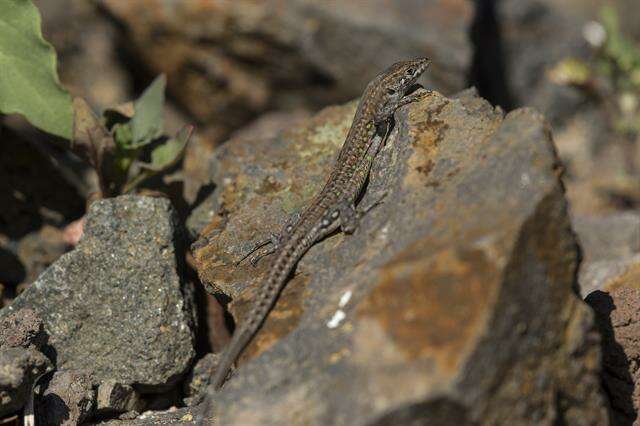
Encyclopedia of Life · EOL (see source)
Gallotia
Sign in to saveThe genus Gallotia are the lacertids (wall lizards) of the Canary Islands. This genus consists of a group that has been evolving there ever since the first islands emerged from the sea over 20 million years ago. The endemic species and subspecies of this group have a number of characteristics that make them quite special within their family (Lacertidae); their only close relatives are the sandrunner lizards (Psammodromus) of the western Mediterranean region. Gallotia are characteristic for eating significant quantities of plants, and several lineages are often presented as classic examples for
Species
GENUS
- KingdomAnimalia
- PhylumChordata
- ClassSquamata
- FamilyLacertidae
Die Kanareneidechsen (Gallotia) leben endemisch auf den Kanarischen Inseln. Für Echte Eidechsen (Lacertidae) haben die Vertreter dieser Gattung relativ breite Schädel und unterscheiden sich auch in Details des Schuppenkleides von ihren Verwandten. Gran-Canaria-Rieseneidechse (Gallotia stehlini) Kanareneidechse (Gallotia galloti) Inhaltsverzeichnis 1 Arten 2 Ernährung 3 Riesenwuchs 4 Weblinks 5 Quellen Arten Zur Gattung der Kanareneidechsen gehören derzeit folgende acht rezente Arten:[1] Ostkanareneidechse (Gallotia atlantica (Peters & Doria, 1882)) La-Palma-Rieseneidechse (Gallotia auaritae Mateo, Garcia-Marquez, López-Jurado & Barahona, 2001) La-Gomera-Rieseneidechse (Gallotia bravoana Hutterer, 1985) Kleine Kanareneidechse (Gallotia caesaris (Lehrs, 1914)) Kanareneidechse (Gallotia galloti (Oudart, 1839)) Teneriffa-Rieseneidechse (Gallotia intermedia Hernández, Nogales & Martín, 2000) El-Hierro-Rieseneidechse (Gallotia simonyi (Steindachner, 1889)) Gran-Canaria-Rieseneidechse (Gallotia stehlini (Schenkel, 1901)) Fossile Arten: † Gallotia goliath (Mertens, 1942) Ernährung Kanareneidechsen fressen, neben der für alle Eidechsen üblichen Insektenkost, viel pflanzliche Nah
via GBIF
Wikidata facts
- Instance of
- taxon
- Parent taxon
- Gallotiinae
- Image
- Kleine Kanareneidechse.JPG
Show 5 more facts
- taxon rank
- genus
- taxon name
- Gallotia
- Commons category
- Gallotia
- topic's main category
- Category:Gallotia
- Commons gallery
- Gallotia
Sources (1)
via Wikidata · CC0
~7 min read
Encyclopedic overview
3 sectionsContents
- Systematics and biogeography
- References
- Footnotes
The genus Gallotia are the lacertids (wall lizards) of the Canary Islands. This genus consists of a group that has been evolving there ever since the first islands emerged from the sea over 20 million years ago. The endemic species and subspecies of this group have a number of characteristics that make them quite special within their family (Lacertidae); their only close relatives are the sandrunner lizards (Psammodromus) of the western Mediterranean region. Gallotia are characteristic for eating significant quantities of plants, and several lineages are often presented as classic examples for insular gigantism. However, a find of an even larger Gallotia species from the early Miocene of mainland Europe casts doubt on this assumption. Instead the ancestor of all modern Gallotia species of the Canary islands was probably already very large but carnivorous (Černaňský et al., 2016).
==Systematics and biogeography== This genus can be broadly divided into two groups - lineages originating from the colonization of the earliest Canary Islands of Lanzarote, Fuerteventura and Gran Canaria, probably between 10-20 million years ago, and a lineage that colonised the younger western islands probably less than 10 million years ago (Cox et al., 2010). Both lineages contain large and small species.
Excerpted from Wikipedia’s “Gallotia” article, available under the CC BY-SA 4.0 licence.
Available in 26 languages
- Español
- Français
- Deutsch
- Русский
- Português
- Italiano
- العربية
- Azerbaijani
- Basque
- Bulgarian
- Catalan
- Cebuano
- Egyptian Arabic
- Galician
- Hungarian
- Lithuanian
- Navajo
- Nederlands
via Wikidata sitelinks · CC0