File:Map_Gallia_Tribes_Towns-la.svg · Wikimedia Commons · See Wikimedia Commons
Gaul
Sign in to saveAlso known as Gallia
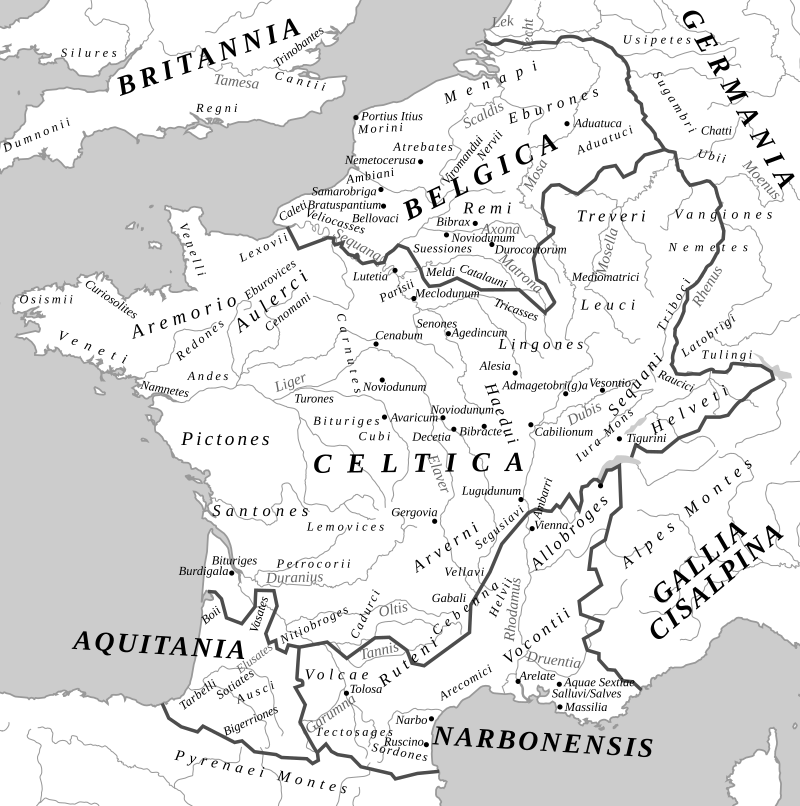
thumb|upright=1.35|Gaul , on the eve of the Gallic Wars. The Romans divided Gaul into five parts: [[Gallia Celtica (largely corresponding to the later province Gallia Lugdunensis), Gallia Belgica, Gallia Cisalpina, Gallia Narbonensis, and Gallia Aquitania.]]
Gaul was a region in ancient Europe that the Romans divided into five parts: Gallia Celtica, Gallia Belgica, Gallia Cisalpina, Gallia Narbonensis, and Gallia Aquitania. It matters historically because it was significant enough for the Romans to formally partition and govern, particularly during the period of the Gallic Wars.
AI-generated from the Wikipedia summary — may contain errors.
Wikidata facts
- Demonym
- Gallach
- Country
- Luxembourg
- Continent
- Europe
- Image
- Gaul in the time of Caesar (134037767).jpg
Show 6 more facts
- Commons category
- Gauls
- topic's main category
- Category:Gaul
- described by source
- Pauly–Wissowa
- different from
- Gallia Lugdunensis
- P8168
- James Aldridge
Sources (2)
via Wikidata · CC0
~19 min read
Encyclopedic overview
11 sectionsContents
- History
- Roman conquest
- Roman Gaul
- Frankish Gaul
- Culture
- Social structure, indigenous nation and tribes
- Religion
- See also
- References
- Sources
- External links
thumb|upright=1.35|Gaul , on the eve of the Gallic Wars. The Romans divided Gaul into five parts: [[Gallia Celtica (largely corresponding to the later province Gallia Lugdunensis), Gallia Belgica, Gallia Cisalpina, Gallia Narbonensis, and Gallia Aquitania.]]
Gaul () was a region of Western Europe first clearly described by the Romans, encompassing present-day France, Belgium, Luxembourg, and parts of Switzerland, the Netherlands, Germany, and Northern Italy. It covered an area of . Archaeologically, the Gauls were bearers of the La Tène culture during the 5th to 1st centuries BC. This material culture was found throughout Gaul and as far east as modern-day southern Poland, Slovakia, and Hungary.
Excerpted from Wikipedia’s “Gaul” article, available under the CC BY-SA 4.0 licence.
Gallery (22)
Available in 105 languages
- Español
- Français
- Deutsch
- 中文
- 日本語
- Русский
- Português
- Italiano
- العربية
- हिन्दी
- Afrikaans
- Albanian
- Aragonese
- Armenian
- Asturian
- azb
- Azerbaijani
- Bahasa Indonesia
Show 86 more
- Bangla
- Basque
- be_x_old
- Belarusian
- Bosnian
- Breton
- Bulgarian
- Catalan
- Chuvash
- Croatian
- Czech
- Danish
- Egyptian Arabic
- Esperanto
- Estonian
- Finnish
- Galician
- Georgian
- Greek
- Hebrew
- Hungarian
- Icelandic
- Ido
- Interlingua
- Irish
- Kannada
- Kazakh
- Kurdish
- Kyrgyz
- Ladino
- Latin
- Latvian
- Limburgish
- Lingua Franca Nova
- Lithuanian
- Lombard
- Low German
- Macedonian
- Malagasy
- Malay
- Malayalam
- Marathi
- Mazanderani
- Neapolitan
- Nederlands
- Northern Frisian
- Norwegian
- Norwegian Nynorsk
- Novial
- nrm
- Occitan
- Old English
- Papiamento
- Picard
- Polski
- Romanian
- Scots
- Serbian
- Serbian (Latin)
- Sicilian
- simple
- Slovak
- Slovenian
- Svenska
- Swahili
- Tajik
- Tibetan
- Tiếng Việt
- Toki Pona
- Türkçe
- Ukrainian
- Urdu
- Uzbek
- Venetian
- Walloon
- Waray
- Welsh
- West Flemish
- Western Frisian
- Western Panjabi
- Wu Chinese
- zh_min_nan
- zh_yue
- فارسی
- ไทย
- 한국어
via Wikidata sitelinks · CC0