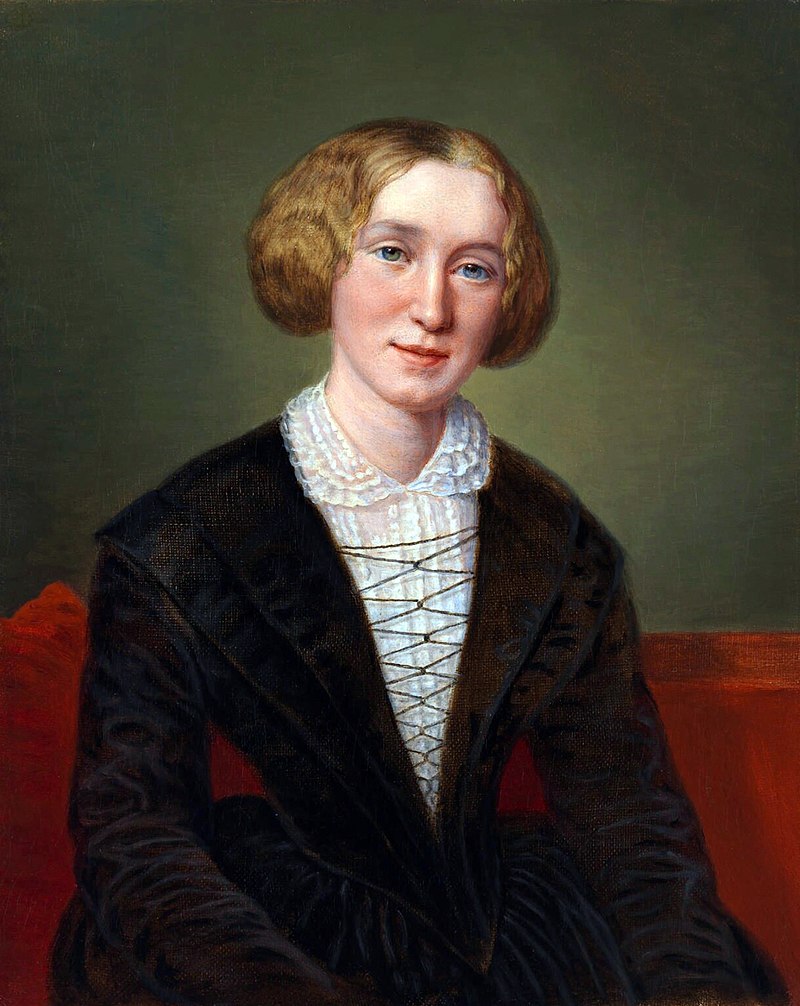
File:George_Eliot,_por_François_D'Albert_Durade.jpg · Wikimedia Commons · See Wikimedia Commons
George Eliot
Sign in to saveAlso known as Mary Ann Evans, Marian Evans, Mary Anne Evans Cross, Mary Anne Cross, Marian Cross
English novelist, essayist, poet and journalist (1819–1880)
George Eliot was an English novelist, essayist, poet, and journalist who lived from 1819 to 1880 and is remembered as one of the major literary figures of the Victorian era. She matters because her novels explored complex human psychology and social issues with intellectual depth, making significant contributions to English literature during a time when few women achieved such literary prominence.
AI-generated from the Wikipedia summary — may contain errors.
Wikidata facts
- Instance of
- human
- Gender
- female
- Citizenship
- United Kingdom of Great Britain and Ireland
- Place of birth
- Nuneaton
- Place of death
- London
- Occupation
- editor
- Educated at
- Royal Holloway, University of London
- Languages spoken
- German
- Native language
- English language
- Religion
- agnosticism
- Notable work
- Romola
- Field of work
- poetry
- Movement
- literary realism
- Image
- George Eliot, por François D'Albert Durade.jpg
Show 19 more facts
- place of burial
- Highgate Cemetery
- Commons category
- George Eliot
- topic's main category
- Category:George Eliot
- date of birth
- 1819-00-00
- date of death
- 1880-00-00
- birth name
- Mary Anne Evans
- Commons gallery
- George Eliot
- archives at
- Harry Ransom Center
- Commons Creator page
- George Eliot
- cause of death
- kidney disease
- name in native language
- Marian Evans
- ethnic group
- English people
- pseudonym
- George Eliot
- unmarried partner
- George Henry Lewes
- writing language
- English language
- P8168
- Ébreuil
- P12749
- Yangzhou
- has works in the collection
- J. Paul Getty Museum
- manner of death
- natural causes
Sources (9)
via Wikidata · CC0
Works in European collections
27 objects attributed to George Eliot, held across European museums, libraries & archives · via Europeana


~31 min read
Encyclopedic overview
Mary Ann Evans (22 November 1819 – 22 December 1880; alternatively Mary Anne or Marian), known by her pen name George Eliot, was an English novelist, poet, journalist, translator, and one of the leading writers of the Victorian era. She wrote seven novels: Adam Bede (1859), The Mill on the Floss (1860), Silas Marner (1861), Romola (1862–1863), Felix Holt, the Radical (1866), Middlemarch (1871–1872) and Daniel Deronda (1876). Like Charles Dickens and Thomas Hardy, she emerged from provincial England, where most of her works are set. Her novels are known for their realism, psychological insight, sense of place, and detailed depiction of the countryside. Middlemarch was described by the novelist Virginia Woolf as "one of the few English novels written for grown-up people" and by Martin Amis and Julian Barnes as the greatest novel in the English language.
Scandalously and unconventionally for the era, she lived with the married George Henry Lewes as his conjugal partner, from 1854 to 1878, and called him her husband. He remained married to his wife, Agnes Jervis, and supported their children, even after Jervis left him to live with another man and have children with him. In May 1880, 18 months after Lewes's death, Eliot married her longtime friend John Cross, a man much younger than she, and changed her name to Mary Ann Cross.
Excerpted from Wikipedia’s “George Eliot” article, available under the CC BY-SA 4.0 licence.
Gallery (8)
Available in 91 languages
- Español
- Français
- Deutsch
- 中文
- 日本語
- Русский
- Português
- Italiano
- العربية
- हिन्दी
- Afrikaans
- Aragonese
- Armenian
- Assamese
- azb
- Azerbaijani
- Bahasa Indonesia
- Bangla
Show 72 more
- Basque
- Bavarian
- be_x_old
- Belarusian
- Bosnian
- Breton
- Bulgarian
- Catalan
- Central Kurdish
- Croatian
- Czech
- Danish
- Egyptian Arabic
- Esperanto
- Estonian
- Filipino
- Finnish
- Galician
- Georgian
- Greek
- Hausa
- Hebrew
- Hungarian
- hyw
- Icelandic
- Igbo
- Irish
- Kannada
- Kazakh
- kbp
- Kotava
- Kyrgyz
- Latin
- Latvian
- Macedonian
- Maithili
- Malayalam
- Maltese
- Marathi
- Mingrelian
- Nederlands
- Nepali
- Norwegian
- Norwegian Nynorsk
- Pashto
- Polski
- Punjabi
- Quechua
- Romanian
- Scots
- Serbian
- Serbian (Latin)
- Silesian
- simple
- Sindhi
- Slovenian
- Svenska
- Telugu
- Tiếng Việt
- Türkçe
- Ukrainian
- Urdu
- Uzbek
- Waray
- Welsh
- Western Frisian
- Wu Chinese
- Yoruba
- zh_yue
- فارسی
- ไทย
- 한국어
via Wikidata sitelinks · CC0