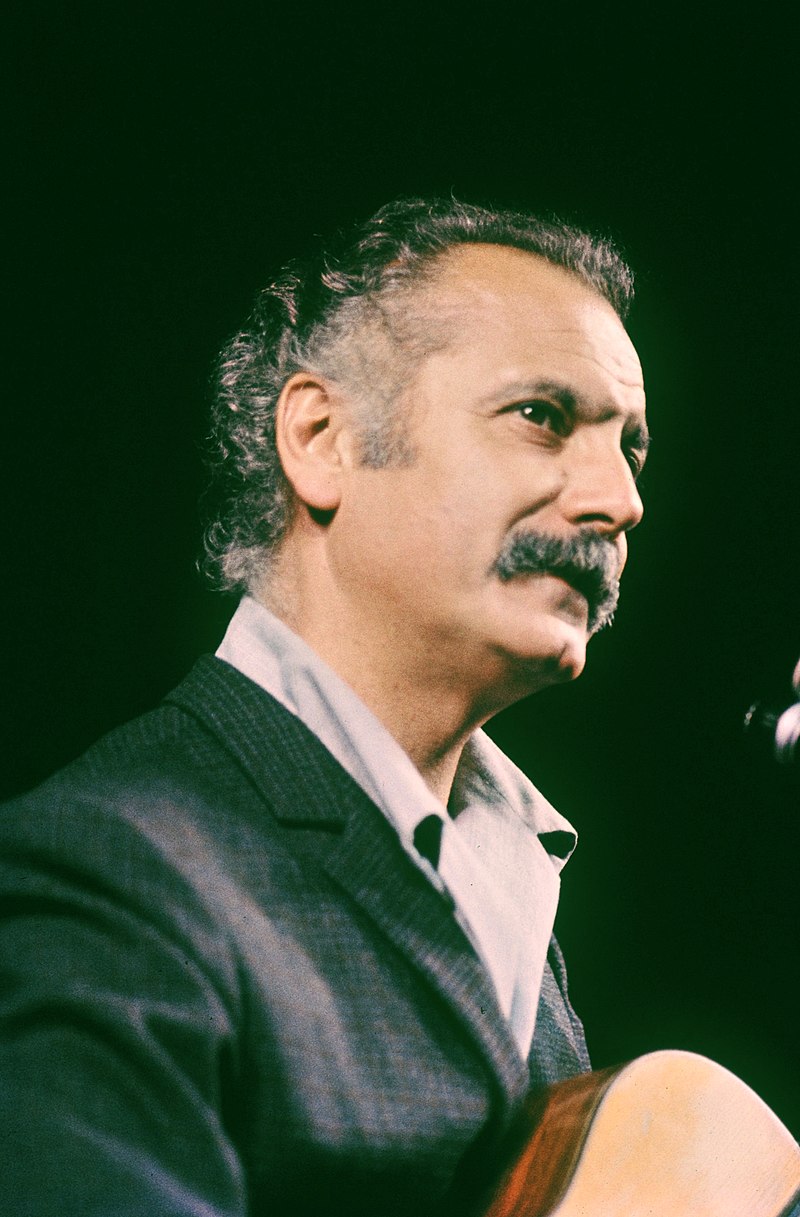
File:Brassens_TNP_1966.jpg · Wikimedia Commons · See Wikimedia Commons
Georges Brassens
Sign in to saveFrench singer-songwriter and poet (1921–1981)
OverviewAI-generated
Georges Charles Brassens was a French poet, writer, banjoist, and guitarist born in Sète, France, on October 22, 1921. He performed using the guitar, voice, and piano, and his work was categorized within the chanson genre. His professional career spanned from 1951 until 1981. During this period, he released recordings through Philips Records and was represented by the copyright organization SACEM.
Brassens received the Grand Prix de Poésie and the Premio Tenco for his contributions. He authored numerous works, including *Georges Brassens*, *auprès de son âme*, and *Les manuscrits de Brassens*. He died of cancer in Saint-Gély-du-Fesc on October 29, 1981. His native language and the primary language of his output was French.
Synthesized by Vinony from 35 facts across 5 sources: Wikidata, Open Library, MusicBrainz, Last.fm, TMDb. Generated from structured data (not the Wikipedia text) and checked against those facts — may still contain errors.
Person · Open Library
- Born
- 1921
- Died
- 1981
- Works
- 24
via Open Library + Wikidata
Film & TV
Sète, Hérault, France
Georges Charles Brassens (22 October 1921 – 29 October 1981) was a French singer-songwriter and poet. As an iconic figure in France, he achieved fame through his elegant songs with their harmonically complex music for voice and guitar and articulate, diverse lyrics. He is considered one of France's most accomplished postwar poets. He has also set to music poems by both well-known and relatively…
Known for
- La TV des 70's : Quand Giscard était président — Self (archive footage)2022
- Charles Trenet, l'enchanteur — Self (archive footage)2022
- Georges Brassens, les meilleures chansons — Self (archive footage)2021
- Archives secrètes — Self (archive footage)2021
- L'affaire Matzneff — (archive footage)2020
- Boris Vian, un cœur qui battait trop fort — Self (archive footage)2020
- Brassens by Brassens — Self (archive footage)2020
- #Merci Brassens — Self (archive footage)2017
- Cavanna, jusqu'à l'ultime seconde j'écrirai — Self (archive footage)2015
- Le regard de Georges Brassens — Self (archive footage)2013
via TMDB
Music · MusicBrainz
- Type
- Person
- Gender
- Male
- Country
- France
- Active from
- 1921
- Active to
- 1981
Discography
- La Mauvaise Réputation / Le Petit Cheval1952
- Le Gorille / La Chasse aux papillons1952
- Le Gorille / La Mauvaise Réputation1952
- Le Gorille / Le Mauvais Sujet repenti1952
- Nº1 : Georges Brassens chante… les chansons poétiques (… et souvent gaillardes) de… Georges Brassens1952
- 1 – Le Parapluie1953
- 2 – La Marine1953
- Bancs publics1953
- Brave Margot / Pauvre Martin – Comme hier1953
- Hécatombe / Corne d’Auroch1953
via MusicBrainz · CC0
Listeners · Last.fm
- Listeners
- 279,481
- Total plays
- 5,924,640
Tags
Georges Brassens was a French singer and songwriter known for accompanying himself with his acoustic guitar. He wrote some extremely controversial, yet poetic songs. In doing so, he managed to change attitudes across France. He was uncompromising when composing his songs. His tactical method of addressing issues was profound and often humorous, making him a unique and effective figure in the French community. Brassens, born in 1921 in the small Mediterrenean port of Sete, wanted to be a poet
Wikidata facts
- Instance of
- human
- Given name
- Charles
- Gender
- male
- Citizenship
- France
- Place of birth
- Sète
- Place of death
- Saint-Gély-du-Fesc
- Occupation
- singer-songwriter
- Languages spoken
- French
- Native language
- French
- Award
- Premio Tenco
- Genre
- chanson
- Instrument
- piano
- Record label
- Philips Records
- Image
- Brassens-StudioHarcourt-1957.png
Show 10 more facts
- Commons category
- Georges Brassens
- cause of death
- cancer
- date of birth
- 1921-10-22
- date of death
- 1981-10-29
- manner of death
- natural causes
- birth name
- Georges Charles Brassens
- start of work period
- 1951-00-00
- end of work period
- 1981-00-00
- social media followers
- 90900
- copyright representative
- SACEM
via Wikidata · CC0
~5 min read
Encyclopedic overview
Georges Charles Brassens ( French: [ʒɔʁʒ(ə) ʃaʁl bʁasɛ̃s]; Occitan: [ˈbɾasens]) was a French singer-songwriter and poet.
George Brassens is considered one of France's most accomplished postwar poets. He achieved fame through his elegant songs, characterised by harmonically complex music for voice and guitar, as well as articulate and diverse lyrics. He also set to music poems by both relatively obscure poets and such well-known ones as Louis Aragon (Il n'y a pas d'amour heureux), Victor Hugo (La Légende de la Nonne, Gastibelza), Paul Verlaine, Jean Richepin, François Villon (La Ballade des Dames du Temps Jadis), and Antoine Pol (Les Passantes).
Excerpted from Wikipedia’s “Georges Brassens” article, available under the CC BY-SA 4.0 licence.