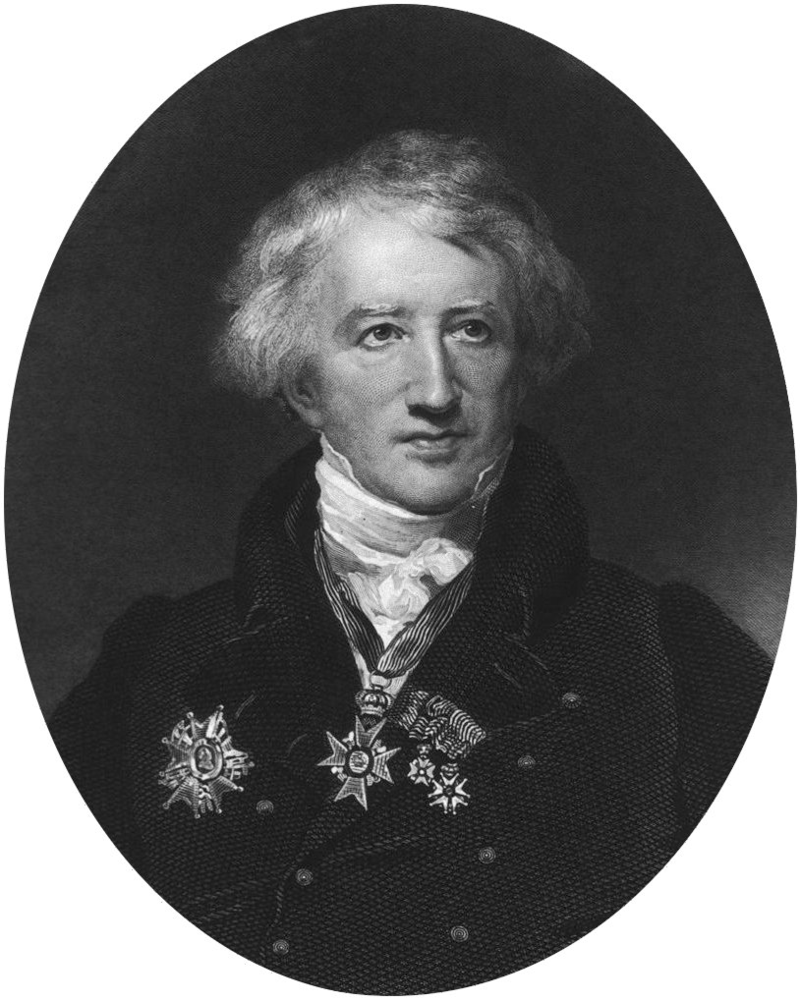
File:Georges_Cuvier.png · Wikimedia Commons · See Wikimedia Commons
Georges Cuvier
Sign in to saveAlso known as Cuvier, Baron Georges Cuvier, Georges, Baron Cuvier, Georges-Léopold-Chrêtien-Frédéric-Dagobert Baron Cuvier, Georges-Leopold-Chretien-Frederic-Dagobert Baron Cuvier, G. Cuvier, G. L. Cuvier, Georges Leopold Cuvier
French naturalist, zoologist and paleontologist (1769–1832)
OverviewAI-generated
Georges Cuvier, born Jean Léopold Nicolas Frédéric Cuvier on August 23, 1769, in Montbéliard, was a French paleontologist, politician, zoologist, and ornithologist. A Protestant, he worked in Paris and was employed by the Collège de France and the Muséum national d'histoire naturelle. He held the noble title of baron and was a member of the Royal Society, the Société Philomathique de Paris, the Académie Française, and the Academy of Science for Public Utility.
Cuvier’s fields of work included comparative anatomy, zoology, paleontology, and natural science. His notable works include *Histoire des progrès des science naturelles, depuis 1789 jusqu'a ce jour*, *Discours sur les révolutions de la surface du globe*, *Histoire naturelle des poissons*, and *Éloges historiques*. He received multiple distinctions, including the Grand Officer, Commander, Officer, and Knight of the Legion of Honour. He died of cholera in Paris on May 13, 1832, and is buried at Père Lachaise Cemetery.
Synthesized by Vinony from 31 facts across 4 sources: Wikidata, Open Library, Europeana Sparql, Vinony collections. Generated from structured data (not the Wikipedia text) and checked against those facts — may still contain errors.
Person · Open Library
- Born
- August 23, 1769
- Died
- May 13, 1832
- Works
- 324
Top works
- Histoire des progrès des science naturelles, depuis 1789 jusqu'a ce jour
- Le r©·gne animal distribu©♭ d'apr©·s son organisation, pour servir de base © l'histoire naturelle des animaux et d'introduction © l'anatomie compar©·e
- Sur les especes des animaux carnassiers dont on trouve les ossemens mêlés a ceux d'ours, dans les caverns d'Allemagne et de Hongrie
- Discours sur les révolutions de la surface du globe, et sur les changemens qu'elles ont produits dans le règne animan
- Histoire naturelle des poissons
via Open Library + Wikidata
Wikidata facts
- Instance of
- human
- Gender
- male
- Citizenship
- France
- Place of birth
- Montbéliard
- Sibling
- Frédéric Cuvier
- Educated at
- University of Stuttgart
- Languages spoken
- German
- Religion
- Protestantism
- Notable work
- Le Règne Animal
- Noble title
- baron
- Student of
- Johann Simon von Kerner
- Doctoral student
- Henri Marie Ducrotay de Blainville
- Field of work
- natural science
- Image
- Georges Cuvier 3.jpg
- Work location
- Paris
Show 18 more facts
- Commons category
- Georges Cuvier
- date of birth
- 1769-01-01
- date of death
- 1832-05-13
- cause of death
- cholera
- Commons Creator page
- Georges Cuvier
- birth name
- Jean Léopold Nicolas Frédéric Cuvier
- manner of death
- natural causes
- Commons gallery
- Georges Cuvier
- student
- Henri Milne-Edwards
- author citation (zoology)
- Cuvier
- writing language
- French
- P6944
- Georges Cuvier
- interested in
- paleontology
- ethnic group
- French
- P8168
- proscenium
- collection items at
- Natural History Museum
- P12749
- Kweneng District
Sources (8)
via Wikidata · CC0
Works in European collections
36 objects attributed to Georges Cuvier, held across European museums, libraries & archives · via Europeana
Essay on the theory of the earth
Discours sur les révolutions de la surface du globe et sur les changements qu'elles ont produits dans le règne animal
Histoire des sciences naturelles, depuis leur origine jusquà nos jours chez tous les peuples connus - T.I,: Première Partie, comprenant les siècles antérieurs au 16e de notre ère /
Histoire des sciences naturelles, depuis leur origine jusquà nos jours chez tous les peuples connus - T.V,: Troisiéme Partie, comprenant la fin de la deuxiéme moité du 18e siécle et une parie du 19e /
Histoire des sciences naturelles, depuis leur origine jusquà nos jours chez tous les peuples connus - T.IV,: Troisiéme Partie, comprenant la deuxiéme moité du 18e siécle /
Histoire des sciences naturelles, depuis leur origine jusquà nos jours chez tous les peuples connus - T.III,: Troisiéme Partie, comprenant la premiére moité du 18e siécle /
Histoire des sciences naturelles, depuis leur origine jusquà nos jours chez tous les peuples connus - T.II,: Deuxiéme Partie, comprenant les 16e et 17 siécles /

Tableau Élémentaire De L'Histoire Naturelle Des Animaux

Recueil des eloges historiques
Letter from Georges Cuvier to Adelbert von Chamisso
Lorenz Oken to Georges Cuvier
Carl Friedrich Kielmeyer to Georges Cuvier
Carl Heinrich Schultz-Schultzenstein to Georges Cuvier
Georges Baron de Cuvier to Carl Friedrich von Kielmeyer
Le règne animal distribué d'après son organisation...
Leçons d'anatomie comparée
Leçons d'anatomie comparée
Leçons d'anatomie comparée
Leçons d'anatomie comparée
Leçons d'anatomie comparée
Histoire des progrès des sciences naturelles, depuis de 1789 jusqu'a ce jour
Recherches sur les ossemens fossile, ou l'on rétablit les caractères de plusieurs espècies d'animaux dont les révolutions du globe ont detruit les espèces - T. 3,: Contenant les os fossiles des platrières des environs de Paris /
Le règne animal distribué d'après son organisation, pour servir de base a l'histoire naturelle des animaux et d'introduction a l'anatomie comparée
Le règne animal distribué d'après son organisation, pour servir de base a l'histoire naturelle des animaux et d'introduction a l'anatomie comparée
Mémoires pour servir à l'histoire et à l'anatomie des mollusques
Le règne animal distribué d'après son organisation...
Le règne animal distribué d'après son organisation...
Le règne animal distribué d'après son organisation...
Leçons d'anatomie comparée
Leçons d'anatomie comparée
Leçons d'anatomie comparée
Leçons d'anatomie comparée
Leçons d'anatomie comparée
Leçons d'anatomie comparée
Leçons d'anatomie comparée
Leçons d'anatomie comparée
~40 min read
Encyclopedic overview
Jean Léopold Nicolas Frédéric, baron Cuvier (23 August 1769 – 13 May 1832), known as Georges Cuvier (/ˈkjuːvieɪ/; French: [ʒɔʁʒ(ə) kyvje]), was a French naturalist and zoologist, sometimes referred to as the "founding father of paleontology". Cuvier was a major figure in natural sciences research in the early 19th century and was instrumental in establishing the fields of comparative anatomy and paleontology through his work in comparing living animals with fossils.
Cuvier's work is considered the foundation of vertebrate paleontology, and he expanded Linnaean taxonomy by grouping classes into phyla and incorporating both fossils and living species into the classification. Cuvier is also known for establishing extinction as a scientific fact—at the time, extinction was considered by many of Cuvier's contemporaries to be merely controversial speculation. In his Essay on the Theory of the Earth (1813), Cuvier proposed that now-extinct species had been wiped out by periodic catastrophic flooding events. In this way, Cuvier became the most influential proponent of catastrophism in geology in the early 19th century. His study of the strata of the Paris basin with Alexandre Brongniart established the basic principles of biostratigraphy.
Excerpted from Wikipedia’s “Georges Cuvier” article, available under the CC BY-SA 4.0 licence.
Gallery (12)
Available in 71 languages
- Español
- Français
- Deutsch
- 中文
- 日本語
- Русский
- Português
- Italiano
- العربية
- Afrikaans
- Armenian
- azb
- Azerbaijani
- Bahasa Indonesia
- Basque
- Belarusian
- Breton
- Bulgarian
Show 52 more
- Burmese
- Catalan
- Central Kurdish
- Croatian
- Czech
- Danish
- Egyptian Arabic
- Esperanto
- Estonian
- Filipino
- Finnish
- Galician
- Georgian
- Greek
- Hebrew
- Hungarian
- Ido
- Igbo
- Irish
- Javanese
- Kazakh
- Latin
- Latvian
- Lithuanian
- Luxembourgish
- Macedonian
- Mingrelian
- Nederlands
- Norwegian
- Occitan
- Pashto
- Piedmontese
- Polski
- Quechua
- Romanian
- Sanskrit
- Serbian
- simple
- Slovak
- Slovenian
- Svenska
- Tiếng Việt
- Türkçe
- Ukrainian
- Uzbek
- Waray
- Western Frisian
- Wu Chinese
- zh_min_nan
- zh_yue
- فارسی
- 한국어
via Wikidata sitelinks · CC0