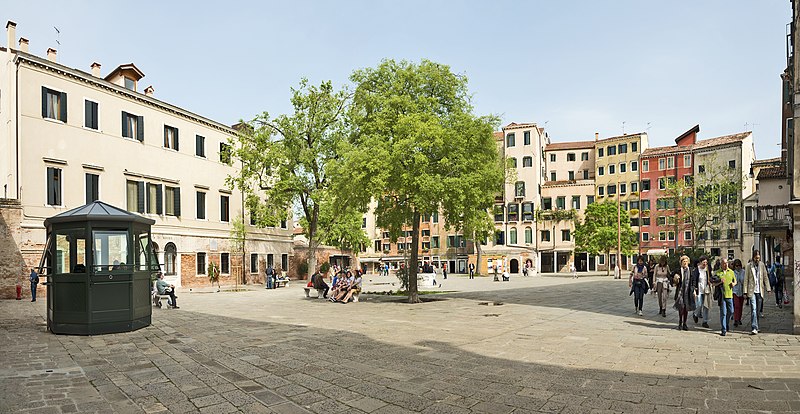
File:Ghetto_(Venice)_Panorama.jpg · Wikimedia Commons · See Wikimedia Commons
ghetto
Sign in to saveA ghetto is a part of a city in which members of a minority group are concentrated, especially as a result of political, social, legal, religious, environmental or economic pressure. Ghettos are often known for being more impoverished than other areas of the city. Versions of such restricted areas have been found across the world, each with their own names, classifications, and groupings of people.
A ghetto is a section of a city where members of a minority group live in concentrated numbers, typically due to political, social, legal, religious, environmental, or economic pressures rather than by free choice. These areas are often characterized by higher levels of poverty than other parts of the city, and similar segregated communities have existed throughout history and across the globe under various names and circumstances.
AI-generated from the Wikipedia summary — may contain errors.
Wikidata facts
- Subclass of
- ethnic enclave
- Image
- Bundesarchiv N 1576 Bild-006, Minsk, Juden.jpg
Show 4 more facts
- Commons category
- Ghetto
- topic's main category
- Category:Ghettos
- described by source
- Encyclopædia Britannica 11th edition
- on focus list of Wikimedia project
- Wikipedia:Vital articles/Level/4
via Wikidata · CC0
~38 min read
Encyclopedic overview
27 sectionsContents
- Etymology and name
- Jewish ghettos
- Nazi-occupied Europe
- Roma ghettos
- In Denmark
- In France
- In the United Kingdom
- In Northern Ireland
- Ghettos in the United States
- Early ghettos
- Black or African-American ghettos
- Effect of World War II on development
- Theories on the development of Black ghettos
- Race-based theories
- Class-based theories
- Alternative theory
- U.S. characterizations of "ghetto"
- Internal characterizations
- Modern usage and reinterpretations of "ghetto"
- Ghettos elsewhere
- Shanghai ghetto
- In popular culture
- Film
- Music
- See also
- References
- External links
A ghetto is a part of a city in which members of a minority group are concentrated, especially as a result of political, social, legal, religious, environmental or economic pressure. Ghettos are often known for being more impoverished than other areas of the city. Versions of such restricted areas have been found across the world, each with their own names, classifications, and groupings of people.
thumb|The main square of what was once the Venetian Ghetto in Italy (2013)|324x324pxThe term was originally used for the Venetian Ghetto in Venice, Italy, as early as 1516, to describe the part of the city where Jewish people were restricted to live and thus segregated from other people. However, other early societies may have formed their own versions of the same structure; words resembling ghetto in meaning appear in Hebrew, Yiddish, Italian, Germanic, Polish, Corsican, Old French, and Latin. During the Holocaust, more than 1,000 Nazi ghettos were established to hold the Jewish populations of Europe, with the goal of exploiting and killing European Jews as part of the Final Solution of Nazi Germany.
Excerpted from Wikipedia’s “ghetto” article, available under the CC BY-SA 4.0 licence.
Gallery (29)
Available in 82 languages
- Español
- Français
- Deutsch
- 中文
- 日本語
- Русский
- Português
- Italiano
- العربية
- हिन्दी
- Albanian
- Albanian
- Aragonese
- Armenian
- Asturian
- Azerbaijani
- Bahasa Indonesia
- Bashkir
Show 63 more
- Basque
- be_x_old
- Belarusian
- Bosnian
- Breton
- Bulgarian
- Catalan
- Central Kurdish
- Croatian
- Czech
- Danish
- Egyptian Arabic
- Esperanto
- Estonian
- Finnish
- Galician
- Georgian
- Greek
- Hebrew
- Hungarian
- Ido
- Kazakh
- Kurdish
- Kyrgyz
- Latin
- Latvian
- Lingua Franca Nova
- Lithuanian
- Luxembourgish
- Macedonian
- Malay
- Mazanderani
- Nederlands
- Norwegian
- Norwegian Nynorsk
- Occitan
- Polski
- Romanian
- Serbian
- Serbian (Latin)
- Shona
- simple
- Slovak
- Slovenian
- Svenska
- Tamil
- Tiếng Việt
- Türkçe
- Tuvinian
- Ukrainian
- Urdu
- Uzbek
- Welsh
- Western Frisian
- Western Panjabi
- Wu Chinese
- Yiddish
- Zaza
- zh_min_nan
- zh_yue
- فارسی
- ไทย
- 한국어
via Wikidata sitelinks · CC0