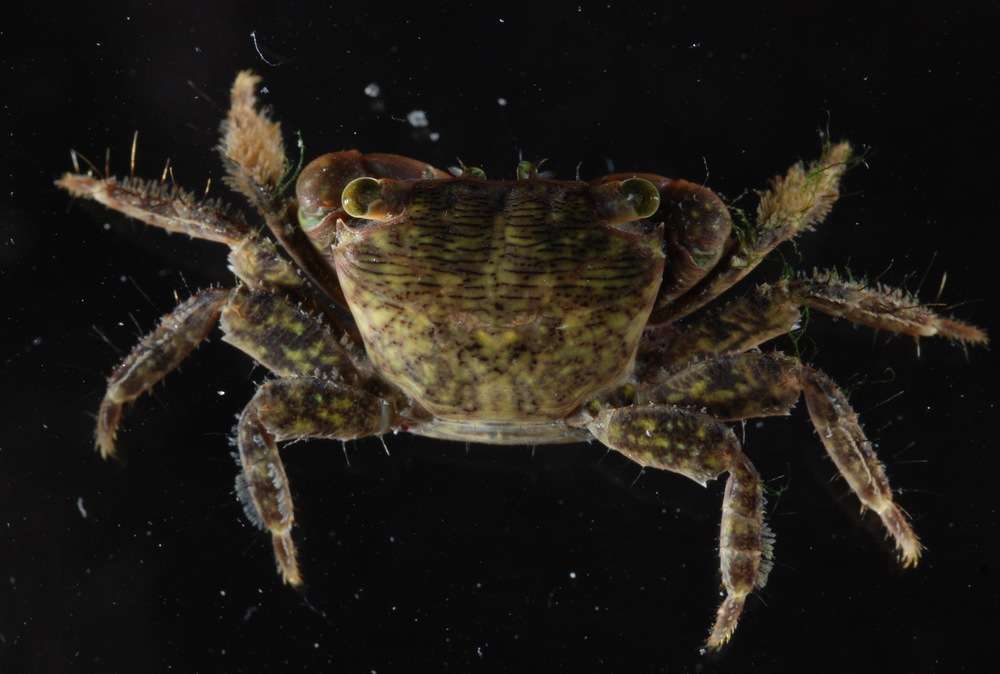
Encyclopedia of Life · EOL (see source)
Grapsoidea
Sign in to saveThe Grapsoidea are a superfamily of crabs; they are well known and contain many taxa which are terrestrial (land-living), semiterrestrial (taking to the sea only for reproduction), or limnic (living in fresh water). Another well-known member with a more conventional lifestyle is the Chinese mitten crab, Eriocheir sinensis.
Species
イワガニ上科
Superfamily
- PhylumArthropoda
- ClassMalacostraca
- OrderDecapoda
Eriocheir sinensis, Elbe, Deutschland Chiromantes haematocheir Hemigrapsus tokanoi, Niederlande Die Grapsoidea sind eine Überfamilie von Krebstieren aus der Teilordnung der Krabben (Brachyura) in der Ordnung der Zehnfußkrebse (Decapoda). Sie leben semiaquatisch (halb an Land, halb im Wasser) sowohl an Süßgewässern wie auch am Meer. Sie kommen hauptsächlich in den Tropen vor, nur wenige Arten leben auch in gemäßigten Breiten. Systematik Gemäß dem Integrated Taxonomic Information System (ITIS) besteht die Überfamilie der Grapsoidea aus sechs Familien.[1] Innerhalb dieser Einteilung sind jedoch nur die Familien Grapsidae, Sesarmidae und Varunidae monophyletisch. Innerhalb der Sesarmidae sind die Gattungen Chiromantes und Parasesarma wahrscheinlich nicht monophyletisch.[2] Gecarcinidae, Landkrabben Cardisoma Cardisoma armatum, Harlekinkrabbe Discoplax Epigrapsus Gecarcinus Gecarcoidea Gecarcoidea natalis, Weihnachtsinsel-Krabbe Johngarthia Glyptograpsidae Glyptograpsus Grapsidae, Quadratkrabben Geograpsus Goniopsis Grapsus Leptograpsus Metopograpsus Pachygrapsus Planes Plagusiidae Euchirograpsus Percnon Plagusia Sesarmidae Aratus Armases Chiromanntes Clistocoeloma Episesarma Geosesarma
via
Wikidata facts
- Instance of
- taxon
- Parent taxon
- Thoracotremata
- Image
- Pachygrapsus mammoratus (5).JPG
Show 5 more facts
- Commons category
- Grapsoidea
- topic's main category
- Category:Grapsoidea
- taxon name
- Grapsoidea
- taxon rank
- superfamily
- taxon common name
- イワガニ上科
Sources (1)
via Wikidata · CC0
~1 min read
Encyclopedic overview
1 sectionsContents
- References
The Grapsoidea are a superfamily of crabs; they are well known and contain many taxa which are terrestrial (land-living), semiterrestrial (taking to the sea only for reproduction), or limnic (living in fresh water). Another well-known member with a more conventional lifestyle is the Chinese mitten crab, Eriocheir sinensis.
The delimitation of the Grapsidae and Plagusiidae is in need of revision; the latter at least is not monophyletic. The same apparently holds true for several genera in the Sesarmidae.
Excerpted from Wikipedia’s “Grapsoidea” article, available under the CC BY-SA 4.0 licence.