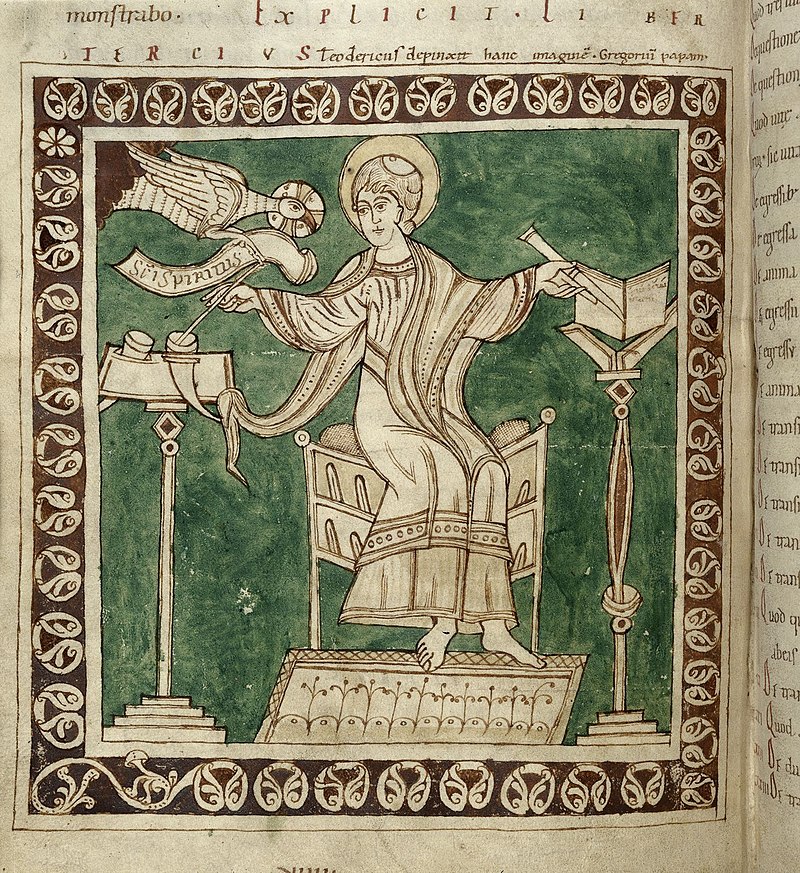
File:Gregory_the_Great_with_the_Holy_Spirit.jpg · Wikimedia Commons · See Wikimedia Commons
Gregory I
Sign in to saveAlso known as Pope Gregory I, Saint Gregory the Great, St. Gregory the Dialogist, Gregory, Gregory the Great, St Gregory, Saint Gregory, Pope St. Gregory I
64th Bishop of Rome, Head of the Roman Catholic Church from 590 to 604
OverviewAI-generated
Gregory I, also known as Gregorius PP. I, was a male Pope and Doctor of the Church. Born in Rome on November 30, 540, to Saint Silvia and the Anicia gens, he served as a diplomat, Latin Catholic priest, and writer. He was a member of the Benedictines and adhered to the Catholic Church, speaking Latin. His notable works include *Pastoral Care* and *Moralia in Job*.
He died in Rome on March 12, 604, and is buried in St. Peter's Basilica. Gregory I is recognized as a saint with feast days on March 12, March 25, and September 3. His writings, such as *Sancti Gregorii magni, Romani Pontificis* and *Dialogorum libri quattuor*, are described in sources including the *Nordisk familjebok* and the *Jewish Encyclopedia of Brockhaus and Efron*. He is included in the Popes collection.
Synthesized by Vinony from 29 facts across 4 sources: Wikidata, Open Library, Europeana Sparql, Vinony collections. Generated from structured data (not the Wikipedia text) and checked against those facts — may still contain errors.
Person · Open Library
- Born
- ca. 540
- Died
- 604
- Works
- 187
Top works
- Sancti Gregorii magni, Romani Pontificis
- Pastoralis cure liber diui Gregorii pape. In sole aureo vici sancti Jacobi Parnhisiis venalis habetur
- La regola pastorale
- Dialogorum libri quattuor
- 對話
via Open Library + Wikidata
Wikidata facts
- Instance of
- human
- Gender
- male
- Place of birth
- Rome
- Place of death
- Rome
- Mother
- Saint Silvia
- Occupation
- writer
- Languages spoken
- Latin
- Religion
- Catholic Church
- Family
- Anicia gens
- Image
- Pope Gregory I illustration.jpg
- Work location
- Rome
- Residence
- Rome
- Religious order
- Benedictines
Show 20 more facts
- Commons category
- Gregorius I Magnus
- date of birth
- 0540-00-00
- date of death
- 0604-03-12
- canonization status
- saint
- Commons Creator page
- Gregorius I Magnus
- described by source
- Wikitólica
- topic's main category
- Category:Pope Gregory I
- place of burial
- St. Peter's Basilica
- name in native language
- Gregorius PP. I
- honorific prefix
- Doctor of the Church
- feast day
- September 3
- P6482
- Gregory I
- has works in the collection
- J. Paul Getty Museum
- diocese
- Diocese of Rome
- writing language
- Latin
- on focus list of Wikimedia project
- Wikipedia:Vital articles/Level/4
- name
- pape Grégoire
- P13311
- Afghanistan
- subject has role
- Pope
Sources (12)
via Wikidata · CC0
Works in European collections
36 objects attributed to Gregory I, held across European museums, libraries & archives · via Europeana

Heid. Hs. 3298,30

Homiliar, Fragment

Theologische Sammelhandschrift

Moralia sive Expositio in Iob. Libri I-XIX

Moralia sive Expositio in Iob. Libri XXI-XXXV
In expositionem Iob moralium libri XXIII-XXXV - Cod. Aug. pap. 66
Moralia in expositione Iob, pars III (libb. 11-16) - Cod. Aug. perg. 3
Gregorii M. expositio euangeliorum - Cod. Aug. perg. 259
Gregorii M. in Euangelia liber II - Cod. Aug. perg. 200
Gregorii M. homiliae in Evangelia - Cod. Aug. perg. 145
Liber regulae pastoralis - Cod. Aug. perg. 240
Dialogorum libri IV. Fragmentum [II 3, 8, 35; III 4, 7, 13-20, 24-28]
Moralia, bierna Expositio w Iob. Libri XVIII-XXXV

Dialogorum libri IV
Moralia sive Expositio in Iob. Libri XIX-XXXV

Sermones in Psalmum XC. Excerpta

Moralia sive Expositio in Iob. Libri I-V

Textus varii

Moralia. Libri I-XVI
Omelias that I fix the blessed Sant Gregorio (...) on the book of the holy Propheta Ezechiel [Manuscript]
Ms 9916-17, Gregorius Magnus, Dialogi, fol. 36: Saint Benedict makes a lost sickle emerge from the water
Ms 9916-17, Gregorius Magnus, Dialogi, fol. 65v: Exorcism of a house by Saint Datian, Bishop of Milan
Ms 9916-17, Gregorius Magnus, Dialogi, fol. 48: Two distinguished nuns are punished for their high courage
Ms 9916-17, Gregorius Magnus, Dialogi, fol. 84: Der heilige Quadragesimus erweckt einen Toten
Ms 9916-17, Gregorius Magnus, Dialogi, fol. 20: The beggar at the table of Saint Boniface of Ferento is killed by a stone
Ms 9916-17, Gregorius Magnus, Dialogi, fol. 52: Ein Gefäß füllt sich wunderbarerweise mit Öl
Ms 9916-17, Gregorius Magnus, Dialogi, fol. 30: Saint Benedict repairs the sieve of his Amme by miracle
Ms 9916-17, Gregorius Magnus, Dialogi, fol. 54v: Saint Benedict raising a peasant’s son
Ms 9916-17, Gregorius Magnus, Dialogi, fol. 46: Two monks complain before Saint Benedict about the famine in the area
Ms 9916-17, Gregorius Magnus, Dialogi, fol. 86: The monk Benedict is put into the oven by the soldiers of Totilas
Ms 9916-17, Gregorius Magnus, Dialogi, fol. 23v: Saint Fortunatus, bishop of Tudertum, (Todi) healing an obsessed
Ms 9916-17, Gregorius Magnus, Dialogi, fol. 71: Der heilige Sabinus, Bischof von Piacenza, beendet die Überschwemmung des Po
Ms 9916-17, Gregorius Magnus, Dialogi, fol. 87v: The devil attaches the shoes to the priest Stephan
Ms 9916-17, Gregorius Magnus, Dialogi, fol. 40v: Two repentant monks before Saint Benedict
Ms 9916-17, Gregorius Magnus, Dialogi, fol. 45: Surrender of one of two vessels by exhilaratus to Saint Benedict; in the other there was a serpent
Ms 9916-17, Gregorius Magnus, Dialogi, fol. 49v: Saint Benedict makes the body of a young monk come to rest
~40 min read
Encyclopedic overview
Pope Gregory I (Latin: Gregorius I; Gregorio I; c. 540 – 12 March 604), commonly known as Saint Gregory the Great (Latin: Sanctus Gregorius Magnus; Italian: San Gregorio Magno), was the 64th Bishop of Rome from 3 September 590 until his death on 12 March 604.
A Roman senator's son, and himself the prefect of Rome at 30, Gregory lived in a monastery that he established on his family estate before becoming a papal ambassador and then pope. During his papacy, his administration greatly surpassed that of the emperors Maurice and Theodosius in improving the welfare of the people of Rome. Gregory regained papal authority in Spain and France and sent missionaries to England, including Augustine of Canterbury and Paulinus of York. The realignment of barbarian allegiance to Rome from their Arian Christian alliances shaped medieval Europe. Gregory saw Franks, Lombards, and Visigoths align with Rome in religion. He also combated the Donatist heresy, popular particularly in North Africa at the time.
Excerpted from Wikipedia’s “Gregory I” article, available under the CC BY-SA 4.0 licence.
Gallery (11)
Available in 94 languages
- Español
- Français
- Deutsch
- 中文
- 日本語
- Русский
- Português
- Italiano
- العربية
- हिन्दी
- Afrikaans
- Albanian
- Albanian
- Armenian
- Asturian
- Azerbaijani
- Bahasa Indonesia
- Basque
Show 75 more
- Bavarian
- be_x_old
- Belarusian
- Bikol
- Breton
- Bulgarian
- Catalan
- cdo
- Cebuano
- Corsican
- Croatian
- Czech
- Danish
- Egyptian Arabic
- Esperanto
- Estonian
- Faroese
- Filipino
- Finnish
- Galician
- Georgian
- Greek
- Hakka Chinese
- Hebrew
- Hungarian
- Ido
- Iloko
- Irish
- Javanese
- Latin
- Latvian
- Ligurian
- Lithuanian
- Lombard
- Low German
- Macedonian
- Malagasy
- Malay
- Malayalam
- Marathi
- Mazanderani
- Nederlands
- Norwegian
- Norwegian Nynorsk
- Occitan
- Old English
- Polski
- Quechua
- Romanian
- Rusyn
- Sardinian
- Serbian
- Serbian (Latin)
- Sicilian
- simple
- Slovak
- Slovenian
- Svenska
- Swahili
- Tamil
- Tiếng Việt
- Türkçe
- Ukrainian
- Urdu
- Venetian
- Waray
- Welsh
- Wu Chinese
- Yoruba
- Zaza
- zh_min_nan
- zh_yue
- فارسی
- ไทย
- 한국어
via Wikidata sitelinks · CC0