
guqin
Sign in to saveAlso known as qin, Chinese psaltery, Chinese zither, kin, kine, 5-string zither, 7-string zither, lyre
Key facts
- Instrument.name
- Guqin
- Instrument.image
- ZhongNiShi.jpg
- Instrument.background
- string
- Instrument.names
- qin, ku-ch'in, qixian-qin
- Instrument.classification
- String
- Instrument.hornbostel_sachs
- 312.22
- Instrument.hornbostel_sachs_desc
- heterochord half-tube zither
- Instrument.developed
- 1st millennium BC or earlier
- Instrument.volume
- quiet
- Instrument.related
- Ichigenkin, geomungo
- Instrument.musicians
- See below
- Intangible heritage.ICH
- Guqin and its music
- Intangible heritage.State Party
- China
- Intangible heritage.ID
- 61
- Intangible heritage.Region
- Asia-Pacific region
- Intangible heritage.Year
- 2003
- Intangible heritage.Session
- 3rd
- Intangible heritage.List
- Representative
via Wikipedia infobox
Described at
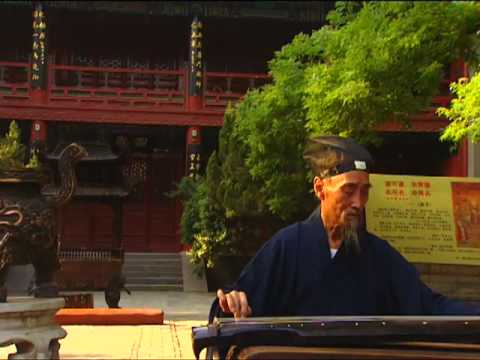
Guqin and its music - UNESCO Intangible Cultural Heritage
ich.unesco.org →The Chinese zither, called guqin, has existed for over 3,000 years and represents China’s foremost solo musical instrument tradition. Described in early literary sources and corroborated by archaeological finds, this ancient instrument is inseparable from Chinese intellectual history. Guqin playing developed as an elite art form, practised by noblemen and scholars in intimate settings, and was therefore never intended for public performance. Furthermore, the guqin was one of the four arts – along with calligraphy, painting and an ancient form of chess – that Chinese scholars were expected to master. According to tradition, twenty years of training were required to attain proficiency. The guqin has seven strings and thirteen marked pitch positions. By attaching the strings in ten different ways, players can obtain a range of four octaves. The three basic playing techniques are known as san (open string), an (stopped string) and fan (harmonics). San is played with the right hand and involves plucking open strings individually or in groups to produce strong and clear sounds for important notes. To play fan, the fingers of the left hand touch the string lightly at positions determined by the inlaid markers, and the right hand plucks, producing a light floating overtone. An is also played with both hands: while the right hand plucks, a left-hand finger presses the string firmly and may slide to other notes or create a variety of ornaments and vibratos. Nowadays, there are fewer than one thousand well-trained guqin players and perhaps no more than fifty surviving masters. The original repertory of several thousand compositions has drastically dwindled to a mere hundred works that are regularly performed today.
Excerpt from a page describing this subject · 6,500 chars · not written by Vinony
Wikidata facts
- Country of origin
- China
- Image
- ZhongNiShi.jpg
Show 6 more facts
- Hornbostel-Sachs classification
- 312.22
- Commons gallery
- 古琴
- Commons category
- Guqin
- topic's main category
- Category:Guqin
- described at URL
- ich.unesco.org/es/RL/00061
- intangible cultural heritage status
- Masterpieces of the Oral and Intangible Heritage of Humanity
Sources (3)
via Wikidata · CC0
~38 min read
Encyclopedic overview
30 sectionsContents
- History
- Schools, societies and players
- Historical schools
- Guqin societies
- Players
- Historical
- Contemporary
- Performance
- Playing technique
- Tablature and notation
- Repertoire
- Transcription
- Rhythm in qin music
- Organology
- Construction
- Strings
- Tuning
- Playing context
- Ritual use of the qin
- Qin aesthetics
- In popular culture
- Electric guqin
- Related instruments
- See also
- Footnotes
- References
- In Chinese
- Qinpu
- In English
- External links
The guqin (; ) is a plucked seven-string Chinese musical instrument. It has been played since ancient times, and has traditionally been favoured by scholars and literati as an instrument of great subtlety and refinement, as highlighted by the quote "a gentleman does not part with his qin or se without good reason," as well as being associated with the ancient Chinese philosopher Confucius. It is sometimes referred to by the Chinese as "the father of Chinese music" or "the instrument of the sages". The guqin is not to be confused with the guzheng, another Chinese long stringed instrument also without frets, but with moveable bridges under each string.
Traditionally, the instrument was simply referred to as the "qin" () but by the twentieth century the term had come to be applied to many other musical instruments as well: the yangqin hammered dulcimer, the huqin family of bowed string instruments, and the Western piano (gangqin ()) and violin (xiaotiqin ()) are examples of this usage. The prefix "gu-" (; meaning "ancient") was later added for clarification. Thus, the instrument is called "guqin" today. It can also be called qixian-qin (; lit. "seven-stringed qin"). Because Robert Hans van Gulik's book about the qin is called The Lore of the Chinese Lute, the guqin is sometimes inaccurately called a lute. Other incorrect classifications, mainly from music compact discs, include "harp" or "table-harp".
Excerpted from Wikipedia’s “guqin” article, available under the CC BY-SA 4.0 licence.
Gallery (34)
Available in 34 languages
- Español
- Français
- Deutsch
- 中文
- 日本語
- Русский
- Português
- Italiano
- العربية
- Azerbaijani
- Bahasa Indonesia
- Basque
- Catalan
- Esperanto
- Gan Chinese
- Hungarian
- Malay
- Nederlands
Show 15 more
via Wikidata sitelinks · CC0