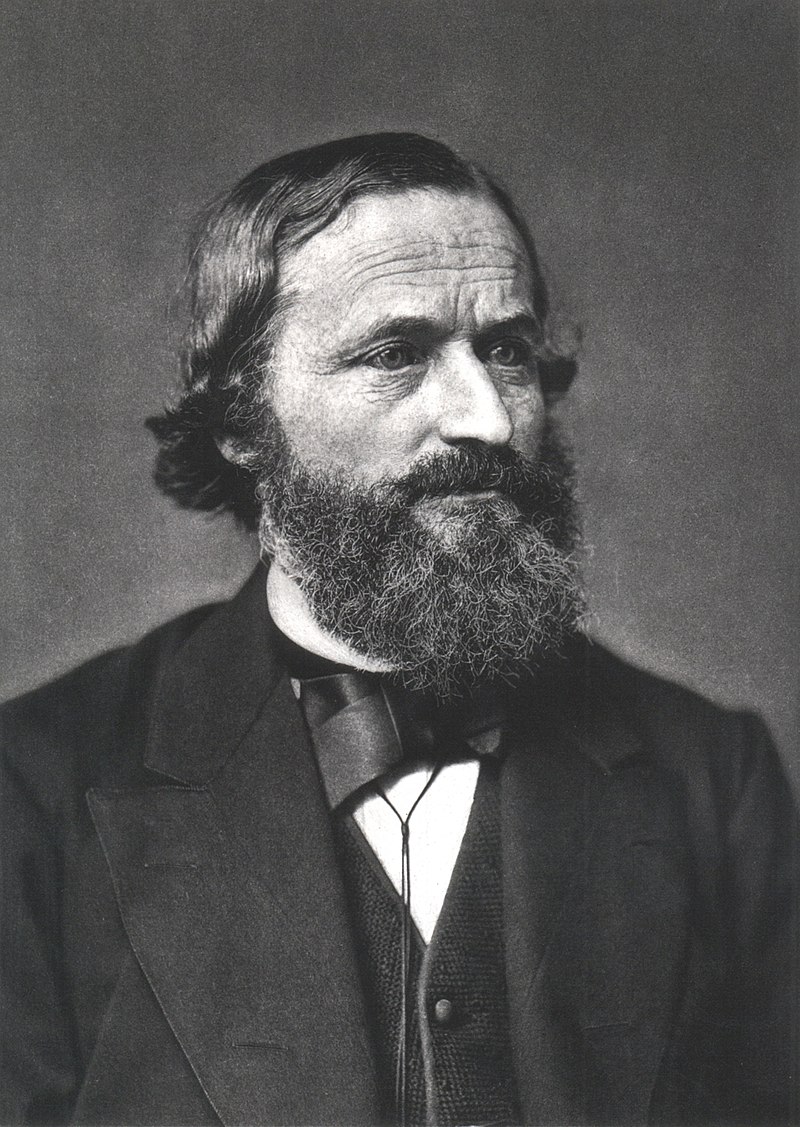
File:Gustav_Robert_Kirchhoff.jpg · Wikimedia Commons · See Wikimedia Commons
Gustav Kirchhoff was a German physicist who made important discoveries about how electricity flows through circuits and how materials emit light. His work laid crucial groundwork for understanding electrical systems and spectroscopy, which are fundamental to modern technology and science.
AI-generated from the Wikipedia summary — may contain errors.
Wikidata facts
- Instance of
- human
- Given name
- Gustav
- Family name
- Kirchhoff
- Gender
- male
- Citizenship
- Kingdom of Prussia
- Place of birth
- Königsberg
- Place of death
- Berlin
- Occupation
- mathematician
- Educated at
- Kneiphof Gymnasium
- Languages spoken
- German
- Doctoral advisor
- Friedrich Julius Richelot
- Doctoral student
- Arthur Schuster
- Field of work
- mechanics
- Image
- Gustav Robert Kirchhoff.jpg
Show 12 more facts
- Commons category
- Gustav Robert Kirchhoff
- member of
- Accademia Nazionale dei Lincei
- date of birth
- 1824-03-12
- date of death
- 1887-10-17
- Commons gallery
- Gustav Robert Kirchhoff
- student
- Dmitry Lachinov
- place of burial
- Alter St.-Matthäus-Kirchhof Berlin
- topic's main category
- Category:Gustav Kirchhoff
- P8168
- Stripa
- name in native language
- Gustav Robert Kirchhoff
- on focus list of Wikimedia project
- Wikipedia:Vital articles/Level/4
- maintained by WikiProject
- WikiProject Mathematics
Sources (6)
via Wikidata · CC0
~9 min read
Encyclopedic overview
Gustav Robert Kirchhoff ( German: [ˈgʊstaːf ˈʁoːbɛʁt ˈkɪʁçhɔf]; 12 March 1824 – 17 October 1887) was a German physicist and mathematician who contributed to the fundamental understanding of electrical circuits, spectroscopy, and the emission of black-body radiation by heated objects. He coined the term black body in 1860.
Several different sets of concepts are named "Kirchhoff's laws" after him, which include Kirchhoff's circuit laws, Kirchhoff's law of thermal radiation, Kirchhoff's diffraction formula, and Kirchhoff's law of thermochemistry.
Excerpted from Wikipedia’s “Gustav Kirchhoff” article, available under the CC BY-SA 4.0 licence.
Gallery (3)
Available in 85 languages
- Español
- Français
- Deutsch
- 中文
- 日本語
- Русский
- Português
- Italiano
- العربية
- हिन्दी
- Albanian
- Armenian
- Asturian
- azb
- Azerbaijani
- Bahasa Indonesia
- Bangla
- Basque
Show 66 more
- be_x_old
- Belarusian
- Bosnian
- Bulgarian
- Burmese
- Catalan
- Croatian
- Czech
- Danish
- Egyptian Arabic
- Esperanto
- Estonian
- Filipino
- Finnish
- Galician
- Georgian
- Greek
- Haitian Creole
- Hebrew
- Hungarian
- Ido
- Irish
- Javanese
- Kannada
- Kazakh
- Latin
- Latvian
- Lithuanian
- Luxembourgish
- Macedonian
- Malagasy
- Malay
- Malayalam
- Marathi
- Mingrelian
- Nederlands
- Norwegian
- Norwegian Nynorsk
- Odia
- Polski
- Romanian
- Scots
- Scottish Gaelic
- Serbian
- Serbian (Latin)
- simple
- Sinhala
- Slovak
- Slovenian
- Sundanese
- Svenska
- Swahili
- Tamil
- Tatar
- Tiếng Việt
- Türkçe
- Ukrainian
- Urdu
- Uzbek
- Waray
- Western Panjabi
- Wu Chinese
- zh_yue
- فارسی
- ไทย
- 한국어
via Wikidata sitelinks · CC0