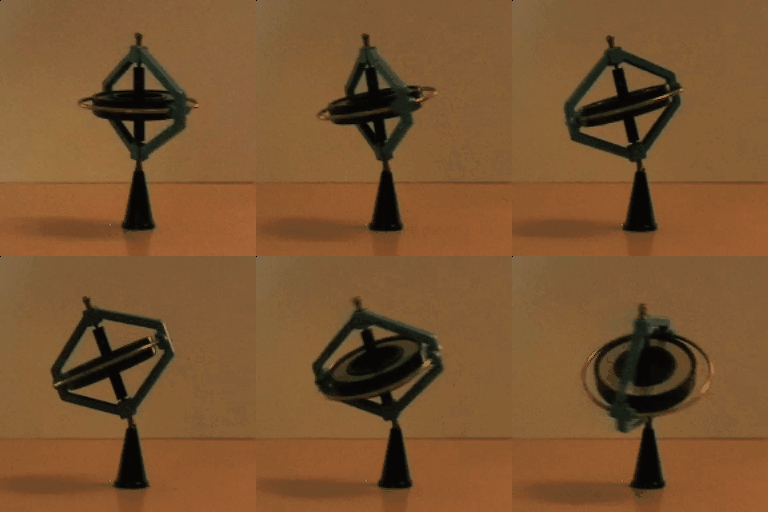
File:Gyro.gif · Wikimedia Commons · See Wikimedia Commons
mechanics
Sign in to savethumb|right|A gyroscope in equilibrium
Mechanics is the branch of physics that studies how objects move and the forces that cause those movements. It matters because understanding mechanics helps us predict and explain the behavior of everything from spinning tops and gyroscopes to cars, planets, and other objects in motion.
AI-generated from the Wikipedia summary — may contain errors.
Research
909,952 papers- The role of mechanics in biological and bio-inspired systems.ReviewNature communications · 2015Egan P, Sinko R, LeDuc PR et al.DOI: 10.1038/ncomms8418
- Thermodynamics and mechanics of membrane curvature generation and sensing by proteins and lipids.ReviewAnnual review of physical chemistry · 2011Baumgart T, Capraro BR, Zhu C et al.DOI: 10.1146/annurev.physchem.012809.103450
- Fluid mechanics of electroosmotic flow and its effect on band broadening in capillary electrophoresis.ReviewElectrophoresis · 2004Ghosal SDOI: 10.1002/elps.200305745
- Building a functional artery: issues from the perspective of mechanics.ReviewFrontiers in bioscience : a journal and virtual library · 2004Gleason RL, Hu JJ, Humphrey JDDOI: 10.2741/1387
- Control of chaos: methods and applications in mechanics.ReviewPhilosophical transactions. Series A, Mathematical, physical, and engineering sciences · 2006Fradkov AL, Evans RJ, Andrievsky BRDOI: 10.1098/rsta.2006.1826
- Progress on mechanics of carbon nanotubes and derived materials.ReviewJournal of nanoscience and nanotechnology · 2006Salvetat JP, Bhattacharyya S, Pipes RBDOI: 10.1166/jnn.2006.305
- New developments in applying quantum mechanics to proteins.ReviewCurrent opinion in structural biology · 2001Gogonea V, Suárez D, van der Vaart A et al.DOI: 10.1016/s0959-440x(00)00193-7
- The specificity enigma: from mechanics to poems.ReviewRivista di biologia · 2006Neuman Y
via PubMed
Wikidata facts
- Instance of
- branch of physics
- Subclass of
- physics
- Part of
- physics
Show 9 more facts
- topic's main Wikimedia portal
- Portal:Mechanics
- Commons category
- Mechanics
- topic's main category
- Category:Mechanics
- studied by
- engineering
- native label
- μηχανική
- practiced by
- mechanician
- title
- μηχανική
- described by source
- Encyclopædia Britannica 11th edition
- on focus list of Wikimedia project
- Wikipedia:Vital articles/Level/4
Sources (3)
via Wikidata · CC0
~15 min read
Encyclopedic overview
15 sectionsContents
- History
- Antiquity
- Medieval age
- Early modern age
- Modern age
- Types of mechanical bodies
- Sub-disciplines
- Classical
- Quantum
- Relativistic
- Professional organizations
- See also
- References
- Further reading
- External links
thumb|right|A gyroscope in equilibrium
Mechanics () is the area of physics concerned with the relationships between force, matter, and motion among physical objects. Forces applied to objects may result in displacements, which are changes of an object's position relative to its environment.
Excerpted from Wikipedia’s “mechanics” article, available under the CC BY-SA 4.0 licence.
Gallery (11)
Available in 109 languages
- Español
- Français
- Deutsch
- 中文
- 日本語
- Русский
- Português
- Italiano
- العربية
- हिन्दी
- Afrikaans
- Albanian
- Armenian
- Asturian
- azb
- Azerbaijani
- Bahasa Indonesia
- Bangla
Show 90 more
- Bashkir
- Basque
- be_x_old
- Belarusian
- Bhojpuri
- Bosnian
- Bulgarian
- Burmese
- Catalan
- Central Kurdish
- Chechen
- Chuvash
- Croatian
- Czech
- Danish
- Esperanto
- Estonian
- Extremaduran
- Fijian
- Filipino
- Finnish
- Galician
- Georgian
- Greek
- Hebrew
- Hungarian
- hyw
- Ido
- Interlingua
- Irish
- Javanese
- Kara-Kalpak
- Kazakh
- Khmer
- Kurdish
- Kyrgyz
- Latin
- Latvian
- Lithuanian
- Lombard
- Luxembourgish
- Macedonian
- Malayalam
- Marathi
- Mazanderani
- Mingrelian
- Mongolian
- Nederlands
- Northern Frisian
- Norwegian
- Norwegian Nynorsk
- Occitan
- Pashto
- Piedmontese
- Polski
- Punjabi
- rki
- Romanian
- Saterland Frisian
- Serbian
- Serbian (Latin)
- simple
- Sindhi
- Sinhala
- Slovak
- Slovenian
- Swahili
- Tachelhit
- Tajik
- Tamil
- Tatar
- Telugu
- Tetum
- Tibetan
- Tiếng Việt
- Türkçe
- Ukrainian
- Urdu
- Uzbek
- Waray
- Welsh
- Wolof
- Wu Chinese
- Yakut
- Yiddish
- zh_min_nan
- zh_yue
- فارسی
- ไทย
- 한국어
via Wikidata sitelinks · CC0