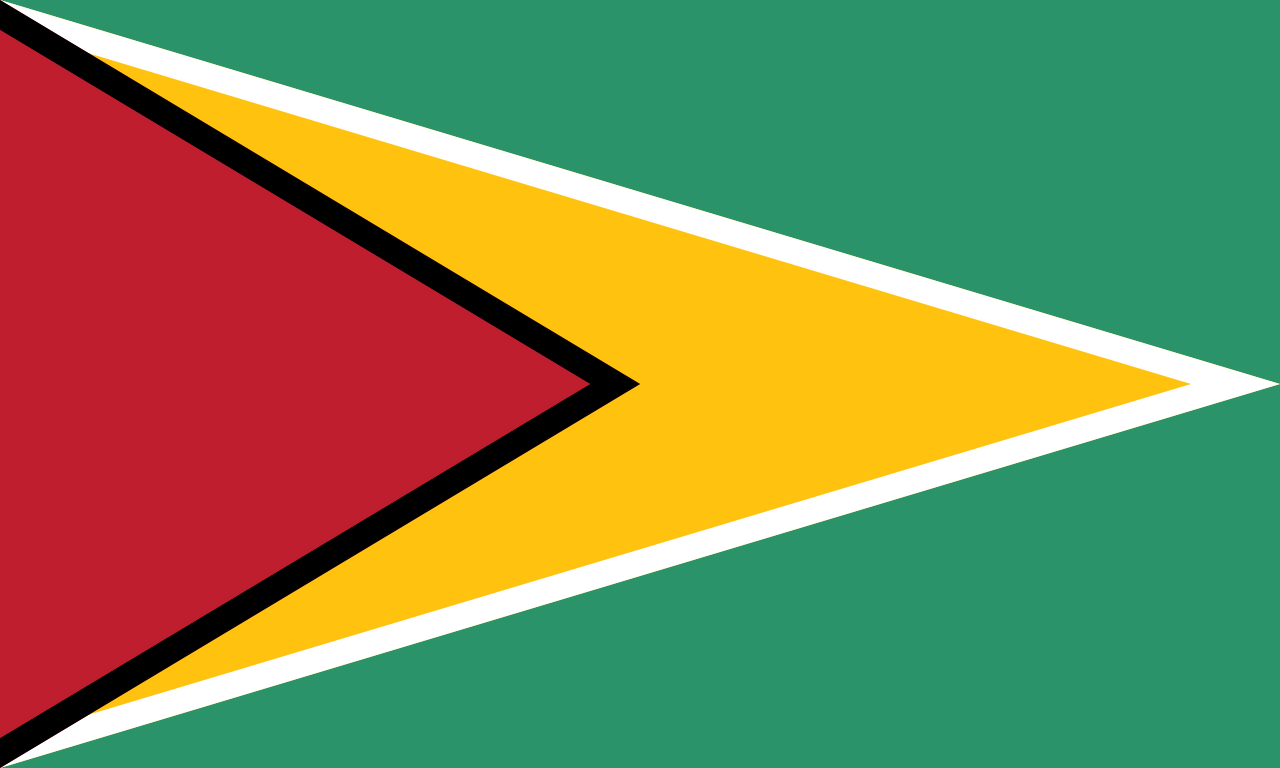
Guyana
Sign in to saveAlso known as Co-operative Republic of Guyana, gy, Republic of Guyana, GUY
Guyana, officially the Co-operative Republic of Guyana, is a developing country on the northern coast of South America. It is bordered by the Atlantic Ocean to the north, Suriname to the east, Brazil to the south and southwest, and Venezuela to the west. It is part of The Guianas. The capital and largest city is Georgetown.
OverviewAI-generated
Guyana is a sovereign state and country located in South America. Its official name is the Co-operative Republic of Guyana. The capital city is Georgetown. The country shares borders with Brazil, Suriname, and Venezuela. English is the official language, and the currency is the Guyanese dollar. The top-level Internet domain is .gy.
The population is reported as 772,975 and 831,087. The area covers 214,969 square units. Forest area comprises 87.0878369802027 percent of the land. The highest point is Mount Roraima. Guyana is a member of the United Nations, Union of South American Nations, Commonwealth of Nations, and World Trade Organization. The head of state has included David A. Granger, Donald Ramotar, and Irfaan Ali.
Synthesized by Vinony from 67 facts across 9 sources: Wikidata, Open Meteo, Openweathermap, REST Countries, World Bank, OpenStreetMap, PubMed, Vinony graph, Geo. Generated from structured data (not the Wikipedia text) and checked against those facts — may still contain errors.
Weather now
7-day forecast
via Open-Meteo
Country
- Capital
- Georgetown
- Population
- 772,975
- Region
- Americas · South America
- Demonym
- Guyanese
- Currencies
- GYD ($)
- Languages
- English
- Calling code
- +592
- Drives on
- Left
- Gini
- 45.1 (1998)
- FIFA code
- GUY
- TLD
- .gy
- Timezones
- UTC-04:00
- Borders
- BRA, SUR, VEN
via REST Countries
Indicators · World Bank
- GDP
- $24.7B(2024)
- Population
- 831,087(2024)
- Life expectancy
- 70.3 yrs(2024)
- Unemployment
- 12 %(2025)
- Urban population
- 26.5 %(2024)
- Internet users
- 83 %(2024)
- Forest area
- 87.1 %(2023)
- Renewable energy
- 12.1 %(2022)
via World Bank Open Data · CC BY 4.0
Wikipedia views (30d)
170,232 totalvia Wikimedia Pageviews API
Key facts
- Country.conventional_long_name
- Co-operative Republic of Guyana
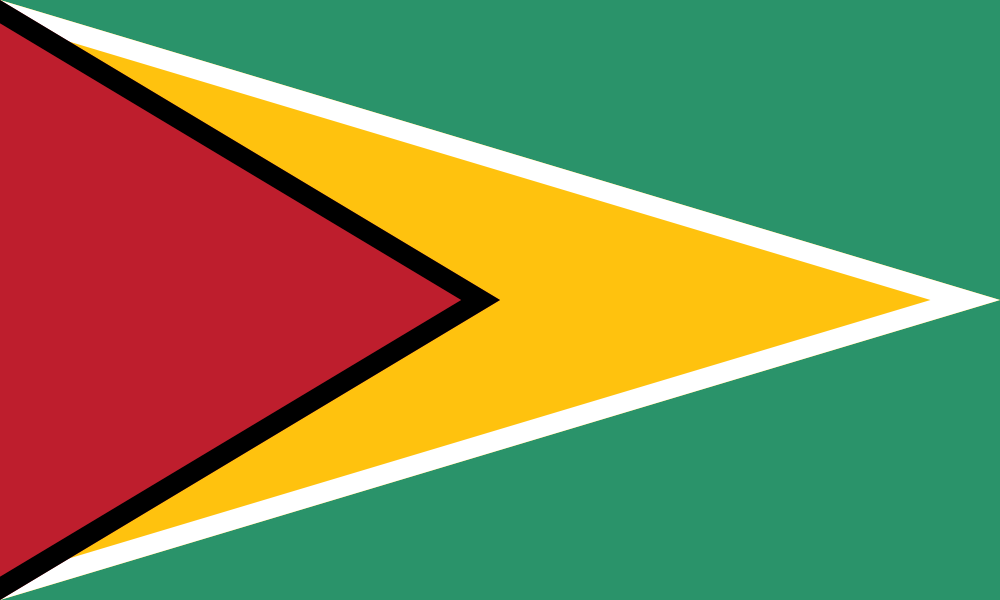
- Country.image_flag
- Flag of Guyana.svg
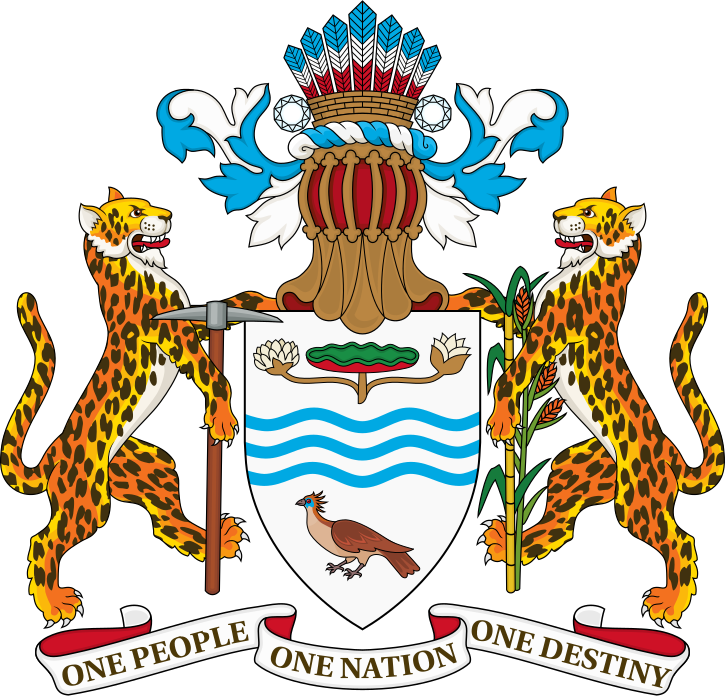
- Country.image_coat
- Coat of Arms of Guyana (relief).svg
- Country.common_name
- Guyana
- Country.national_motto
- "One People, One Nation, One Destiny"
- Country.national_anthem
- "Green Land of Guyana"
- Country.image_map
- Guyana (orthographic projection).svg
- Country.map_caption
- Location of South America in grey
- Country.capital
- Georgetown
- Country.largest_city
- capital
- Country.official_languages
- English
- Country.languages_type
- Vernacular language
- Country.languages
- Guyanese Creole
- Country.languages2_type
- Other languages
- Country.ethnic_groups_year
- 2012
- Country.religion_year
- 2024
- Country.demonym
- Guyanese
- Country.government_type
- Unitary parliamentary republic with an executive presidency
via Wikipedia infobox
Research
2,048 papers- The Guyana Program to Advance Cardiac Care: A Model for Equitable Cardiovascular Care Delivery.ReviewGlobal heart · 2023Klassen SL, Then K, Warnica JW et al.DOI: 10.5334/gh.1193
- Guyana.Department of State publication. Background notes series · 1985United States. Department of State. Bureau of Public Affairs
- The Rise in Cardiovascular Risk Factors and Chronic Diseases in Guyana: A Narrative Review.ReviewAnnals of global health · 2021Sockalingam L, Desai D, Wong A et al.DOI: 10.5334/aogh.3060
- Dengue in Guyana.Lancet (London, England) · 1999Palmer CJ, Validum L, Vorndam VA et al.DOI: 10.1016/s0140-6736(99)03078-0
- Black Scorpion (Tityus obscurus) Fatalities in Guyana and a Literature Review.ReviewThe Journal of emergency medicine · 2019Iserson KV, Jagit Ramcharran SDDOI: 10.1016/j.jemermed.2019.07.018
- Human-centered design process and solutions to promote malaria testing and treatment seeking behavior in Guyana hinterlands.ReviewBMC public health · 2021Yan SD, Simpson J, Mitchum L et al.DOI: 10.1186/s12889-021-12297-0
- Fruit and seed traits and vertebrate-fruit interactions of tree species occurring in Guyana, Suriname, and French Guiana.Ecology · 2023Vaessen RW, van Wijngaarden K, Boeschoten L et al.DOI: 10.1002/ecy.4165
- Guyana housecall.Canadian family physician Medecin de famille canadien · 2014Perry J
via PubMed
Wikidata facts
- Instance of
- country
- Official name
- Gajanos Kooperacinė Respublika
- Demonym
- Guánach
- Country
- Guyana
- Contains
- Upper Takutu-Upper Essequibo
- Continent
- South America
- Capital
- Georgetown
- Official language
- English language
- Currency
- Guyanese dollar
- Population
- 878674
- Area
- 214970
- Head of government
- Mark Phillips
- Head of state
- Irfaan Ali
- Form of government
- parliamentary republic
- Legislature
- National Assembly
- Shares border with
- Venezuela
- Highest point
- Mount Roraima
- Official website
- parliament.gov.gy
- Life expectancy
- 66
- Nominal GDP
- 15357537068
- Unemployment rate
- 11
- Calling code
- +592
- Licence plate code
- GUY
Show 58 more facts
- Electrical plug type
- BS 1363
- Mains voltage
- 240
- Motto
- Un Bobl, Un Cenedl, Un Tynged
- Flag
- flag of Guyana
- Coat of arms
- coat of arms of Guyana
- topic's main Wikimedia portal
- Portal:Guyana
- top-level Internet domain
- .gy
- Commons category
- Guyana
- topic's main category
- Category:Guyana
- Commons gallery
- Guyana
- category for people born here
- Category:Births in Guyana
- category for people who died here
- Category:Deaths in Guyana
- category of associated people
- Category:Guyanese people
- diplomatic relation
- Kosovo
- history of topic
- history of Guyana
- lowest point
- Atlantic Ocean
- mobile country code
- 738
- driving side
- left
- geography of topic
- Geography of Guyana
- age of majority
- 18
- marriageable age
- 18
- office held by head of government
- Prime Minister of Guyana
- office held by head of state
- President of Guyana
- water as percent of area
- 8.4
- native label
- Co-operative Republic of Guyana
- language used
- Berbice Creole Dutch
- number of out-of-school children
- 39197
- has characteristic
- free country
- located in/on physical feature
- Caribbean
- total fertility rate
- 2.558
- maritime identification digits
- 750
- on focus list of Wikimedia project
- Wikipedia:Vital articles/Level/4
- inception
- 1966-01-01
- Unicode character
- 🇬🇾
- central bank
- Bank of Guyana
- culture
- culture of Guyana
- category for maps or plans
- Category:East Berbice-Corentyne
- VAT rate
- 16
- replaces
- Commonwealth realm of Guyana
- economy of topic
- economy of Guyana
- demographics of topic
- demographics of Guyana
- different from
- French Guiana
- Democracy Index
- 6.25
- Human Development Index
- 0.714
- P11012
- Cape Agulhas
- hashtag
- Guyana
- Gini coefficient
- 45.1
- Inequality-adjusted Human Development Index
- 0.591
- P12749
- checkers
- birth rate
- 19.897
- male population
- 395982
- death rate
- 9.762
- rural population
- 590192
- female population
- 412743
- urban population
- 218534
- most populous urban area
- Georgetown
- Commonwealth Sport country code
- GUY
Sources (15)
via Wikidata · CC0
Travel guide
Understand
The name Guyana (from Arawak Wayana) means "Land of many waters."
Guyana mostly consists of rolling highlands with a low coastal plain and savannah in the south. The highest point is Mount Roraima with 2,835 m, at the border tripoint with Brazil and Venezuela.
Get in
thumb|375px|A map showing the visa requirements of Guyana, with countries in green having visa-free access, countries in light green having visa on arrival
Get around
thumbnail|Crossing Essequibo, the country's longest river When people in Guyana refer to buses, they mean minibuses. Minibuses travel throughout Guyana and are the cheapest way to travel. Minibus fares range from G$60-1,000 depending on the length of the journey. Travel in this mode at night could be risky.
Many parts of Guyana are separated by large rivers. These areas can be traversed by way of river taxi. Go to the port village and ask from where the speedboats launch. Ask other passengers what the fare is while travelling as boat operators tend to seek higher fees from tourists. Do not take "specials" without first negotiating the price.
Taxis are a good way to get around in Georgetown. Fares should never be more than G$500 for travel within the city and most fares should be around G$400. All taxi number plates begin with 'H.' There are set prices for taxis for different destinations, e.g. from the airport to town costs G$5,000, from the airport to Moleson Creek is G$24,000. From Ogle to downtown is G$1,500.
One can also rent cars or 4x4s; check the local telephone listings for car rentals. Consult more than one rental agency as prices can vary. You might also be able to negotiate the prices charged to some extent. Deposits are usually required. If renting a vehicle, be sure to inquire whether your driver's licence will be acceptable. Violations of traffic laws can result in much time wasted and possible trips to the local courts.
See
thumb|Kaieteur Falls Iwokrama Rainforest Reserve Jonestown Compound. A historic site near Port Kaituma. It is wise to have a local accompany you as the area is heavily forested and is easy to get lost in.
Do
Eco-Tourism is a booming industry in Guyana. Rainforest Jungle Excursions: Take a guided overnight trip starting with a boat trip down the maze of mahogany rivers to get to your overnight site. Stay in a classic thatched roof hut, with a mosquito net at night. Hike the Jungle trails and enjoy the jungle foods. Stop and visit an authentic inland Amerindian rainforest village. You may pass by locals who are taking their child to school by boat. There are a number of these tours. Watch cricket: Guyana Amazon Warriors in action in the Carribean Premier League.
Buy
There are numerous markets and shopping malls, in Guyana. Stabroek Market is a quaint market in Georgetown. Trips to the market for tourists are best done in groups or with a local with whom you feel comfortable. Muggings are possible but not frequent. thumbnail|Commerce at Stabroek Market in Georgetown Lots of locally made and beautiful crafts ranging from paintings; to sculpture; to leather purses, satchels, wallets; hand-painted, tie-dyed and batiked fabrics, pressed flowers, sun hats; semi-precious stones and hand-crafted costume jewellery using indigenous materials, can be purchased at an esplanade outside the Central Post-Office near the National Museum in downtown Georgetown. Ask around and you'll find out about the craft and gift shops as well as galleries.
Guyana is also noted for its exceptional gold jewellery.
Eat
thumbnail|Pepperpot, the national dish Guyanese food, like the entire country, is a creole fusion.
If there's a dominant cuisine, it is dishes influenced by the Indian subcontinent that have been localized. The most prominent of these are the curries, especially chicken, pork, beef, pumpkin and aubergine. Larger roti shops and those by the sea will have shrimp, crab and other seafood. Curries are traditionally served with roti, an Indian bread or rice.
The national dish of Guyana is pepperpot, a slow-cooked stew of pork (or other meats), red peppers (capsicum), cinnamon and casareep. It is dark in colour and strongly flavoured and usually reserved for special occasions such as Christmas, but you can find restaurants in Georgetown serving the dish all year round. Pepperpot is enjoyed with plain white bread or roti.
Chinese restaurants are common, with noodle dishes such as chow mein and lo mein along with meat and rice dishes. The growing Brazilian population have led to several outdoor BBQ restaurants and churrascarias opening in the capital and near the border in Lethem.
Georgetown has a greater variety of food options than elsewhere in the country, which include a couple of steakhouses, upmarket colonial dining, European fare and Indian food. In smaller towns, there may only be restaurants serving a creole menu of a few dishes, which almost always includes a curry or two and a noodle dish.
In jungle lodges, the food can be limited to tinned goods and rice, along with w…
Drink
The most popular national drink is Caribbean-style dark rum. Some national favourites are XM "10" Year OLD, produced by local beverage giant Banks DIH Limited and El Dorado and X-tra Mature which both offer 5-, 10-, 12- and 25-year varieties.
El Dorado also offers a 15-year-old variety which has won the "Best Rum in the World" award since 1999. Mix the cheaper ones with Coke or coconut water if you please. All are quality enough to drink neat or by themselves with the 25-year-olds comparing with high-quality scotch whisky.
Banks Beer produced by local beverage giant Banks DIH Limited is the National beer. It comes in a lager and a stout (Milk Stout). The beverage giant also bottles and distributes Heineken Beer and Guinness Stout under licence.
Also available are the lighter Carib (Trinidad and Tobago) and darker Mackeson's. Guinness is brewed locally under licence and is a bit sweeter than its Irish counterpart, but just as good. Polar (Venezuelan) and Skol (Brazilian) can be found throughout the country. You can also find Heineken and Corona at posher bars in Georgetown.
Sleep
thumbnail|Lodging in Surama, in the middle of the country
Georgetown has far and away the biggest range of options, but here there are a number of problems. None of the luxury options in the capital, primarily the Pegasus and the Princess, have the polish or charm to justify the hundreds of US dollars they charge. On the other end of the scale are a number of tiny guesthouses and pay-by-the-hour places with lower prices. The only backpacker option is the Tropicana Hostel, which is above a club with the slogan "All Nite Long": it's true. There are some good options in Georgetown, especially at the three- and four-star level, including the colonial option Cara Lodge and the Herdmanston Lodge. The rising Chinese and Brazilian populations in town may lead to better options.
In the interior there are some amazing jungle lodges and camps, including those at the ranches and the south and the community-supported ecolodges in the middle of the country. Other developing options are community supported huts in Amerindian towns on the Linden-Lethm road.
The adventurous could try to get by with a hammock and paying small fees to hang it up in a benab. This isn't an option in Georgetown and will involve some planning ahead, lots of bug spray and cunning to accomplish.
Some small towns have basic guesthouses, which may have fans, mosquito nets or other amenities.
Rainforest Jungle Excursions: Take a guided overnight trip starting with a boat trip down the maze of mahogany rivers to get…
Stay safe
thumbnail|View of [[Lethem in the south of the country]] Georgetown is notorious for petty street crime. Do not walk alone at night, or even in the day, unless you know the area well. Areas such as the Tiger Bay area east of Main Street and the entire southeastern part of the city including Albouystown and Ruimveldt are traditional high crime areas but one can be relatively safe in groups and with native escorts. Police are unlikely to help you unless they see the crime in action. Be sensible about wearing jewellery.
The interior regions with the breath-taking waterfalls, the beautiful rainforests and mountains are safe. Many rural areas around the country are filled with a friendly atmosphere and are safe. Crime is rarely directed at tourists, so don't feel intimidated. Just be sensible about the company you keep, where you go and how you behave.
"Sodomy" is punishable with a maximum sentence of life in prison. A local NGO reported that there were a few prosecutions, but neither the NGO nor the courts could provide numbers. It was reportedly more common for the police to use the law to intimidate suspected same-sex male partners. There are no laws concerning same-sex sexual activity between women. The health minister in a speech to a regional HIV/AIDS conference said that he “must be driven by public health reality,” that “sex between consenting adults in private falls into the category of personal freedom,” and that the law is “in contradiction of this expression of perso…
Travel guide from Wikivoyage (CC BY-SA 4.0)
~40 min read
Encyclopedic overview
44 sectionsContents
- Etymology
- History
- Before colonisation
- Colonial period
- Independence
- Geography
- Biodiversity and conservation
- Government and politics
- Politics
- Public procurement
- Administrative divisions
- Natural regions
- Essequibo conflict
- Foreign relations
- Boundary disputes
- Organisation of American States (OAS)
- Indigenous Leaders Summits of America (ILSA)
- Agreements which affect financial relationships
- The Double Taxation Relief (CARICOM) Treaty 1994
- FATCA
- Military
- LGBT rights
- Economy
- Summary
- Economic history
- Tax policy
- Transport
- Electricity
- Demographics
- Largest cities
- Languages
- Religion
- Health
- Education
- Culture
- Media
- Traditional Foods of Guyana
- Landmarks
- Sports
- See also
- Explanatory notes
- References
- Further reading
- External links
Guyana, officially the Co-operative Republic of Guyana, is a country on the northern coast of South America. It is bordered by the Atlantic Ocean to the north, Suriname to the east, Brazil to the south and southwest, and Venezuela to the west. It is part of The Guianas. The capital and largest city is Georgetown.
With a land area of 214,969 km (83,000 sq mi), Guyana is the third-smallest sovereign state by area in mainland South America after Uruguay and Suriname, and is the second-least populous sovereign state in South America after Suriname; it is also one of the least densely populated countries on Earth. The official language of the country is English, although a large part of the population is bilingual in English and the Indigenous languages. Guyana is the only country in mainland South America to have English as the official language. The majority of the population also speaks Guyanese Creole, which is an English-based creole. Guyana is part of the Commonwealth Caribbean. It is part of the mainland Caribbean region maintaining strong cultural, historical, and political ties with other Caribbean countries as well as serving as the headquarters for the Caribbean Community (CARICOM). In 2008, the country joined the Union of South American Nations as a founding member.
Excerpted from Wikipedia’s “Guyana” article, available under the CC BY-SA 4.0 licence.
Gallery (39)
On the map
4 mapped locations
Available in 243 languages
- Español
- Français
- Deutsch
- 中文
- 日本語
- Русский
- Português
- Italiano
- العربية
- हिन्दी
- Abkhazian
- Achinese
- Adyghe
- Afrikaans
- Albanian
- Albanian
- Amharic
- ami
Show 224 more
- Angika
- Aragonese
- Armenian
- Arpitan
- Asturian
- Awadhi
- Aymara
- azb
- Azerbaijani
- Bahasa Indonesia
- Balinese
- Bangla
- Bashkir
- Basque
- bat_smg
- Batak Toba
- Bavarian
- be_x_old
- Belarusian
- Betawi
- Bhojpuri
- Bikol
- Bishnupriya
- Bislama
- Bosnian
- Breton
- Bulgarian
- Buriat
- Burmese
- Catalan
- cbk_zam
- cdo
- Cebuano
- Central Kurdish
- Chechen
- Chuvash
- Cornish
- Corsican
- Crimean Tatar
- Croatian
- Czech
- dag
- Danish
- Divehi
- dty
- Egyptian Arabic
- Esperanto
- Estonian
- Ewe
- Extremaduran
- Faroese
- Fiji Hindi
- Filipino
- Finnish
- fiu_vro
- Fula
- Gagauz
- Galician
- gcr
- Georgian
- Gilaki
- Goan Konkani
- Gothic
- Greek
- Guarani
- Gujarati
- Haitian Creole
- Hakka Chinese
- Hausa
- Hawaiian
- Hebrew
- Hungarian
- Icelandic
- Ido
- Igbo
- Iloko
- Inari Sami
- Interlingua
- Interlingue
- Irish
- Jamaican Creole English
- Javanese
- Kabyle
- kai
- Kannada
- Kara-Kalpak
- Karachay-Balkar
- Kashmiri
- Kazakh
- Kikuyu
- Kinyarwanda
- Kongo
- Kurdish
- Kyrgyz
- Ladino
- Lao
- Latgalian
- Latin
- Latvian
- Ligurian
- Limburgish
- Lingala
- Lingua Franca Nova
- Lithuanian
- lld
- Lojban
- Lombard
- Low German
- Lower Sorbian
- Luxembourgish
- Macedonian
- Madurese
- Malagasy
- Malay
- Malayalam
- Maltese
- Manipuri
- Manx
- Māori
- map_bms
- Marathi
- Mari
- Mazanderani
- Minangkabau
- Mingrelian
- Moksha
- Mongolian
- Moroccan Arabic
- Navajo
- nds_nl
- Nederlands
- Nepali
- Newari
- Northern Frisian
- Northern Sami
- Norwegian
- Norwegian Nynorsk
- Novial
- nup
- Occitan
- Odia
- Old English
- olo
- Oromo
- Ossetic
- Pampanga
- Papiamento
- Pashto
- Piedmontese
- Polski
- Punjabi
- Quechua
- rki
- roa_rup
- Romanian
- Samoan
- Sanskrit
- Santali
- Sardinian
- Saterland Frisian
- Scots
- Scottish Gaelic
- Serbian
- Serbian (Latin)
- Shan
- Shona
- Sicilian
- Silesian
- simple
- Sindhi
- Sinhala
- Slovak
- Slovenian
- Somali
- Sranan Tongo
- Sundanese
- Svenska
- Swahili
- szy
- Tajik
- Tamil
- Taroko
- Tatar
- tay
- Telugu
- Tetum
- Tibetan
- Tiếng Việt
- Tok Pisin
- Toki Pona
- Tongan
- Tumbuka
- Türkçe
- Turkmen
- Udmurt
- Ukrainian
- Upper Sorbian
- Urdu
- Uyghur
- Uzbek
- Venetian
- Veps
- Volapük
- Walloon
- Waray
- Welsh
- West Flemish
- Western Frisian
- Western Mari
- Western Panjabi
- Wolof
- Wu Chinese
- Yakut
- Yiddish
- Yoruba
- Zaza
- Zeelandic
- zh_classical
- zh_min_nan
- zh_yue
- Zhuang
- فارسی
- ไทย
- 한국어
via Wikidata sitelinks · CC0