
Venezuela
Sign in to saveAlso known as Bolivarian Republic of Venezuela, BR Venezuela, Republic of Venezuela
Venezuela, officially the Bolivarian Republic of Venezuela, is a country on the northern coast of South America, consisting of a continental landmass and various islands and islets in the Caribbean Sea. It comprises an area of , with a population estimated at 31.8 million in 2025. The capital and largest urban agglomeration is Caracas. The continental territory is bordered on the north by the Caribbean Sea and the Atlantic Ocean, on the west by Colombia, Brazil on the south, Trinidad and Tobago to the north-east, and on the east by Guyana. Venezuela consists of 23 states, the Capital District,
OverviewAI-generated
Venezuela, officially the Bolivarian Republic of Venezuela, is a country in South America. Its capital is Caracas. The nation operates as a federal republic with a presidential system. The head of government holds the office of President of Venezuela, and the legislative body is the National Assembly. Venezuela shares diplomatic relations with Brazil, Russia, Cuba, and the Holy See. It replaced Gran Colombia and the Republic of Venezuela.
The country has a population of 31,977,065 according to Wikidata, while other sources list figures such as 28,517,000 and 28,405,543. Its area is 916,445 square kilometers. The currency is the bolívar, or sovereign bolivar. The demonym is venezolano, venezuelai, Venezuelano, or Venesolänan. The flag is 🇻🇪, and the license plate code is YV. The time zone is UTC-04:00, and the top-level domain is .ve. The emergency phone number is 911.
Synthesized by Vinony from 68 facts across 9 sources: Wikidata, REST Countries, Openweathermap, Open Meteo, World Bank, OpenStreetMap, PubMed, Vinony graph, Geo. Generated from structured data (not the Wikipedia text) and checked against those facts — may still contain errors.
Weather now
cached 16h ago7-day forecast
via Open-Meteo
Country
- Capital
- Caracas
- Population
- 28,517,000
- Region
- Americas · South America
- Demonym
- Venezuelan
- Currencies
- VES (Bs.S.)
- Languages
- Spanish
- Calling code
- +58
- Drives on
- Right
- Gini
- 44.8 (2006)
- FIFA code
- VEN
- TLD
- .ve
- Timezones
- UTC-04:00
- Borders
- BRA, COL, GUY
via REST Countries
Indicators · World Bank
- GDP
- $119.8B(2024)
- Population
- 28,405,543(2024)
- Life expectancy
- 72.7 yrs(2024)
- Unemployment
- 5.3 %(2025)
- Urban population
- 89.3 %(2024)
- Internet users
- 76.7 %(2024)
- Forest area
- 52.2 %(2023)
- Renewable energy
- 33.7 %(2021)
via World Bank Open Data · CC BY 4.0
Place details
- Locality
- Parroquia Ascención Farreras
- Region
- Bolívar
- Country
- Venezuela
via OpenStreetMap · GeoNames
Wikipedia views (30d)
166,938 totalvia Wikimedia Pageviews API
Key facts
- Country.conventional_long_name
- Bolivarian Republic of Venezuela
- Country.common_name
- Venezuela
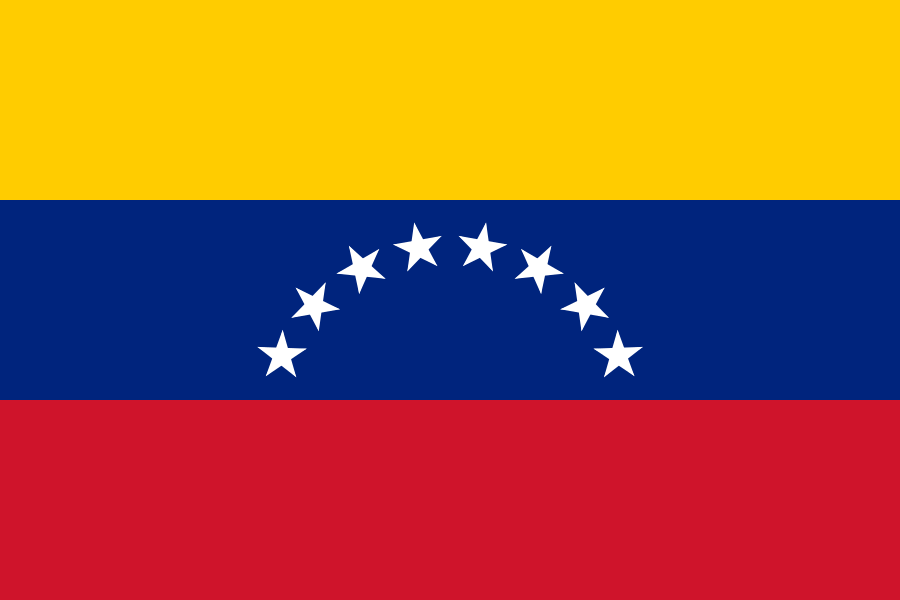
- Country.image_flag
- Flag of Venezuela.svg
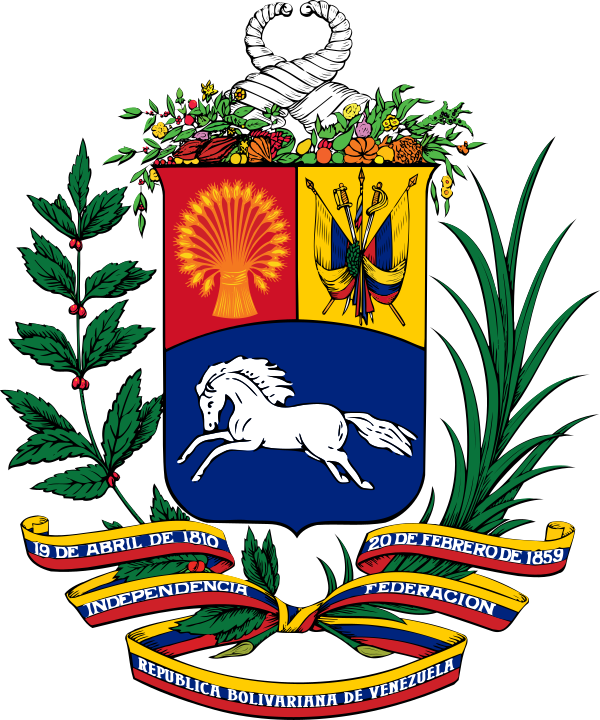
- Country.image_coat
- Coat of arms of Venezuela.svg
- Country.national_motto
- ()
- Country.national_anthem
- ()
- Country.capital
- Caracas
- Country.largest_city
- Caracas
- Country.official_languages
- Spanish
- Country.ethnic_groups_year
- 2011
- Country.religion_year
- 2020
- Country.demonym
- Venezuelan
- Country.government_type
- Federal presidential republic under an authoritarian dictatorship
- Country.leader_title1
- President
- Country.leader_name1
- Delcy Rodríguez (acting)Nicolás Maduro (de jure)
- Country.leader_title2
- Vice President
- Country.leader_name2
- Vacant
- Country.legislature
- National Assembly
via Wikipedia infobox
Research
23,120 papers- Venezuela's public health crisis: a regional emergency.ReviewLancet (London, England) · 2019Page KR, Doocy S, Reyna Ganteaume F et al.DOI: 10.1016/S0140-6736(19)30344-7
- Venezuela's humanitarian crisis, resurgence of vector-borne diseases, and implications for spillover in the region.ReviewThe Lancet. Infectious diseases · 2019Grillet ME, Hernández-Villena JV, Llewellyn MS et al.DOI: 10.1016/S1473-3099(18)30757-6
- Venezuela's health-care crisis.Lancet (London, England) · 2017Bello RJ, Damas JJ, Marco FJ et al.DOI: 10.1016/S0140-6736(17)31831-7
- Venezuela's upheaval threatens Yanomami.Science (New York, N.Y.) · 2019Paniz-Mondolfi AE, Grillet ME, Tami A et al.DOI: 10.1126/science.aay6003
- Ivermectin: repurposing a multipurpose drug for Venezuela's humanitarian crisis.ReviewInternational journal of antimicrobial agents · 2020Perez-Garcia LA, Mejias-Carpio IE, Delgado-Noguera LA et al.DOI: 10.1016/j.ijantimicag.2020.106037
- Venezuela's way ahead.Nature · 2007DOI: 10.1038/450922a
- Venezuela's harmful mining activities grow.Science (New York, N.Y.) · 2023Stachowicz I, Morón Zambrano V, Giordano AJ et al.DOI: 10.1126/science.adh4314
- Malaria control and elimination, Venezuela, 1800s –1970s.ReviewEmerging infectious diseases · 2014Griffing SM, Villegas L, Udhayakumar VDOI: 10.3201/eid2010.130917
via PubMed
Wikidata facts
- Instance of
- country
- Part of
- G3 Free Trade Agreement
- Named after
- Venice
- Official name
- la République bolivarienne du Vénézuéla
- Demonym
- Venezuelan
- Contains
- Anzoátegui
- Continent
- South America
- Capital
- Caracas
- Official language
- Venezuelan Sign Language
- Currency
- sovereign bolivar
- Population
- 31250306
- Area
- 912050
- Body of water
- Atlantic Ocean
- Head of state
- Delcy Rodríguez
- Form of government
- presidential system
- Legislature
- National Assembly
- Anthem
- gloria al bravo pueblo
- Highest point
- Pico Bolívar
- Official website
- mppre.gob.ve
- Image
- Embalse la Vueltosa 2022.jpg
- Life expectancy
- 74.5
- Calling code
- +58
- Licence plate code
- YV
- Mains voltage
- 120
Show 67 more facts
- Coat of arms
- coat of arms of Venezuela
- topic's main Wikimedia portal
- Portal:Venezuela
- Unicode character
- 🇻🇪
- category of associated people
- Category:Venezuelan people
- geography of topic
- Geography of Venezuela
- office held by head of government
- President of Venezuela
- diplomatic relation
- North Korea
- inception
- 1845-03-30
- Commons gallery
- Venezuela
- trunk prefix
- 0
- history of topic
- history of Venezuela
- replaces
- Republic of Venezuela
- on focus list of Wikimedia project
- Wikipedia:Vital articles/Level/4
- mobile country code
- 734
- total fertility rate
- 2.18
- maritime identification digits
- 775
- marriageable age
- 16
- topic's main category
- Category:Venezuela
- central bank
- Central Bank of Venezuela
- category for people buried here
- Category:Burials in Venezuela
- age of majority
- 18
- GS1 country code
- 759
- category for films shot at this location
- Category:Films shot in Venezuela
- executive body
- Cabinet of Venezuela
- category for people who died here
- Category:Deaths in Venezuela
- ethnic group
- Lebanese Venezuelans
- office held by head of state
- President of Venezuela
- Commons category
- Venezuela
- top-level Internet domain
- .ve
- category for people born here
- Category:Births in Venezuela
- number of out-of-school children
- 1410805
- driving side
- right
- lowest point
- Lagunillas
- described by source
- Granat Encyclopedic Dictionary
- language used
- Mapoyo
- native label
- Venezuela
- culture
- culture of Venezuela
- VAT rate
- 12
- BTI Status Index
- 2.65
- BTI Governance Index
- 1.44
- economy of topic
- economy of Venezuela
- demographics of topic
- demographics of Venezuela
- hashtag
- venezuela
- retirement age
- 55
- Democracy Index
- 2.11
- topic has template
- Template:Venezuela topics
- P8168
- Showtime
- Human Development Index
- 0.691
- P11012
- train
- Happy Planet Index score
- 48.9
- Gini coefficient
- 44.8
- Inequality-adjusted Human Development Index
- 0.592
- suicide rate
- 2.1
- name
- ꠜꠦꠘꠦꠏꠥꠄꠟꠣ
- P12749
- Flemish Parliament
- birth rate
- 16.7
- male population
- 13996791
- death rate
- 6.5
- rural population
- 3289223
- female population
- 14304904
- urban population
- 25012473
- located in/on physical feature
- Hispanic America
- most populous urban area
- Caracas
- described at URL
- baike.sogou.com/v74969.htm
- different from
- Venezuela
Sources (15)
via Wikidata · CC0
Travel guide
Understand
thumb|Angel Falls Venezuela is home to the world's highest waterfall, Angel Falls and the second longest river in South America, the Orinoco. It also has the longest coastline to the Caribbean sea. Venezuela is the world's fifth-largest oil exporter and also has vast untapped reserves of natural gas. Ecologically, Venezuela is considered among the 20 Megadiverse countries of the planet; more than 40% of its national territory is covered by protected areas.
Although geologically diverse, the effects of climate change have gravely affected Venezuela's ecodiversity. May 2024 marked the date of when the country became the first Andean country and one of the first in the modern world to lose all of its glaciers.
Get in
thumb|375px|A map showing the visa requirements of Venezuela, with countries in red and blue having visa-free access thumb|Entry stamp
Get around
thumb|Avenida Bolívar in Caracas
See
Angel Falls in the Guiana Highlands and Canaima National Park Los Roques with its crystalline beaches. Los Llanos and its spectacular wildlife. Mérida and its breathtaking Andes scenery. Caracas, the true urban jungle.
Eat
Venezuela is experiencing a severe food shortage, and whatever food is available tends to be very expensive.
Arepas, thick corn tortillas which are split and stuffed with myriad fillings, are the quintessential Venezuelan dish. The most famous variations are the "reina pepiada" (shredded chicken salad with avocado) and “domino” (stuffed with black beans and shredded white cheese). Hallacas (Venezuela's homegrown version of the tamale, with meat, olives, raisins covered in cornmeal and wrapped in plantain leaves to be steamed) are a popular Christmas dish. Cachapas (corn pancakes often topped with a salty cheese called "telita" or "queso de mano"), empanadas (savory pastries) and the ubiquitous "perros calientes" (hot dogs) are popular street food. For slow food, try delicious fish meals, or a shrimp soup known as “cazuela de mariscos”.
The traditional Venezuelan lunch is pabellón, and consists of rice, black beans, and meat, with a side of fried plantain slices. The above dishes are known as "comida criolla", or Creole food.
Venezuela is a leading producer of fine cacao beans and Venezuelan chocolate can be excellent. The El Rey brand has consistent quality.
Drink
To some tastes, especially those who prefer stronger and complicated beers, Venezuelan beers may seem thin and watery. The most popular beer brand is Polar, which is available in a low-calorie version (Polar Light), light version (Polar Ice), or premium version (Solera). Zulia and Regional are other beers available throughout the country. Whisky is very popular among Venezuelans, particularly for special events. Venezuelan-made rum is generally dark and of very good quality. Among the best is the "1796" brand from Santa Teresa. It is a Solera rum. Others popular brands of rum are Pampero "caballito frenado" and Cacique.
Venezuelans are heavy drinkers and will often go through a case of beer during vacation days, starting before breakfast, only to carry on with a bottle of rum or whisky come nightfall.
A popular non-alcoholic drink is called "chicha Andina," which is made from rice or corn flour.
Malta or Maltin is a carbonated non-alcoholic malt drink sold alongside regular soft drinks, although it is also manufactured by the Polar company.
Venezuelan coffee is excellent, but make sure you are asking for proper coffee (machine-made, 'de la maquina'), otherwise you might be served a 'negrito' or 'guayoyo', which can be anything from weak filter coffee to coffee-smelling brown water.
Sleep
In Caracas, there is a good selection of 5-star hotels, although these are predictably expensive. At tourist spots elsewhere in Venezuela, guest houses or B&Bs, known as posadas are usually the best option, each with an individual style and usually offering breakfast or dinner if requested. Posadas can vary enormously in price and quality. Youth hostels are very scarce.
The beds in many hotels (mostly up to the mid-range levels) are nothing more than mattresses on concrete slabs that resemble box springs. Depending on what your sleep preference is, they may not be the most comfortable for you. Something for you to consider when looking for a hotel to stay at.
Stay safe
Venezuela suffers from widespread poverty, corruption, and crime. Venezuela has one of the highest homicide rates worldwide. It is necessary to be vigilant when in crowded cities, as pickpockets and muggers may be around. Most sections of large cities are not safe to walk at night. Stay in populated areas. Always travel by vehicle at night. The outskirts of many cities are very poor and crime-ridden, and are not appropriate for tourists. When in doubt, ask local inhabitants or taxi drivers whether an area is safe or not. In general, if one looks like a (presumably wealthy) tourist, these sections of town should be avoided. It is advisable not to wear expensive jewellery or watches. Take care with using the cell phone, taking pictures and unfolding maps in crowds. Pretend you know where you are going even if you aren't sure.
Always ride on a legal taxi (Yellow plates). The white plates taxis are not legal and may be dangerous.
Additionally, be wary of corrupt officials (police and National Guard). Some officials may demand bribes or otherwise extort voyagers. Keep watch of your belongings at all times. Despite all these recommendations, you are usually quite safe in Venezuela if you apply a little common sense, and avoid looking overly wealthy when travelling. Women with big purses should not walk around alone. Tourists should avoid walking long distances in the towns and cities unless you know where you are going. Where possible arrange vehicle transport. It is not advisabl…
Stay healthy
There is a severe shortage of medical supplies in Venezuela, so you may have difficulty getting adequate treatment in an emergency. Ensure that you are covered by travel insurance that includes medical evacuations, as being evacuated to a neighboring country may be the only way to get proper treatment.
You may have some diarrhea issues adjusting to the food in Venezuela. You should preferably buy bottled water and not drink from the tap, but iced drinks and salads are generally fine (depending on the water supply quality of your native country). Note that food will go off more quickly in the tropical climate.
You usually find street vendors by highways, who sell food and who don't always have much knowledge of hygienic food handling practices. Use common sense when selecting what to eat in the street. Mind, that fresh food and mayonnaise may go bad fast due to the local climate.
As elsewhere in the tropics, health risks include getting sunburnt and tropical diseases.
Respect
thumb|Almost 5 km above sea level, Pico Bólivar is the highest mountain in Venezuela Most Venezuelans are laid-back regarding racial issues, since white or creole persons blend naturally with natives and Afro-Venezuelans in everyday life (education, living, politics, marriage). So the word "negro" can be used regardless of who's saying it, or who is being referred to in this way. Expressions like "negrito" or "mi negro" are often used as a term of endearment. You could hear someone calling "negra" to a woman, regardless of the race of the person. And in general, Afro-Venezuelans don't find it offensive, as they are simply variations on the Spanish word for "black". Similarly, don't be offended if someone calls you "flaco" (thin) or "gordo" (fat) as these may also be used fairly indiscriminately, and often as a term of friendliness.
Differences between Brits, Americans, or Europeans are not perceived by most Venezuelans. Hence, you can expect to be called "gringo" even if you are, say, Russian. Don't let this offend you as a non Spanish-speaking visitor; Venezuelans are not trying to be offensive.
Venezuelans, like Colombians, Nicaraguans and Panamanians, have a very amusing way of pointing to objects by pouting their lips and lifting their chin, so don't assume that people are blowing kisses to you when you ask for directions.
Another important point to be kept in mind is that the Venezuelan society is severely split between "Chavistas" (those who support former President…
Travel guide from Wikivoyage (CC BY-SA 4.0)
~40 min read
Encyclopedic overview
56 sectionsContents
- Etymology
- History
- Pre-Columbian history
- Colonization
- German colonization
- 16th to 18th century
- Independence and 19th century
- 20th century
- Bolivarian government under Chávez: 1999–2013
- Bolivarian government under Maduro: 2013–2026
- US capture of Maduro
- Geography
- Climate
- Biodiversity and conservation
- Hydrography
- Relief
- Valleys
- Deserts
- Government and politics
- Administrative divisions
- Suspension of constitutional rights
- Foreign relations
- Military
- Law and crime
- Human rights
- Corruption
- Economy
- Tourism
- Shortages
- Petroleum and other resources
- Transport
- Utilities
- Demographics
- Largest cities
- Ethnicity
- Languages
- Religion
- Health
- Education
- Culture
- Architecture
- Art
- Literature
- Music
- Sport
- Baseball
- Football
- Others
- See also
- Notes
- References
- Bibliography
- Articles
- Books
- Talks and interviews
- External links
Venezuela, officially the Bolivarian Republic of Venezuela, is a country on the northern coast of South America, consisting of a continental landmass and various islands and islets in the Caribbean Sea. It comprises an area of 912,050 km (352,140 sq mi), with a population estimated at 31.8 million in 2025. The capital and largest urban agglomeration is Caracas. The continental territory is bordered on the north by the Caribbean Sea and the Atlantic Ocean, on the west by Colombia, Brazil on the south, Trinidad and Tobago to the north-east, and on the east by Guyana. Venezuela consists of 23 states, the Capital District, and federal dependencies covering Venezuela's offshore islands. Venezuela is among the most urbanized countries in Latin America; the vast majority of Venezuelans live in the cities of the north, including in the capital.
The territory of Venezuela was colonized by Spain in 1522, amid resistance from Indigenous peoples. In 1811, it became one of the first Spanish-American territories to declare independence from the Spanish and to form part of the first federal Republic of Colombia (Gran Colombia). It separated as a fully sovereign country in 1830. During the 19th century, Venezuela suffered political turmoil and autocracy, remaining dominated by regional military dictators until the mid-20th century. From 1958, the country had a series of democratic governments, as an exception where most of the region was ruled by military dictatorships, and the period was characterized by economic prosperity. Economic shocks in the 1980s and 1990s led to major political crises and widespread social unrest, including the deadly Caracazo riots of 1989, two attempted coups in 1992, and the impeachment of a president for embezzlement of public funds charges in 1993. Confidence in the existing political parties collapsed during the 1998 Venezuelan presidential election, in which Hugo Chávez was elected and which became the catalyst for the Bolivarian Revolution. During the 1999 Constituent Assembly, a new Constitution of Venezuela was written and ratified.
Excerpted from Wikipedia’s “Venezuela” article, available under the CC BY-SA 4.0 licence.
Gallery (59)
On the map
6 mapped locations
Available in 273 languages
- Español
- Français
- Deutsch
- 中文
- 日本語
- Русский
- Português
- Italiano
- العربية
- हिन्दी
- Abkhazian
- Achinese
- Adyghe
- Afrikaans
- Albanian
- Albanian
- Amharic
- ami
Show 254 more
- Angika
- Aragonese
- Aramaic
- Armenian
- Arpitan
- Assamese
- Asturian
- Avaric
- Awadhi
- Aymara
- azb
- Azerbaijani
- Bahasa Indonesia
- Balinese
- Bambara
- Bangla
- Bashkir
- Basque
- bat_smg
- Bavarian
- be_x_old
- Belarusian
- Betawi
- Bhojpuri
- Bikol
- Bishnupriya
- Bislama
- Bosnian
- Breton
- Bulgarian
- Buriat
- Burmese
- Catalan
- cdo
- Cebuano
- Central Kurdish
- Chamorro
- Chechen
- Cherokee
- Chuvash
- Cornish
- Corsican
- Crimean Tatar
- Croatian
- Czech
- Danish
- Divehi
- dty
- Dzongkha
- Egyptian Arabic
- eml
- Erzya
- Esperanto
- Estonian
- Ewe
- Extremaduran
- Faroese
- Fiji Hindi
- Fijian
- Filipino
- Finnish
- fiu_vro
- Fon
- Friulian
- Fula
- Gagauz
- Galician
- gcr
- Georgian
- Gilaki
- Goan Konkani
- Gothic
- Greek
- Guarani
- Gujarati
- Haitian Creole
- Hakka Chinese
- Hausa
- Hawaiian
- Hebrew
- Hungarian
- hyw
- Icelandic
- Ido
- Igbo
- Iloko
- Inari Sami
- Ingush
- Interlingua
- Interlingue
- Irish
- Jamaican Creole English
- Javanese
- Kabardian
- Kabyle
- Kannada
- Kanuri
- Kara-Kalpak
- Karachay-Balkar
- Kashmiri
- Kashubian
- Kazakh
- kbp
- Khmer
- Kinyarwanda
- Kongo
- Kotava
- Kurdish
- Kyrgyz
- Ladino
- Lao
- Latgalian
- Latin
- Latvian
- Lezghian
- Ligurian
- Limburgish
- Lingala
- Lingua Franca Nova
- Lithuanian
- lld
- Lojban
- Lombard
- Low German
- Lower Sorbian
- Luxembourgish
- Macedonian
- Madurese
- Maithili
- Malagasy
- Malay
- Malayalam
- Maltese
- Manipuri
- Manx
- Māori
- map_bms
- Marathi
- Mari
- Mazanderani
- Minangkabau
- Mingrelian
- Mirandese
- Moksha
- Mongolian
- Moroccan Arabic
- Navajo
- nds_nl
- Neapolitan
- Nederlands
- Nepali
- Newari
- Northern Frisian
- Northern Sami
- Northern Sotho
- Norwegian
- Norwegian Nynorsk
- Novial
- nrm
- Occitan
- Old English
- olo
- Oromo
- Ossetic
- Pampanga
- Pangasinan
- Papiamento
- Pashto
- Picard
- Piedmontese
- Polski
- Punjabi
- Quechua
- roa_tara
- Romanian
- Romansh
- Romany
- Rundi
- Rusyn
- Samoan
- Sanskrit
- Santali
- Sardinian
- Saterland Frisian
- Scots
- Scottish Gaelic
- Serbian
- Serbian (Latin)
- Shan
- Shona
- Sicilian
- Silesian
- simple
- Sindhi
- Sinhala
- Slovak
- Slovenian
- Somali
- Sranan Tongo
- Standard Moroccan Tamazight
- Sundanese
- Svenska
- Swahili
- szy
- Tajik
- Talysh
- Tamil
- Taroko
- Tatar
- tay
- Telugu
- Tetum
- Tibetan
- Tiếng Việt
- Tigrinya
- Tok Pisin
- Toki Pona
- Tongan
- Tumbuka
- Türkçe
- Turkmen
- Tyap
- Udmurt
- Ukrainian
- Upper Sorbian
- Urdu
- Uyghur
- Uzbek
- Venetian
- Veps
- Volapük
- Walloon
- Waray
- Wayuu
- Welsh
- West Flemish
- Western Frisian
- Western Mari
- Western Panjabi
- Wolof
- Wu Chinese
- Yakut
- Yiddish
- Yoruba
- Zaza
- Zeelandic
- zh_classical
- zh_min_nan
- zh_yue
- Zhuang
- Zulu
- فارسی
- ไทย
- 한국어
via Wikidata sitelinks · CC0