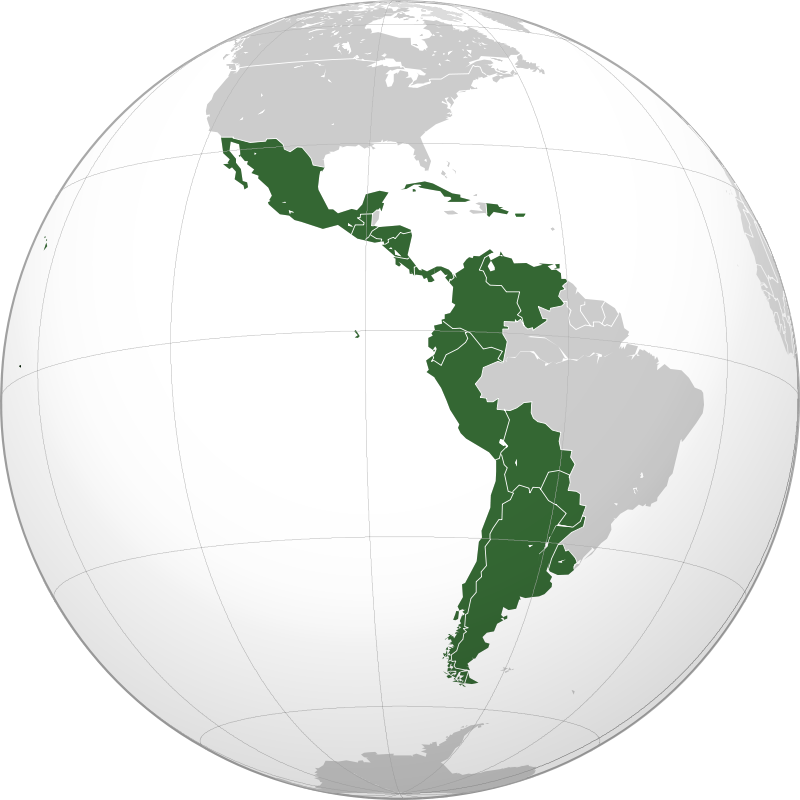
File:Hispanic_America_(orthographic_projection).svg · Wikimedia Commons · See Wikimedia Commons
Hispanic America
Sign in to saveAlso known as Spanish America, Castilian America
countries in the Americas with predominantly Spanish-speaking populations
Key facts
- Area
- 11,485,417 km (4,434,544 sq mi)
- Population
- 427,122,274
- Population density
- 37.19/km (96.3/sq mi)
- Demonym
- Hispanic American
- Countries
- 18 Argentina Bolivia Chile Colombia Costa Rica Cuba Dominican Republic Ecuador El Salvador Guatemala Honduras Mexico Nicaragua Panama Paraguay Peru Uruguay Venezuela
- Dependencies
- Puerto Rico
- Languages
- Spanish and Indigenous languages of the Americas
- Time zones
- UTC−03:00 to UTC−08:00
- Largest cities
- Largest urban areas:, 0 1. Mexico City , 0 2. Buenos Aires , 0 3. Bogotá , 0 4. Lima , 0 5. Santiago , 0 6. Guadalajara , 0 7. Caracas , 0 8. Guatemala City , 0 9. Monterrey , 10. Medellín
via Wikipedia infobox
Wikidata facts
- Part of
- Ibero-America
- Country
- Venezuela
Show 2 more facts
- topic's main category
- Category:Hispanic America
- described by source
- The Nuttall Encyclopædia
Sources (1)
via Wikidata · CC0
~18 min read
Encyclopedic overview
Hispanic America (Spanish: Hispanoamérica or América Hispana), historically known as Spanish America (Spanish: América Española) or Castilian America (Spanish: América Castellana), consists of the Spanish-speaking countries and territories of the Americas. In all of these countries, Spanish is the main language—sometimes sharing official status with one or more indigenous languages (such as Guaraní, Quechua, Aymara or Mayan) or English (in Puerto Rico), and Latin Catholicism is the predominant religion.
Hispanic America is sometimes grouped together with Brazil under the term Ibero-America, meaning those countries in the Americas with cultural roots in the Iberian Peninsula. Hispanic America also contrasts with Latin America, which includes not only Hispanic America, but also Brazil (the former Portuguese America), and by few definitions, the former French colonies in the Western Hemisphere (areas that are now in either the United States or Canada are usually excluded).
Excerpted from Wikipedia’s “Hispanic America” article, available under the CC BY-SA 4.0 licence.