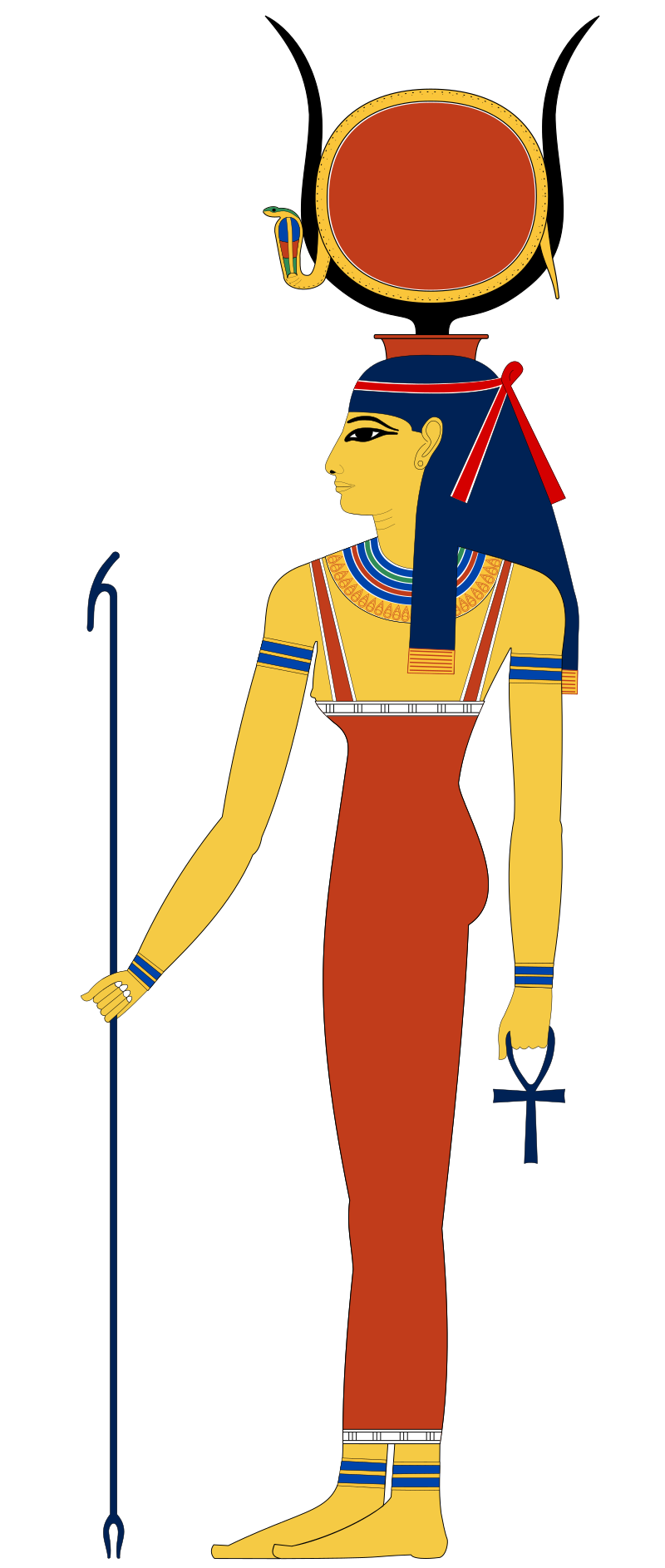
File:Hathor.svg · Wikimedia Commons · See Wikimedia Commons
Hathor
Sign in to saveAlso known as Lady of Mefkat, Lady of Faience, Lady of Amethyst, goddess of turquoise
thumb|right|Hathor as a cow Hathor (, , , Meroitic: '''') was a major goddess in ancient Egyptian religion who played a wide variety of roles. As a sky deity, she was the mother or consort of the sky god Horus and the sun god Ra, both of whom were connected with kingship, and thus she was the symbolic mother of their earthly representatives, the pharaohs. She was one of several goddesses who acted as the Eye of Ra, Ra's feminine counterpart, and in this form, she had a vengeful aspect that protected him from his enemies. Her beneficent side represented beauty, music, dance, joy, love, sexualit
Hathor was a major goddess in ancient Egyptian religion who served multiple important roles, including as the mother or consort of key gods like Horus and Ra, making her symbolically the mother of the pharaohs themselves. She was also known as the Eye of Ra, a protective feminine force with both a vengeful side against Ra's enemies and a benevolent side associated with beauty, music, dance, joy, and love.
AI-generated from the Wikipedia summary — may contain errors.
Key facts
- Deity.type
- Egyptian
- Deity.name
- Hathor
- Deity.image
- Hathor.svg
- Deity.caption
- Composite image of Hathor's most common iconography, based partly on images from the tomb of Nefertari
- Deity.alt
- Profile of a woman in ancient Egyptian clothing. She has yellow skin and bears on head a pair of cow horns, between which sits a red disk encircled by a cobra. She holds a forked staff in one hand and an ankh sign in the other.
- Deity.hiero
- Egyptian: ḥwt-ḥr O10
- Deity.parents
- Ra
- Deity.offspring
- Ihy, Neferhotep of Hu, Ra , Horus (In some myths)
via Wikipedia infobox
Wikidata facts
- Instance of
- horned deity
- Part of
- Egyptian mythology
- Gender
- female
- Spouse
- Horus
- Child
- Bastet
- Father
- Ra
- Image
- Hathor.svg
- Said to be same as
- Ba‘alat Gebal
Show 6 more facts
- described by source
- Pauly–Wissowa
- Commons category
- Hathor
- worshipped by
- religion of ancient Egypt
- topic's main category
- Category:Hathor
- different from
- Hat Hor
- on focus list of Wikimedia project
- Wikipedia:Vital articles/Level/4
Sources (2)
via Wikidata · CC0
~50 min read
Encyclopedic overview
23 sectionsContents
- Origins
- Roles
- Sky goddess
- Solar goddess
- Music, dance, and joy
- Sexuality, beauty, and love
- Motherhood and queenship
- Fate
- Foreign lands and goods
- Afterlife
- Iconography
- Worship
- Relationship with royalty
- Temples in Egypt
- Festivals
- Worship outside Egypt
- Popular worship
- Funerary practices
- References
- Citations
- Works cited
- Further reading
- External links
thumb|right|Hathor as a cow Hathor (, , , Meroitic: '''') was a major goddess in ancient Egyptian religion who played a wide variety of roles. As a sky deity, she was the mother or consort of the sky god Horus and the sun god Ra, both of whom were connected with kingship, and thus she was the symbolic mother of their earthly representatives, the pharaohs. She was one of several goddesses who acted as the Eye of Ra, Ra's feminine counterpart, and in this form, she had a vengeful aspect that protected him from his enemies. Her beneficent side represented beauty, music, dance, joy, love, sexuality, and maternal care, and she acted as the consort of several male deities and the mother of their sons. These two aspects of the goddess exemplified the Egyptian conception of femininity. Hathor crossed boundaries between worlds, helping deceased souls in the transition to the afterlife.
Hathor was often depicted as a cow, symbolizing her maternal and celestial aspect, although her most common form was a woman wearing a headdress of cow horns and a sun disk. She could also be represented as a lioness, a cobra, or a sycomore tree.
Excerpted from Wikipedia’s “Hathor” article, available under the CC BY-SA 4.0 licence.
Gallery (34)
Available in 78 languages
- Español
- Français
- Deutsch
- 中文
- 日本語
- Русский
- Português
- Italiano
- العربية
- हिन्दी
- Afrikaans
- Aragonese
- Armenian
- Asturian
- Azerbaijani
- Bahasa Indonesia
- Bangla
- Basque
Show 59 more
- Belarusian
- Bosnian
- Bulgarian
- Catalan
- cdo
- Croatian
- Czech
- Danish
- Egyptian Arabic
- Esperanto
- Estonian
- Filipino
- Finnish
- Galician
- Georgian
- Greek
- Hebrew
- Hungarian
- Icelandic
- Irish
- Kashmiri
- Latin
- Latvian
- Lithuanian
- Lombard
- Macedonian
- Malay
- Malayalam
- Manipuri
- Mingrelian
- Nederlands
- Norwegian
- Occitan
- Polski
- Romanian
- Serbian
- Serbian (Latin)
- Sicilian
- simple
- Sindhi
- Slovak
- Slovenian
- Svenska
- Swahili
- Tamil
- Tatar
- Tibetan
- Tiếng Việt
- Toki Pona
- Türkçe
- Ukrainian
- Urdu
- Waray
- Welsh
- Wu Chinese
- zh_yue
- فارسی
- ไทย
- 한국어
via Wikidata sitelinks · CC0