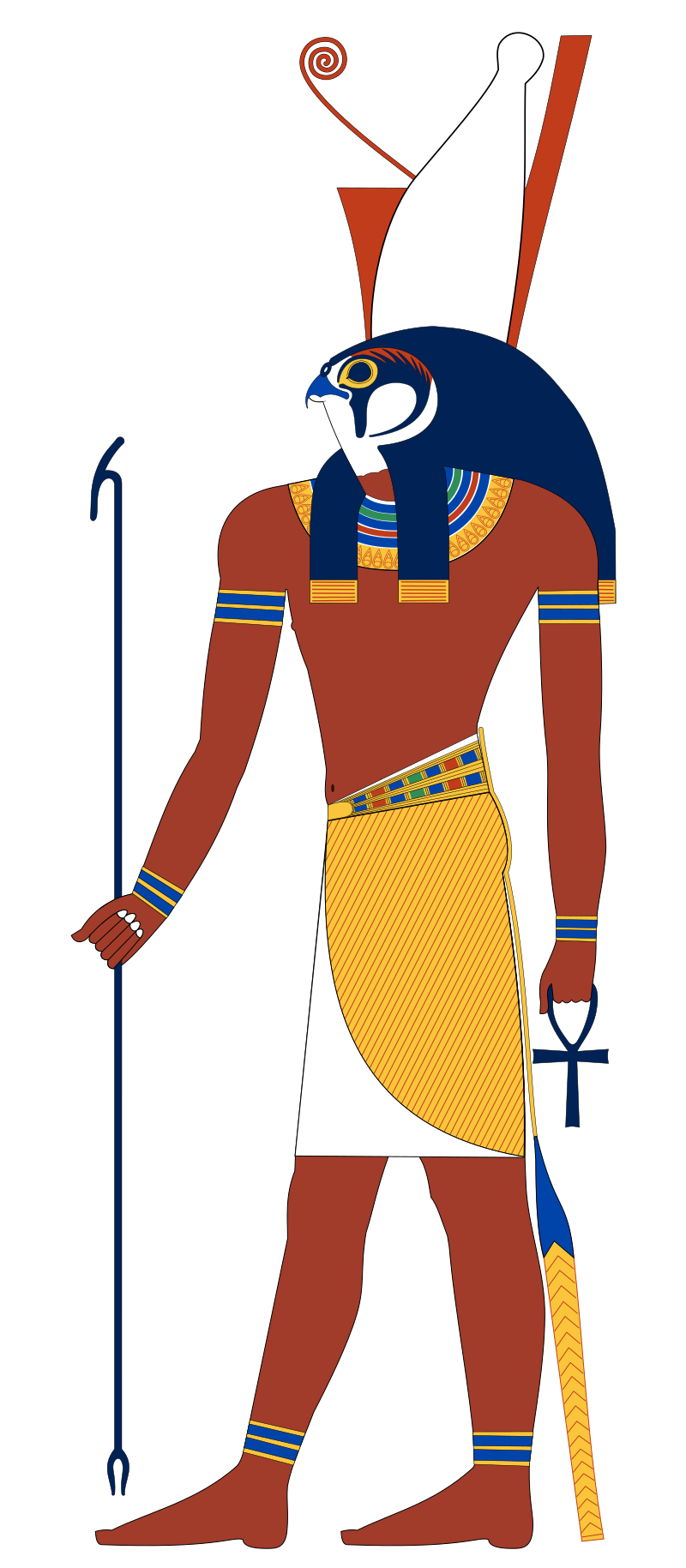
File:Horus_standing.svg · Wikimedia Commons · See Wikimedia Commons
Horus
Sign in to saveAlso known as Hor
Horus (), also known as Heru, Har, Her, or Hor () Ϩⲱⲣ (Coptic), in Ancient Egyptian, is one of the most significant ancient Egyptian deities who served many functions, most notably as the god of kingship, healing, protection, the sun, and the sky. He was worshipped from at least the late prehistoric Egypt until the Ptolemaic Kingdom and Roman Egypt. Different forms of Horus are recorded in history, and these are treated as distinct gods by Egyptologists. These various forms may be different manifestations of the same multi-layered deity in which certain attributes or syncretic relationships ar
Horus, also known by several alternate names, was one of ancient Egypt's most important gods, serving roles as the deity of kingship, healing, protection, the sun, and the sky from prehistoric times through the Roman period. Egyptologists recognize multiple forms of Horus throughout history, which they treat as distinct gods, though these may represent different manifestations of a single complex deity with varying attributes and relationships.
AI-generated from the Wikipedia summary — may contain errors.
Key facts
- Deity.caption
- Horus was often the ancient Egyptians' national tutelary deity. He was usually depicted as a falcon-headed man wearing the pschent, also known as a red and white crown, as a symbol of kingship over the entire kingdom of Egypt.
- Deity.cult_center
- Edfu
- Deity.symbol
- winged sun
- Deity.parents
- Geb and Nut, or Ra and Heqet
- Deity.siblings
- Osiris, Isis, Set, and Nephthys, or Tasenetnofret
- Deity.consort
- Hathor
- Deity.offspring
- Harsomtus
- Deity.greek_equivalent
- Apollo
- Deity.hiero
- G5-bH:d:t*y
- Deity.equivalent1
- Mandulis
- Deity.equivalent1_type
- Nubian
- Deity.type
- Egyptian
- Deity.name
- Horus
- Deity.image
- Horus standing.svg
- Deity.image_upright
- 1
- Deity.enemy
- Set
via Wikipedia infobox
Wikidata facts
- Instance of
- war deity
- Part of
- Egyptian mythology
- Gender
- male
- Spouse
- Hathor
- Child
- Ihy
- Father
- Ra
- Mother
- Nut
- Image
- Horus standing.svg
- Connects with
- Eye of Horus
Show 11 more facts
- worshipped by
- religion of ancient Egypt
- Commons category
- Horus
- topic's main category
- Category:Horus
- Commons gallery
- Horus
- described by source
- Pauly–Wissowa
- on focus list of Wikimedia project
- Wikipedia:Vital articles/Level/4
- name in hiero markup
- H-Hr:r
- enemy
- Seth
- domain of saint or deity
- sky
- appears in the form of
- falcon
Sources (1)
via Wikidata · CC0
~27 min read
Encyclopedic overview
23 sectionsContents
- Etymology
- Horus and the pharaoh
- Origin mythology
- Genealogy
- Mythological roles
- Sky god
- Conflict between Horus and Set
- Golden Horus Osiris
- Forms of Horus
- Heru-ur (Horus the Elder)
- Heru-pa-khered (Horus the child)
- Heru-Behdeti (Horus of [[Behdet]])
- Har-em-akhet (Horus in the Horizon)
- Harpara (Horus the sun)
- Other forms of Horus
- Celebrations of Horus
- Suggested influence on Christianity
- In popular culture
- Gallery
- See also
- Notes
- References
- External links
Horus (), also known as Heru, Har, Her, or Hor () Ϩⲱⲣ (Coptic), in Ancient Egyptian, is one of the most significant ancient Egyptian deities who served many functions, most notably as the god of kingship, healing, protection, the sun, and the sky. He was worshipped from at least the late prehistoric Egypt until the Ptolemaic Kingdom and Roman Egypt. Different forms of Horus are recorded in history, and these are treated as distinct gods by Egyptologists. These various forms may be different manifestations of the same multi-layered deity in which certain attributes or syncretic relationships are emphasized, not necessarily in opposition but complementary to one another, consistent with how the Ancient Egyptians viewed the multiple facets of reality. He was most often depicted as a falcon, most likely a lanner falcon or peregrine falcon, or as a man with a falcon head.
The earliest recorded form of Horus is the tutelary deity of Nekhen in Upper Egypt, who is the first known national god, specifically related to the ruling pharaoh who in time came to be regarded as a manifestation of Horus in life and Osiris in death. The most commonly encountered family relationship describes Horus as the son of Isis and Osiris, and he plays a key role in the Osiris myth as Osiris's heir and the rival to Set, the murderer and brother of Osiris. In another tradition, Hathor is regarded as his mother and sometimes as his wife.
Excerpted from Wikipedia’s “Horus” article, available under the CC BY-SA 4.0 licence.
Gallery (34)
Available in 90 languages
- Español
- Français
- Deutsch
- 中文
- 日本語
- Русский
- Português
- Italiano
- العربية
- हिन्दी
- Afrikaans
- Albanian
- Albanian
- Armenian
- Asturian
- Azerbaijani
- Bahasa Indonesia
- Bangla
Show 71 more
- Basque
- Bavarian
- Belarusian
- Breton
- Bulgarian
- Burmese
- Catalan
- cdo
- Central Kurdish
- Chuvash
- Croatian
- Czech
- Danish
- Egyptian Arabic
- Esperanto
- Estonian
- Filipino
- Finnish
- Galician
- Georgian
- Greek
- Hebrew
- Hungarian
- Icelandic
- Irish
- Javanese
- Latin
- Latvian
- Lithuanian
- Macedonian
- Malagasy
- Malay
- Malayalam
- Manipuri
- Mingrelian
- Nederlands
- Nepali
- Norwegian
- Occitan
- Pashto
- Polski
- Punjabi
- Romanian
- Scots
- Serbian
- Serbian (Latin)
- Sicilian
- simple
- Sindhi
- Sinhala
- Slovak
- Slovenian
- Svenska
- Swahili
- Tajik
- Tamil
- Tatar
- Tibetan
- Tiếng Việt
- Toki Pona
- Türkçe
- Ukrainian
- Urdu
- Waray
- Western Panjabi
- Wu Chinese
- Zaza
- zh_yue
- فارسی
- ไทย
- 한국어
via Wikidata sitelinks · CC0