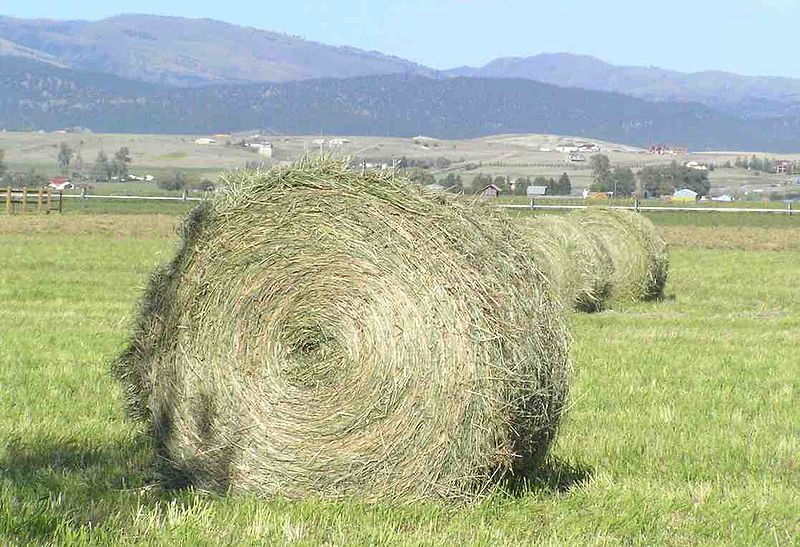
File:Roundbale1.jpg · Wikimedia Commons · See Wikimedia Commons
Also known as grass hay, alfalfa, dried grass
Hay is grass, legumes, or other herbaceous plants that have been cut and dried to be stored for use as animal fodder, either for large grazing animals raised as livestock, such as cattle, horses, goats, and sheep, or for smaller domesticated animals such as rabbits and guinea pigs. Pigs can eat hay, but they do not digest it as efficiently as herbivores do.
Hay is dried grass, legumes, or other plants that are stored and fed to animals, ranging from livestock like cattle and horses to smaller pets like rabbits and guinea pigs. It matters because it provides a practical food source for herbivores and other domesticated animals, allowing farmers and pet owners to feed animals during seasons when fresh vegetation isn't available.
AI-generated from the Wikipedia summary — may contain errors.
Wikidata facts
- Image
- Foin meule Roumanie.jpg
- Has use
- animal feed
Show 8 more facts
- Commons category
- Hay
- Commons gallery
- Hay
- natural product of taxon
- Poaceae
- different from
- straw
- on focus list of Wikimedia project
- Wikipedia:Vital articles/Level/4
- exact match
- purl.obolibrary.org/obo/ENVO_00002869
- fabrication method
- haymaking
- has characteristic
- dehydration
Sources (6)
via Wikidata · CC0
~34 min read
Encyclopedic overview
17 sectionsContents
- Composition
- Use
- Harvest and transport
- History
- Early methods
- Modern mechanized techniques
- Fertilization and weed control
- Baling
- Stacking
- Safety
- Mold
- Spontaneous combustion
- Weight
- Chemical composition
- See also
- References
- External links
Hay is grass, legumes, or other herbaceous plants that have been cut and dried to be stored for use as animal fodder, either for large grazing animals raised as livestock, such as cattle, horses, goats, and sheep, or for smaller domesticated animals such as rabbits and guinea pigs. Pigs can eat hay, but they do not digest it as efficiently as herbivores do.
Hay can be used as animal fodder when or where there is not enough pasture or rangeland on which to graze an animal, when grazing is not feasible due to weather (such as during the winter), or when lush pasture by itself would be too rich for the health of the animal. It is also fed when an animal cannot access any pastures—for example, when the animal is being kept in a stable or barn.
Excerpted from Wikipedia’s “hay” article, available under the CC BY-SA 4.0 licence.
Gallery (52)
Available in 84 languages
- Español
- Français
- Deutsch
- 中文
- 日本語
- Русский
- Português
- Italiano
- العربية
- हिन्दी
- Aragonese
- Asturian
- Bahasa Indonesia
- Bangla
- Bashkir
- Basque
- bat_smg
- be_x_old
Show 65 more
- Belarusian
- Bosnian
- Bulgarian
- Catalan
- Central Kurdish
- Cheyenne
- Chuvash
- Croatian
- Czech
- Danish
- Esperanto
- Estonian
- Filipino
- Finnish
- Galician
- Georgian
- Hebrew
- Hungarian
- Icelandic
- Ido
- Interlingua
- Kannada
- Kazakh
- Kyrgyz
- Latin
- Latvian
- Limburgish
- Lithuanian
- Lombard
- Low German
- Luxembourgish
- Macedonian
- Malagasy
- Malay
- Malayalam
- nds_nl
- Nederlands
- Norwegian
- Norwegian Nynorsk
- Ossetic
- Piedmontese
- Polski
- Romanian
- Scots
- Serbian
- Serbian (Latin)
- Sicilian
- simple
- Slovak
- Svenska
- Tajik
- Telugu
- Tiếng Việt
- Türkçe
- Ukrainian
- Uzbek
- Venetian
- Walloon
- Western Frisian
- Wu Chinese
- Zaza
- zh_yue
- فارسی
- ไทย
- 한국어
via Wikidata sitelinks · CC0