File:White-tailed_deer_(Odocoileus_virginianus)_grazing_-_20050809.jpg · Wikimedia Commons · See Wikimedia Commons
herbivore
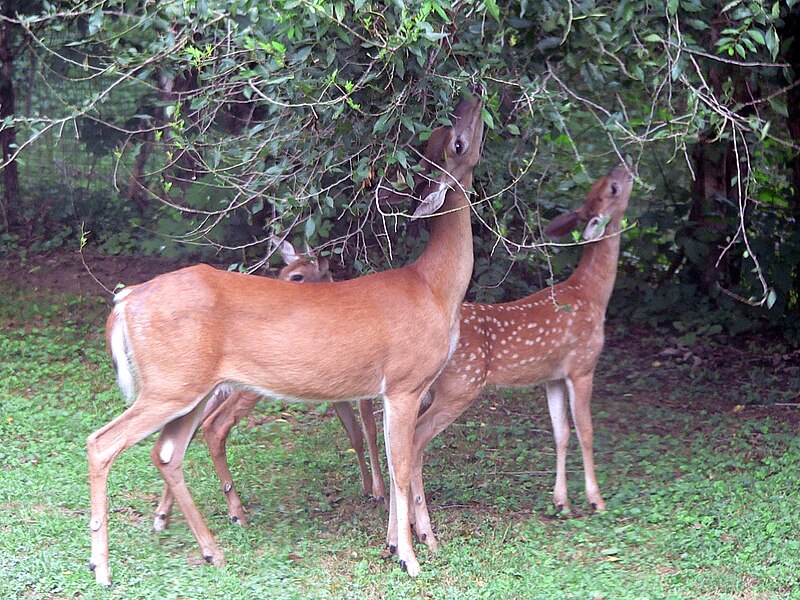
Sign in to savethumb|250px|A deer and two fawns feeding on foliage thumb|250px|A sawfly larva feeding on a leaf thumb|250px|Tracks made by terrestrial gastropods with their radulas, scraping [[green algae from a surface inside a greenhouse]]
A herbivore is an animal that eats plants as its primary food source, including leaves, foliage, algae, and other plant material. Herbivores are important in ecosystems because they consume plants and serve as food sources for other animals, forming a key link in food chains.
AI-generated from the Wikipedia summary — may contain errors.
Wikidata facts
- Subclass of
- feeding behavior
- Image
- Fawn and mother.jpg
- Said to be same as
- vegetarian
Show 5 more facts
- topic's main category
- Category:Herbivorous animals
- has characteristic
- trophic level
- Commons category
- Herbivores
- opposite of
- carnivore
- on focus list of Wikimedia project
- Wikipedia:Vital articles/Level/4
Sources (2)
via Wikidata · CC0
~26 min read
Encyclopedic overview
17 sectionsContents
- Etymology
- Definition and related terms
- Evolution of herbivory{{anchor|evolution}}
- Food chain
- Feeding strategies
- Plant-herbivore interactions
- Herbivore offense
- Plant defense
- Predator–prey theory
- Mutualism
- Impacts
- Trophic cascades and environmental degradation
- Economic impacts
- See also
- References
- Further reading
- External links
thumb|250px|A deer and two fawns feeding on foliage thumb|250px|A sawfly larva feeding on a leaf thumb|250px|Tracks made by terrestrial gastropods with their radulas, scraping [[green algae from a surface inside a greenhouse]]
A herbivore is an animal anatomically or physiologically evolved to feed on plants, especially upon vascular tissues such as foliage, fruits or seeds, as the main component of its diet. These more broadly also encompass animals that eat non-vascular autotrophs such as mosses, algae and lichens, but do not include those feeding on decomposed plant matters (i.e. detritivores) or macrofungi (i.e. fungivores).
Excerpted from Wikipedia’s “herbivore” article, available under the CC BY-SA 4.0 licence.
Gallery (21)
Available in 94 languages
- Español
- Français
- Deutsch
- 中文
- 日本語
- Русский
- Português
- Italiano
- العربية
- Afrikaans
- Albanian
- Aragonese
- Armenian
- Asturian
- azb
- Azerbaijani
- Bahasa Indonesia
- Bangla
Show 75 more
- Basque
- Belarusian
- Bosnian
- Breton
- Bulgarian
- Catalan
- Central Kurdish
- Cornish
- Croatian
- Czech
- Danish
- Esperanto
- Estonian
- Faroese
- Filipino
- Finnish
- Galician
- Georgian
- Greek
- Haitian Creole
- Hebrew
- Hungarian
- Icelandic
- Ido
- Irish
- Javanese
- Kannada
- Kazakh
- Latin
- Latvian
- Lithuanian
- Macedonian
- Malagasy
- Malay
- Malayalam
- Maltese
- Mongolian
- Nederlands
- Nepali
- Norwegian
- Norwegian Nynorsk
- Occitan
- Pashto
- Polski
- Quechua
- Romanian
- Sanskrit
- Scots
- Serbian
- Serbian (Latin)
- simple
- Slovak
- Slovenian
- Somali
- Sundanese
- Svenska
- Swahili
- Tamil
- Tatar
- Tiếng Việt
- Türkçe
- Ukrainian
- Urdu
- Uzbek
- Walloon
- Waray
- Welsh
- Western Frisian
- Western Panjabi
- Wu Chinese
- Zaza
- zh_yue
- فارسی
- ไทย
- 한국어
via Wikidata sitelinks · CC0