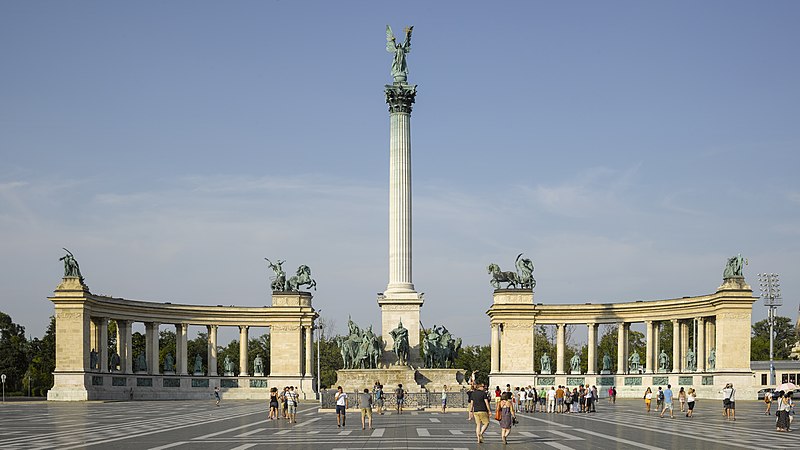
File:HUN-2015-Budapest-Heroes’_Square.jpg · Wikimedia Commons · See Wikimedia Commons
Key facts
- Location
- Zugló , Budapest , Hungary
- Part of
- " Andrássy Avenue and the Underground " part of Budapest, including the Banks of the Danube , the Buda Castle Quarter and Andrássy Avenue
- Criteria
- Cultural: (ii)(iv)
- Reference
- 400bis-002
- Inscription
- 1987 (11th Session )
via Wikipedia infobox
Wikidata facts
Show 4 more facts
- inception
- 1896-00-00
- native label
- Hősök tere
- Commons gallery
- Heroes' square, Budapest
- Commons category
- Hősök tere (Budapest 14)
via Wikidata · CC0
~10 min read
Encyclopedic overview
Hősök tere ( Hungarian: [ˈhøːʃøk ˈtɛrɛ]; lit. 'Heroes' Square') is one of the major squares in Budapest, Hungary, noted for its iconic Millennium Monument with statues featuring the Seven chieftains of the Magyars and other important Hungarian national leaders, as well as the Memorial Stone of Heroes, often erroneously referred as the Tomb of the Unknown Soldier. The square lies at the outbound end of Andrássy Avenue next to City Park (Városliget). It hosts the Museum of Fine Arts and the Palace of Art (Műcsarnok). The square has played an important part in contemporary Hungarian history and has been a host to many political events, such as the reburial of Imre Nagy in 1989. Most sculptures were made by sculptor György Zala from Lendva, with one made by György Vastagh.
In Budapest there are three more squares named Hősök tere, 'Heroes' Square', in the districts or neighbourhoods of Soroksár, Békásmegyer and Rákosliget.
Excerpted from Wikipedia’s “Heroes' Square” article, available under the CC BY-SA 4.0 licence.