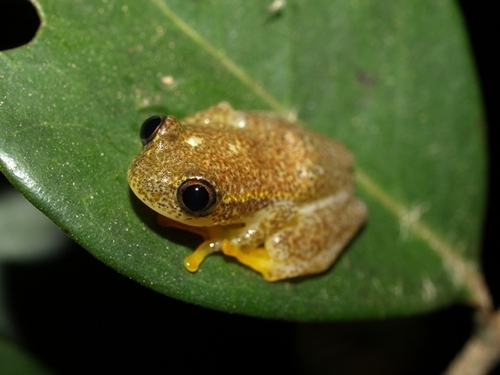
(c) devinedmonds, all rights reserved, uploaded by devinedmonds
Heterixalus
Sign in to saveHeterixalus is a genus of frogs within the family Hyperoliidae, endemic to Madagascar. It is the sister taxon to the genus Tachycnemis. These frogs are commonly referred to as Madagascar reed frogs. Heterixalus species are colorful, small to medium-sized frogs ranging from 18-40 mm in length. They have webbing on both the front and back feet, and the digits and webbing are typically yellow and orange. The tips of the digits are circularly enlarged, and the lateral metatarsalia are connected. Distinct among Malagasy frogs, the pupil is shaped as a "vertical rhomboid," with the anterior side poi
Species
Betsileo Reed Frog
GENUS
- KingdomAnimalia
- PhylumChordata
- ClassAmphibia
- OrderAnura
- FamilyHyperoliidae
via GBIF
Museum specimens
- Specimen records
- 109
- With media
- 1
- Family
- Hyperoliidae
- Collections
- USNM, KU, CAS
- Recorded in
- Madagascar
Wikidata facts
- Instance of
- taxon
- Parent taxon
- Hyperoliidae
- Image
- Heterixalus variabilis01.jpg
Show 5 more facts
- Commons category
- Heterixalus
- taxon name
- Heterixalus
- taxon rank
- genus
- topic's main category
- Category:Heterixalus
- endemic to
- Madagascar
Sources (1)
via Wikidata · CC0
~2 min read
Encyclopedic overview
2 sectionsContents
- Species
- References
Heterixalus is a genus of frogs within the family Hyperoliidae, endemic to Madagascar. It is the sister taxon to the genus Tachycnemis. These frogs are commonly referred to as Madagascar reed frogs. Heterixalus species are colorful, small to medium-sized frogs ranging from 18-40 mm in length. They have webbing on both the front and back feet, and the digits and webbing are typically yellow and orange. The tips of the digits are circularly enlarged, and the lateral metatarsalia are connected. Distinct among Malagasy frogs, the pupil is shaped as a "vertical rhomboid," with the anterior side pointed outward and the posterior side semicircular. Additionally, vomerine teeth are absent. Males are slightly smaller than females and can be told apart from the latter by weakly developed nuptial pads and a single, distensible vocal sac.
Heterixalus species tend to be very variable in color and patterning, and up to three species can be found at the same location. Therefore, while many species do have characteristic coloration, the best way to distinguish species and species complexes are by call. Typically, Heterixalus species live outside dense forests, where they inhabit sunlit pools, swamps and ricefields.
Excerpted from Wikipedia’s “Heterixalus” article, available under the CC BY-SA 4.0 licence.