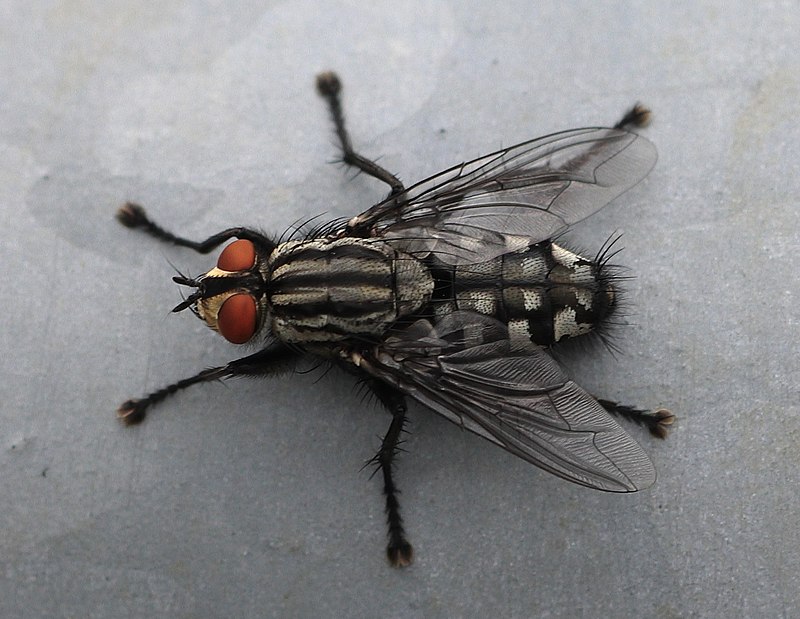
File:Echte_Fleischfliege_Sarcophaga_sp_male_2057_(cropped).jpg · Wikimedia Commons · See Wikimedia Commons
Hexapoda
Sign in to saveAlso known as Hexapod, Hexapods
The subphylum Hexapoda (from Greek for 'six legs') or hexapods comprises the largest clade of arthropods and includes most of the extant arthropod species. It includes the crown group class Insecta (true insects), as well as the much smaller clade Entognatha, which includes three classes of wingless arthropods that were once considered insects: Collembola (springtails), Protura (coneheads) and Diplura (two-pronged bristletails). The insects and springtails are very abundant and are some of the most important pollinators, basal consumers, scavengers/detritivores and micropredators in terrestria
OverviewAI-generated
Hexapoda is a subphylum within the phylum Arthropoda, classified as a taxon with a rank of subphylum. It belongs to the parent taxa Allotriocarida and Pancrustacea. The group is also referred to as Sechsfießer, سداسيات الأرجل, Altıayaqlılar, Шасціногія, or hexapodes. Its status is accepted.
The habitat of Hexapoda includes marine, brackish, and freshwater environments. Records indicate presence in the United States, Mexico, Venezuela, and Colombia. Data sources include institutions SDNHM and LACM. There are 1702 records and 52 media items associated with the subject.
Hexapoda originated about 440 million years ago. It is described in the Encyclopædia Britannica 11th edition. The term is referenced by 222 other encyclopedia articles. It appears on the Wikipedia:Vital articles/Level/4 focus list.
Synthesized by Vinony from 23 facts across 4 sources: Wikidata, WoRMS, iDigBio, Vinony graph. Generated from structured data (not the Wikipedia text) and checked against those facts — may still contain errors.
Species
hexapodes
Subphylum
- PhylumArthropoda
六足亞門(学名:Hexapoda)是節肢動物門中的最大一個類群(依其物種數量),包括昆蟲和三個較小類群的無翅節肢動物:彈尾目、原尾目和雙尾目(這些都曾經被認為是昆蟲)。「六足亞門」這一名稱是由其最獨特的特徵來命名的:堅固的胸部上都長有三對腳。大多數其他的節肢動物會有多於三對以上的腳。 目录 1 形態學 2 關係 3 參考文獻 4 外部連結 形態學 六足亞門的身體可以分成前面的頭部、胸部和後面的腹部。頭部是由最前節通常帶有眼睛的口前葉,和之後的六節所組成,全部都緊密地結合在一起,並附有如下的肢體: 第一節 無 第二節 觸角,但在原尾目中沒有 第三節 無 第四節 上顎 第五節 下顎 第六節 唇片 嘴位於第四節和第五節之間,且被由第六節伸出來,稱之為唇片的凸出物覆蓋住。昆蟲綱的口器是外露的,而其他類群的口器則是內藏在頭部的。類似的肢體也可以在單肢亞門和甲殼亞門中被找到。 胸部是由三節所組成的,每一節都帶有一對腳。如同一般適應了陸地生命的節肢動物,每個腳都只有單一個由五節組成的步肢,而沒有在一些其他節肢動物中發現的鰓肢。大多數昆蟲的第二及第三節胸部也帶有翅膀。據猜測,昆蟲的翅膀可能和甲殼亞門的鰓肢是同源的,或者是發展自各節的伸展。 昆蟲的腹部是由十一節所組成的,原尾目是由十二節所組成的,而彈尾目則只有四到六節。腹部的肢體是極度退化的,只有生殖器的外部,以及有時在最後一節會有一對尾鬚。 關係 基於形態上的相似,單肢亞門傳統上被認為和六足亞門最為親近,因此曾被認為可同歸於單肢動物此一亞門之中。但是,最新的研究對此提出了疑問,且顯示和六足亞門最為親近是似乎是甲殼亞門。[2]非昆蟲的六足亞門動物在各方面被認為是單一個演化線(一般被歸為內口綱),或者是和昆蟲綱有著不同關係的數條線。特別是雙尾目,和昆蟲綱的關係比彈尾目或原尾目更為親近。亦有一些證據猜測六足亞門可能不是同源的,尤其彈尾目可能屬於其他類群。 分子分析猜測六足亞門是由其旁系群-天使蝦分支出來的,大約在志留紀剛開始時,正好和陸地上的維管植物出現同一時期。[1] 參考文獻 ^ 1.0 1.1 Gaunt, M.W.; Miles, M.A. An Insect Molecular Clock Dates the Origin of the Insects and Accords with Palaeontological and Biogeographic Landmarks. Molecular Biology and Evolution. 2002-05-01, 19: 748–761 [2007-07-14]. ISSN 1537-1719. (原始内容存档于2005-03-20). 引文使用过时参数coauthors (帮助) ^ Giribet, G., Edgecombe, G.D. and Wheeler,
via
Museum specimens
- Specimen records
- 1,702
- With media
- 52
- Collections
- SDNHM, LACM
- Recorded in
- United States, Mexico, Venezuela, Colombia
Wikidata facts
- Instance of
- taxon
- Subclass of
- arthropod
- Parent taxon
- Pancrustacea
- Image
- Common blue damselfly02.jpg
Show 10 more facts
- taxon rank
- subphylum
- taxon name
- Hexapoda
- Commons category
- Hexapoda
- topic's main category
- Category:Hexapoda
- taxon common name
- šesteronožni členonožci
- start time
- 440000000-
- described by source
- Encyclopædia Britannica 11th edition
- on focus list of Wikimedia project
- Wikipedia:Vital articles/Level/4
- IPA transcription
- ˈhɛksəˈpɑdə
- Serbo-Croatian preferred project code
- sr
Sources (3)
via Wikidata · CC0
~6 min read
Encyclopedic overview
4 sectionsContents
- Morphology
- Evolution and relationships
- References
- External links
The subphylum Hexapoda (from Greek for 'six legs') or hexapods comprises the largest clade of arthropods and includes most of the extant arthropod species. It includes the crown group class Insecta (true insects), as well as the much smaller clade Entognatha, which includes three classes of wingless arthropods that were once considered insects: Collembola (springtails), Protura (coneheads) and Diplura (two-pronged bristletails). The insects and springtails are very abundant and are some of the most important pollinators, basal consumers, scavengers/detritivores and micropredators in terrestrial environments.
Hexapods are named for their most distinctive feature: a three-part body plan with a consolidated thorax and three pairs of legs. Most other arthropods have more than three pairs of legs. Most recent studies have recovered Hexapoda as a subgroup of Pancrustacea.
Excerpted from Wikipedia’s “Hexapoda” article, available under the CC BY-SA 4.0 licence.
Gallery (6)
Available in 73 languages
- Español
- Français
- Deutsch
- 中文
- 日本語
- Русский
- Português
- Italiano
- العربية
- हिन्दी
- Afrikaans
- Albanian
- Asturian
- azb
- Azerbaijani
- Bahasa Indonesia
- Bangla
- Basque
Show 54 more
- Belarusian
- Bulgarian
- Catalan
- Cebuano
- Cornish
- Croatian
- Czech
- Danish
- Egyptian Arabic
- Esperanto
- Estonian
- Filipino
- Finnish
- Galician
- Greek
- Guarani
- Hebrew
- Hungarian
- Icelandic
- Ido
- Latin
- Latvian
- Limburgish
- Lithuanian
- Low German
- Macedonian
- Malagasy
- Malay
- Nederlands
- Norwegian
- Norwegian Nynorsk
- Occitan
- Oromo
- Pashto
- Polski
- Romanian
- Scots
- Serbian
- Serbian (Latin)
- simple
- Sindhi
- Slovak
- Slovenian
- Svenska
- Tamil
- Tiếng Việt
- Türkçe
- Ukrainian
- Waray
- Wu Chinese
- zh_yue
- فارسی
- ไทย
- 한국어
via Wikidata sitelinks · CC0