File:Tree_Of_Life_(with_horizontal_gene_transfer).svg · Wikimedia Commons · See Wikimedia Commons
horizontal gene transfer
Sign in to saveAlso known as lateral gene transfer, HGT, LGT, gene transfer, horizontal, GO:0009292
movement of genetic material between organisms other than by transmission from parent to offspring
Research
17,409 papers- Horizontal gene transfer and adaptive evolution in bacteria.Nature reviews. Microbiology · 2022
- Horizontal gene transfer among host-associated microbes.Cell host & microbe · 2023
- Horizontal Gene Transfer Involving Chloroplasts.International journal of molecular sciences · 2021
- Horizontal Gene Transfer in Archaea-From Mechanisms to Genome Evolution.Annual review of microbiology · 2022
- Horizontal Gene Transfer in Eukaryotes: Not if, but How Much?Trends in genetics : TIG · 2020
via PubMed
Wikidata facts
- Instance of
- biological process
Show 3 more facts
- Commons category
- Horizontal gene transfer
- time of discovery or invention
- 1959-00-00
- exact match
- purl.obolibrary.org/obo/GO_0009292
Sources (2)
via Wikidata · CC0
~40 min read
Encyclopedic overview
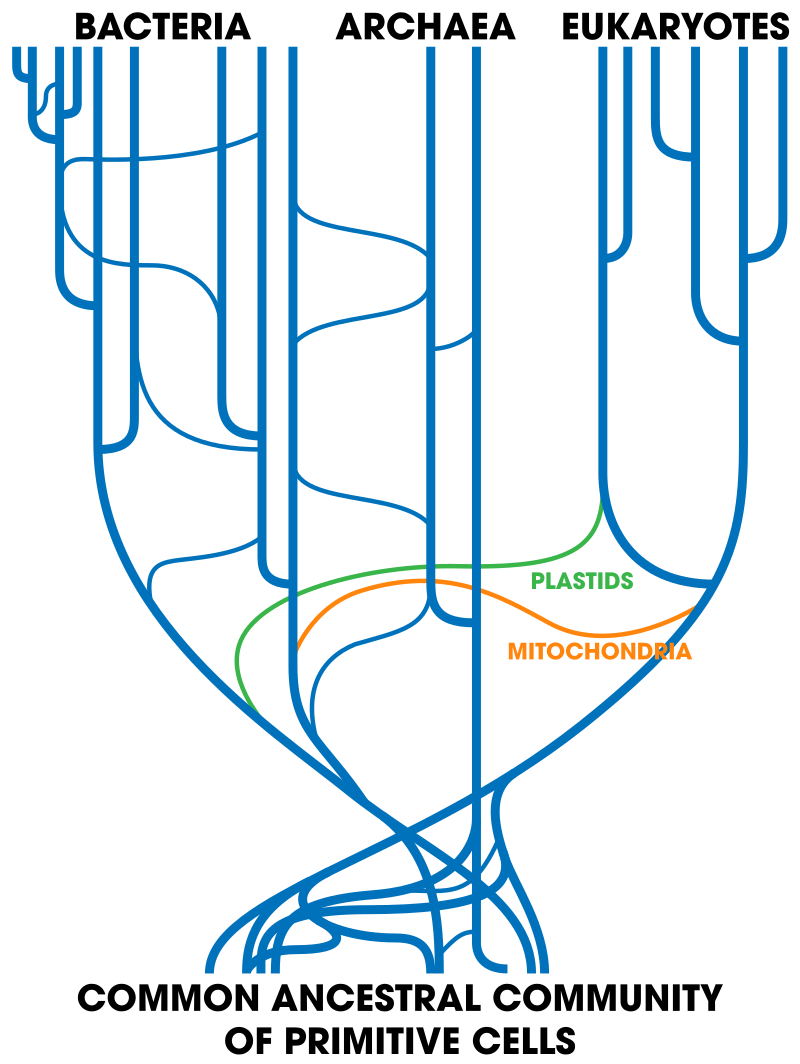
Tree of life showing vertical and horizontal gene transfers Horizontal gene transfer (HGT) or lateral gene transfer (LGT) is the movement of genetic material between organisms other than by the ("vertical") transmission of DNA from parent to offspring (reproduction). HGT is an important factor in the evolution of many organisms. HGT is influencing scientific understanding of higher-order evolution while more significantly shifting perspectives on bacterial evolution.
Horizontal gene transfer is the primary mechanism for the spread of antibiotic resistance in bacteria, and plays an important role in the evolution of bacteria that can degrade novel compounds such as human-created pesticides and in the evolution, maintenance, and transmission of virulence. It often involves temperate bacteriophages and plasmids. Genes responsible for antibiotic resistance in one species of bacteria can be transferred to another species of bacteria through various mechanisms of HGT such as transformation, transduction and conjugation, subsequently arming the antibiotic resistant genes' recipient against antibiotics. The rapid spread of antibiotic resistance genes in this manner is becoming a challenge to manage in the field of medicine. Ecological factors may also play a role in the HGT of antibiotic resistant genes.
Excerpted from Wikipedia’s “horizontal gene transfer” article, available under the CC BY-SA 4.0 licence.