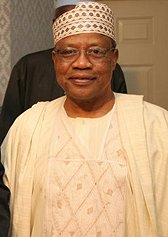
File:Ibrahim_Babangida_(cropped).jpg · Wikimedia Commons · See Wikimedia Commons
Ibrahim Babangida
Sign in to saveAlso known as Ibrahim Badamosi Babangida, Ibrahim Badamasi Babangida, IBB, IBB, 1941-, Babangida, Ibrahim Badamasi, 1941-
Head of State of Nigeria
Key facts
- Vice president
- Ebitu Ukiwe , (1985–1986) Augustus Aikhomu , (1986–1993)
- Preceded by
- Muhammadu Buhari , (as Military Head of State )
- Succeeded by
- Ernest Shonekan , (as Interim Head of State )
- Born
- ( 1941-08-17 ) 17 August 1941 (age 84) , Minna , Northern Region, British Nigeria, (now in Niger State , Nigeria)
- Party
- Peoples Democratic Party
- Spouse
- Maryam Babangida ( married</span>"}]]}'>m. 6 September 1969</span>"}]]}'>1969 ; died 2009 )
- Alma mater
- Royal Armoured Centre
- Occupation
- Politician military officer
- Allegiance
- Nigeria
- Branch
- Nigerian Army
- Service years
- 1962–1993
- Rank
- General
- Conflict
- Nigerian Civil War
via Wikipedia infobox
Wikidata facts
- Instance of
- human
- Given name
- Ibrahim
- Gender
- male
- Citizenship
- Nigeria
- Place of birth
- Minna
- Occupation
- politician
- Political party
- Peoples Democratic Party
- Languages spoken
- Nigerian Pidgin
- Religion
- Islam
- Award
- Order of the Nigeria
- Conflict
- Nigerian Civil War
- Military rank
- general
- Image
- Ibrahim Babangida (cropped).jpg
Show 4 more facts
- Commons category
- Ibrahim Babangida
- date of birth
- 1941-08-17
- name in native language
- Ibrahim Babangida
- start of work period
- 1962-00-00
Sources (2)
via Wikidata · CC0
~22 min read
Encyclopedic overview
Ibrahim Badamasi BabangidaListen GCFR GCB (born 17 August 1941) is a Nigerian general and politician who ruled as military president of Nigeria from 1985 when he orchestrated a coup d'état against Muhammadu Buhari, until his resignation in 1993 as a result of the crisis of the Third Republic.
He rose through the ranks of the Nigerian Army fighting in the Nigerian Civil War and at various times being involved in almost all the military coups in Nigeria, before advancing to the rank of a General and ultimately as Commander-in-Chief of the Armed Forces; and as an unelected President and military dictator from 1985 to 1993, ruling for an uninterrupted period of eight years. His years in power, colloquially known as the Babangida Era, are considered one of the most controversial in Nigerian political and military history, being characterized by a burgeoning political culture of corruption in Nigeria, with Babangida and his regime estimated to have misappropriated at least 12 billion dollars (23.9 billion today).
Excerpted from Wikipedia’s “Ibrahim Babangida” article, available under the CC BY-SA 4.0 licence.