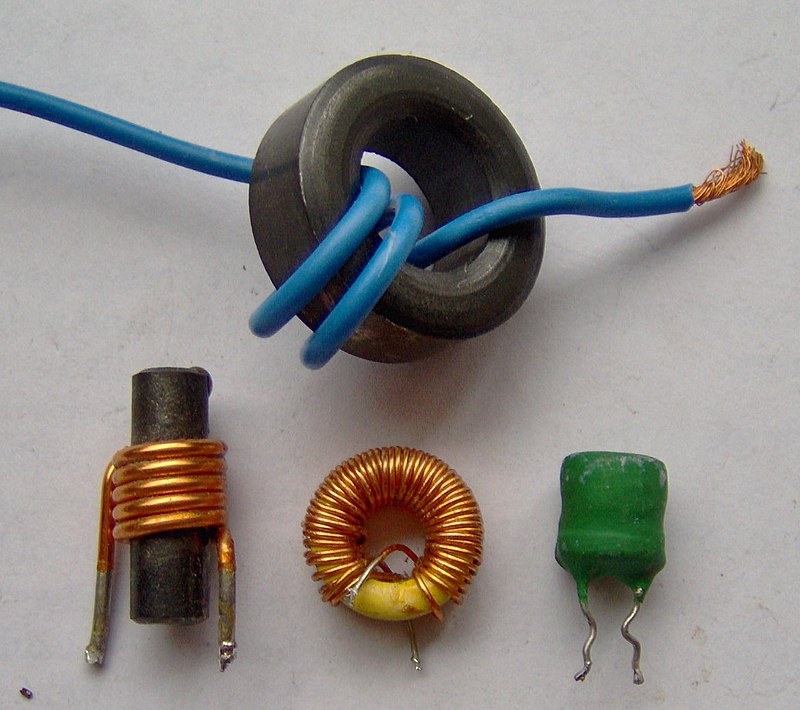
File:Electronic_component_inductors.jpg · Wikimedia Commons · See Wikimedia Commons
inductor
Sign in to saveAlso known as passive two terminal, choke
An inductor, also called a coil, choke, or reactor, is a passive two-terminal electrical component that stores energy in a magnetic field when an electric current flows through it. An inductor typically consists of an insulated wire wound into a coil.
An inductor is an electrical component made from coiled wire that stores energy in a magnetic field when electricity flows through it. It matters because this ability to store and release magnetic energy makes it useful for controlling electrical currents and power in countless devices and circuits.
AI-generated from the Wikipedia summary — may contain errors.
Key facts
- Electronic component.component
- Inductor
- Electronic component.image
- Electronic component inductors.jpg
- Electronic component.caption
- A selection of low-value inductors
- Electronic component.type
- Passive
- Electronic component.working_principle
- Electromagnetic induction
- Electronic component.invented
- Michael Faraday
- Electronic component.symbol
- 100px
- Electronic component.invention_Year
- 1831
- Electronic component.terminal_number
- 2
via Wikipedia infobox
Wikidata facts
- Subclass of
- electromagnet
- Image
- Electronic component inductors.jpg
Show 4 more facts
- Commons category
- Inductors
- Commons gallery
- Inductor
- has characteristic
- inductance
- on focus list of Wikimedia project
- Wikipedia:Vital articles/Level/4
via Wikidata · CC0
~41 min read
Encyclopedic overview
32 sectionsContents
- Description
- Constitutive equation
- Lenz's law
- Energy stored in an inductor
- Derivation
- Voltage step response
- Ideal and real inductors
- ''Q'' factor
- Applications
- Inductor construction
- Shielded inductors
- Types
- Air-core inductor
- Radio-frequency inductor
- Ferromagnetic-core inductor
- Laminated-core inductor
- Ferrite-core inductor
- Powdered-iron-core inductor <span class="anchor" id="powdered_iron_anchor"></span>
- Toroidal-core inductor
- Variable inductor
- Choke
- Circuit analysis
- Reactance
- Corner frequency
- Laplace circuit analysis ({{mvar|s}}-domain)
- Inductor networks
- Mutual inductance
- Inductance formulas
- See also
- Notes
- References
- External links
An inductor, also called a coil, choke, or reactor, is a passive two-terminal electrical component that stores energy in a magnetic field when an electric current flows through it. An inductor typically consists of an insulated wire wound into a coil.
When the current flowing through the coil changes, the time-varying magnetic field induces an electromotive force (emf), or voltage, in the conductor, described by Faraday's law of induction. According to Lenz's law, the induced voltage has a polarity (direction) which opposes the change in current that created it. As a result, inductors oppose any changes in current through them.
Excerpted from Wikipedia’s “inductor” article, available under the CC BY-SA 4.0 licence.
Gallery (38)
Available in 102 languages
- Español
- Français
- Deutsch
- 中文
- 日本語
- Русский
- Português
- Italiano
- العربية
- हिन्दी
- abstract
- Afrikaans
- Albanian
- Albanian
- Amharic
- Aragonese
- Assamese
- Asturian
Show 83 more
- azb
- Azerbaijani
- Bahasa Indonesia
- Bangla
- Bashkir
- Basque
- be_x_old
- Belarusian
- Bosnian
- Bulgarian
- Burmese
- Catalan
- Chechen
- Chuvash
- Croatian
- Czech
- Egyptian Arabic
- Esperanto
- Estonian
- Fiji Hindi
- Filipino
- Finnish
- Galician
- Greek
- Haitian Creole
- Hebrew
- Hungarian
- Icelandic
- Ido
- Interlingua
- Javanese
- Kazakh
- Kurdish
- Kyrgyz
- Latin
- Latvian
- Lithuanian
- Lombard
- Macedonian
- Malay
- Malayalam
- Marathi
- Mongolian
- Nederlands
- Nepali
- Newari
- Northern Frisian
- Norwegian Nynorsk
- Occitan
- Oromo
- Piedmontese
- Polski
- Punjabi
- Quechua
- Romanian
- Serbian
- Serbian (Latin)
- Sicilian
- simple
- Sindhi
- Sinhala
- Slovak
- Slovenian
- Svenska
- Swahili
- Tajik
- Tamil
- Tatar
- Tiếng Việt
- Türkçe
- Ukrainian
- Urdu
- Uzbek
- Waray
- Welsh
- Western Panjabi
- Wolof
- Wu Chinese
- Yiddish
- zh_yue
- فارسی
- ไทย
- 한국어
via Wikidata sitelinks · CC0