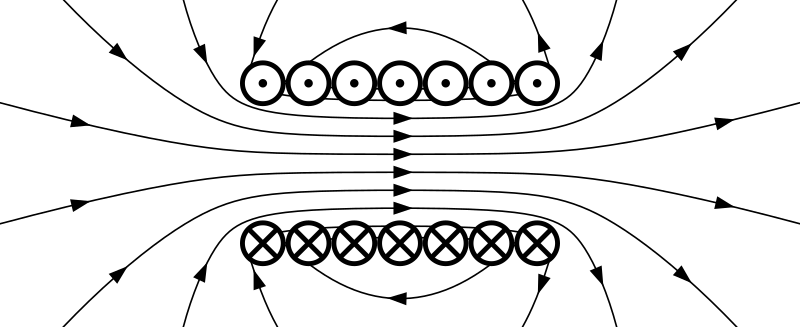
File:VFPt_Solenoid_correct2.svg · Wikimedia Commons · See Wikimedia Commons
inductance
Sign in to saveAlso known as magnetic inductance, self-inductance
Inductance is the tendency of an electrical conductor to oppose a change in the electric current flowing through it. The electric current produces a magnetic field around the conductor. The magnetic field strength depends on the magnitude of the electric current, and therefore follows any changes in the magnitude of the current. From Faraday's law of induction, any change in magnetic field through a circuit induces an electromotive force (EMF) (voltage) in the conductors, a process known as electromagnetic induction. This induced voltage created by the changing current has the effect of opposi
Inductance is the tendency of an electrical conductor to resist changes in the electric current flowing through it, which happens because a changing current produces a changing magnetic field that creates an opposing voltage. This property matters because it affects how electrical circuits respond to current changes, influencing everything from the behavior of power systems to the operation of electronic devices.
AI-generated from the Wikipedia summary — may contain errors.
Key facts
- Physical quantity.name
- Inductance
- Physical quantity.unit
- henry (H)
- Physical quantity.baseunits
- kg⋅m2⋅s−2⋅A−2
- Physical quantity.dimension
- M1·L2·T−2·I−2
via Wikipedia infobox
Described at

Inductance – The Physics Hypertextbook
When current is turned on in a solenoid, a magnetic field is generated that tries to stop the solenoid from being turned on. This property is called inductance., When current is turned on in a solenoid, a magnetic field is generated that tries to stop the solenoid from being turned on. This property is called inductance.
physics.info →Let's walk through these equations again, but with a time-varying twist. A solenoid with a changing current running through it will generate a changing magnetic field. which may not look like much, until you realize that the terms in the first fraction are largely determined by the geometry of the solenoid. Had we chosen a different configuration of wires, the same basic thing would have happened. Inductance is best defined by its role in the equation derived from Faraday's law of induction. (This is how we will derive the inductance equations for a few easy circuit elements later in this section.) Some people don't like this and prefer definitions written in the subject-verb-object form of a simple sentence. The unit of inductance is the henry, named after Joseph Henry US") (1797–1878), the American scientist who discovered electromagnetic induction independently of and at about the same time as Michael Faraday England") (1791–1867) did in England. Faraday published his findings first and so gets most of the credit. Henry also discovered self inductance and mutual inductance (which will be described later in this section) and invented the electromechanical relay (which was the basis for the telegraph). A circuit with a self inductance of one henry will experience a back emf of one volt when the current changes at a rate of one ampère per second. Inductance is a function of geometry. Let's derive some inductances for a few circuit elements with simple geometries. (There aren't many.) Start with the definition of magnetic flux for a region of uniform strength. We can't assume a uniform field strength in this case. Start with an equation for magnetic flux that can handle this. One that integrates an infinite number of infinitesimally small areas where the field is effectively constant. The difference in two logs is the log of their ratios. (That's not quite the right way to say it.) I haven't figured out how to explain this one yet. Here's the answer. The function cosh−1 is the inverse hyperbolic cosine, by the way. Fun stuff.
Excerpt from a page describing this subject · 12,673 chars · not written by Vinony
Wikidata facts
- Subclass of
- scalar quantity
- Image
- Inductor.jpg
Show 5 more facts
- on focus list of Wikimedia project
- Wikipedia:Vital articles/Level/4
- Stack Exchange tag
- physics.stackexchange.com/tags/inductance
- maintained by WikiProject
- WikiProject Mathematics
- characteristic of
- inductor
- described at URL
- physics.info/inductance
via Wikidata · CC0
~40 min read
Encyclopedic overview
33 sectionsContents
- History
- Source of inductance
- Self-inductance and magnetic energy
- Inductive reactance
- Calculating self-inductance
- Straight single wire
- Practical formulas
- Wire loop
- Solenoid
- Coaxial cable
- Multilayer coils
- Magnetic cores
- Mutual inductance
- Definition of Mutual induction or Coefficient of mutual induction
- Mutual inductance of two parallel straight wires
- Mutual inductance of two wire loops
- Derivation
- Derivation of mutual inductance
- Mutual inductance and magnetic field energy
- Coupling coefficient
- Matrix representation
- Multiple Coupled Inductors
- Equivalent circuits
- T-circuit
- π-circuit
- Resonant transformer
- Ideal transformers
- Self-inductance of thin wire shapes
- See also
- Footnotes
- References
- General references
- External links
Inductance is the tendency of an electrical conductor to oppose a change in the electric current flowing through it. The electric current produces a magnetic field around the conductor. The magnetic field strength depends on the magnitude of the electric current, and therefore follows any changes in the magnitude of the current. From Faraday's law of induction, any change in magnetic field through a circuit induces an electromotive force (EMF) (voltage) in the conductors, a process known as electromagnetic induction. This induced voltage created by the changing current has the effect of opposing the change in current. This is stated by Lenz's law, and the voltage is called back EMF.
Inductance is defined as the ratio of the induced voltage to the rate of change of current causing it. It is a proportionality constant that depends on the geometry of circuit conductors (e.g., cross-section area and length) and the magnetic permeability of the conductor and nearby materials. An electronic component designed to add inductance to a circuit is called an inductor. It typically consists of a coil or helix of wire.
Excerpted from Wikipedia’s “inductance” article, available under the CC BY-SA 4.0 licence.
Gallery (13)
Available in 69 languages
- Español
- Français
- Deutsch
- 中文
- 日本語
- Русский
- Português
- Italiano
- العربية
- हिन्दी
- Afrikaans
- Albanian
- Amharic
- Armenian
- Asturian
- Azerbaijani
- Bahasa Indonesia
- Bangla
Show 50 more
- Basque
- Bavarian
- be_x_old
- Belarusian
- Bulgarian
- Catalan
- Chuvash
- Croatian
- Czech
- Danish
- Esperanto
- Estonian
- Finnish
- Galician
- Georgian
- Greek
- Haitian Creole
- Hebrew
- Icelandic
- Irish
- Kyrgyz
- Latvian
- Lithuanian
- Macedonian
- Malay
- Nederlands
- Newari
- Northern Frisian
- Norwegian
- Norwegian Nynorsk
- Polski
- Romanian
- Serbian
- Serbian (Latin)
- Slovak
- Slovenian
- Svenska
- Tamil
- Tatar
- Tiếng Việt
- Türkçe
- Turkmen
- Ukrainian
- Uzbek
- Wolof
- Wu Chinese
- zh_min_nan
- zh_yue
- فارسی
- 한국어
via Wikidata sitelinks · CC0