File:Interference_of_two_waves.svg · Wikimedia Commons · See Wikimedia Commons
interference
Sign in to saveAlso known as phase interference, wave interference
phenomenon in which two coherent waves combine into a resultant wave with greater intensity or lower amplitude
Interference happens when two waves overlap and combine to create a new wave that can be either stronger or weaker than the original waves. It matters because it explains many everyday phenomena, from the colors in soap bubbles to how noise-canceling headphones work, and is fundamental to how light and sound behave.
AI-generated from the Wikipedia summary — may contain errors.
Wikidata facts
- Instance of
- phenomenon
- Subclass of
- physical law
- Part of
- physics
- Image
- Interference of two waves.svg
Show 6 more facts
- Stack Exchange tag
- physics.stackexchange.com/tags/interference
- on focus list of Wikimedia project
- Wikipedia:Vital articles/Level/4
- Commons category
- Interference
- Commons gallery
- Interference
- topic's main category
- Category:Interference
- described at URL
- www.youtube.com/watch?v=ugZBrWlHETQ
Sources (2)
via Wikidata · CC0
~27 min read
Encyclopedic overview
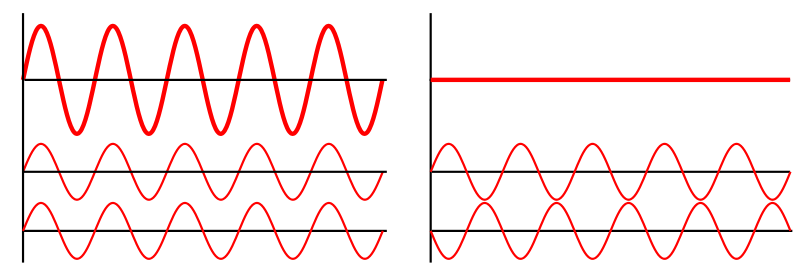
The interference of two waves. In phase: the two lower waves combine (left panel), resulting in a wave of added amplitude (constructive interference). Out of phase: (here by 180 degrees), the two lower waves combine (right panel), resulting in a wave of zero amplitude (destructive interference). Interfering water waves on the surface of a lake
In physics, interference is a phenomenon in which two coherent waves are combined by adding their intensities or displacements with due consideration for their phase difference. The resultant wave may have greater amplitude (constructive interference) or lower amplitude (destructive interference) if the two waves are in phase or out of phase, respectively. Interference effects can be observed with all types of waves, for example, light, radio, acoustic, surface water waves, gravity waves, or matter waves as well as in loudspeakers as electrical waves.
Excerpted from Wikipedia’s “interference” article, available under the CC BY-SA 4.0 licence.
Gallery (12)
Available in 72 languages
- Español
- Français
- Deutsch
- 中文
- 日本語
- Русский
- Português
- Italiano
- العربية
- हिन्दी
- Amharic
- Armenian
- Asturian
- Azerbaijani
- Bahasa Indonesia
- Bangla
- Basque
- Belarusian
Show 53 more
- Bosnian
- Bulgarian
- Catalan
- Chuvash
- Croatian
- Czech
- Danish
- Esperanto
- Estonian
- Filipino
- Finnish
- Galician
- Greek
- Haitian Creole
- Hebrew
- Hungarian
- Ido
- Interlingua
- Irish
- Kannada
- Latvian
- Lithuanian
- Luxembourgish
- Macedonian
- Malay
- Malayalam
- Mongolian
- Nederlands
- Norwegian
- Norwegian Nynorsk
- Polski
- Punjabi
- Romanian
- Serbian
- Serbian (Latin)
- simple
- Slovak
- Slovenian
- Svenska
- Tamil
- Tatar
- Tiếng Việt
- Türkçe
- Ukrainian
- Urdu
- Uzbek
- Welsh
- Wu Chinese
- zh_min_nan
- zh_yue
- فارسی
- ไทย
- 한국어
via Wikidata sitelinks · CC0