
Iraq
Sign in to saveAlso known as Republic of Iraq, iq
Iraq, officially the Republic of Iraq, is a country in West Asia. Located within the geo-political region of the Middle East, it is bordered by Saudi Arabia to the south, Turkey to the north, Iran to the east, the Persian Gulf and Kuwait to the southeast, Jordan to the southwest, and Syria to the west. The country covers an area of and has a population of over 46 million, making it the 58th largest country by area and the 31st most populous in the world. Baghdad, home to over 8 million people, is the capital city and the largest in the country.
OverviewAI-generated
Iraq, officially the Republic of Iraq, is a country in Western Asia. Its capital is Baghdad. The nation operates as a federal republic with a head of state holding the office of President of Iraq and a head of government serving as Prime Minister of Iraq. The legislative body is the Council of Representatives of Iraq. Iraq gained its inception on 1932-01-01. The country’s motto is Takbir, and its currency is the Iraqi dinar.
The population is recorded at various figures, including 38274618, 46118793, and 46042015. The ethnic groups include Arabs, Kurds in Iraq, Iraqi Turkmen, and Assyrians in Iraq. Approximately 69.8861494108913 percent of the population lives in urban areas. The area of the country is 438317. The time zone is UTC+03:00, and the top-level domain is .iq. Diplomatic relations exist with the United States, Italy, Australia, and Germany.
Notable attributes include a life expectancy of 72.424 years and an unemployment rate of 15.485 percent. The forest area constitutes 1.90035242899592 percent of the land, while renewable energy accounts for 1.1 percent. Internet users make up 81.47450256 percent of the population. The number of out-of-school children is 2345088. The GDP is 279641257615.385 USD. The license plate code is IRQ.
Synthesized by Vinony from 67 facts across 9 sources: Wikidata, REST Countries, Openweathermap, Open Meteo, World Bank, OpenStreetMap, PubMed, Vinony graph, Geo. Generated from structured data (not the Wikipedia text) and checked against those facts — may still contain errors.
Weather now
cached 16h ago7-day forecast
via Open-Meteo
Country
- Capital
- Baghdad
- Population
- 46,118,793
- Region
- Asia · Western Asia
- Demonym
- Iraqi
- Currencies
- IQD (ع.د)
- Languages
- Arabic, Aramaic, Sorani
- Calling code
- +964
- Drives on
- Right
- Gini
- 29.5 (2012)
- FIFA code
- IRQ
- TLD
- .iq
- Timezones
- UTC+03:00
- Borders
- IRN, JOR, KWT, SAU, SYR, TUR
via REST Countries
Indicators · World Bank
- GDP
- $279.6B(2024)
- Population
- 46,042,015(2024)
- Life expectancy
- 72.4 yrs(2024)
- Unemployment
- 15.5 %(2025)
- Urban population
- 69.9 %(2024)
- Internet users
- 81.5 %(2024)
- Forest area
- 1.9 %(2023)
- Renewable energy
- 1.1 %(2021)
via World Bank Open Data · CC BY 4.0
Wikipedia views (30d)
157,066 totalvia Wikimedia Pageviews API
Key facts
- Country.conventional_long_name
- Republic of Iraq
- Country.common_name
- Iraq
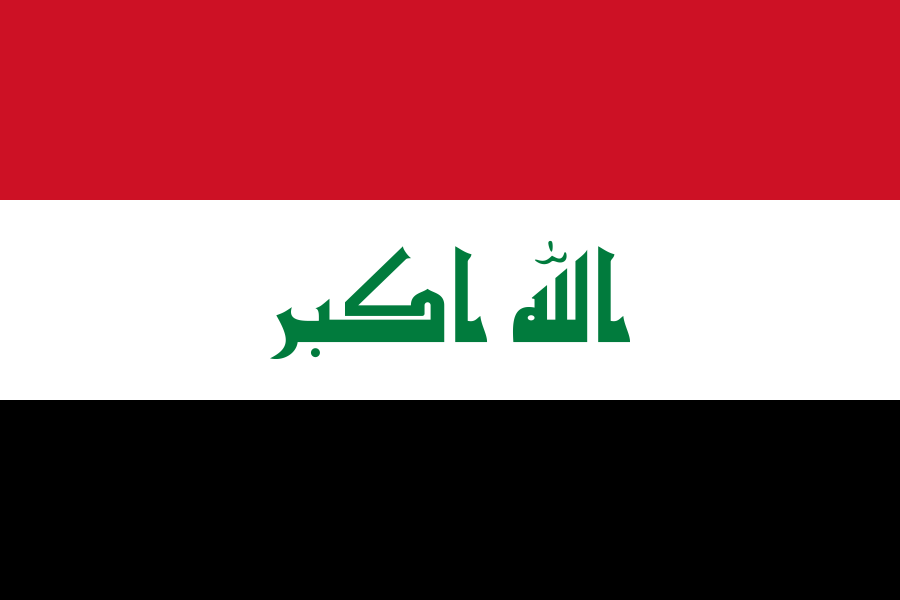
- Country.image_flag
- Flag of Iraq.svg
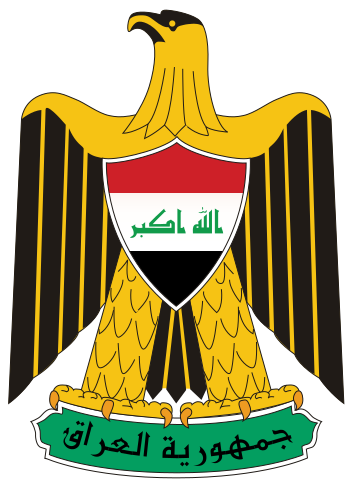
- Country.image_coat
- Coat of arms of Iraq.svg
- Country.coa_size
- 80
- Country.map_width
- 250px
- Country.national_anthem
- "My Homeland"
- Country.capital
- Baghdad
- Country.largest_city
- capital
- Country.religion
- 90–95% Islam (official) 61% Shia 35% Sunni 5–10% Christianity, Mandaeism, Yazidism, Judaism, Yarsanism, irreligion and others
- Country.religion_year
- 2020
- Country.demonym
- Iraqi
- Country.government_type
- Federal parliamentary republic
- Country.leader_title1
- President
- Country.leader_name1
- Abdul Latif Rashid
- Country.leader_title2
- Prime Minister
- Country.leader_name2
- Mohammed Shia' al-Sudani
- Country.leader_title3
- Speaker
via Wikipedia infobox
Research
35,950 papers- Toward a healthier Iraq.ReviewThe Yale journal of biology and medicine · 2014Al Hilfi TK
- Suicide and suicidality in Iraq: a systematic review.Medicine, conflict, and survival · 2023Younis MS, Lafta RKDOI: 10.1080/13623699.2023.2170580
- Emerging pneumococcal serotypes in Iraq: scope for improved vaccine development.ReviewF1000Research · 2023Dawood HN, Al-Jumaili AH, Radhi AH et al.DOI: 10.12688/f1000research.132781.2
- Iraq tackles meningitis outbreak.The Lancet. Infectious diseases · 2023Bagcchi SDOI: 10.1016/S1473-3099(23)00447-4
- Iraq.Department of State publication. Background notes series · 1987United States. Department of State. Bureau of Public Affairs
- Iraq's children.Lancet (London, England) · 2000
- Review of Iraq's nationwide attempts to transform medical school curricula over the last ten decades.ReviewEastern Mediterranean health journal = La revue de sante de la Mediterranee orientale = al-Majallah al-sihhiyah li-sharq al-mutawassit · 2022Alsheikh G, Al-Sheikh M, Kadhim T et al.DOI: 10.26719/emhj.22.046
- A review of antibiotic misuse and bacterial resistance in Iraq.ReviewEastern Mediterranean health journal = La revue de sante de la Mediterranee orientale = al-Majallah al-sihhiyah li-sharq al-mutawassit · 2024Al-Jumaili AA, Ahmed KKDOI: 10.26719/2024.30.10.663
via PubMed
Wikidata facts
- Instance of
- country
- Part of
- Middle East
- Official name
- Republic of Iraq
- Demonym
- Iarácach
- Country
- Iraq
- Contains
- Karbala Governorate
- Continent
- Asia
- Capital
- Baghdad
- Official language
- Kurdish
- Currency
- Iraqi dinar
- Population
- 38274618
- Area
- 437072
- Time zone
- UTC+03:00
- Head of government
- Muhammad Shia' al-Sudani
- Head of state
- Abdul Latif Rashid
- Form of government
- federation
- Anthem
- Mawtini
- Shares border with
- Iran
- Highest point
- Cheekha Dar
- Follows
- Kingdom of Iraq
- Official website
- gds.gov.iq
- Image
- View of Sulaymaniyah (Slemani) City in Winter - Snow 2015.JPG
- Life expectancy
- 71
- Nominal GDP
- 264182173793
Show 67 more facts
- Unemployment rate
- 30
- Calling code
- +964
- Licence plate code
- IRQ
- Electrical plug type
- BS 1363
- Mains voltage
- 230
- Flag
- flag of Iraq
- Coat of arms
- coat of arms of Iraq
- topic's main Wikimedia portal
- Portal:Iraq
- motto
- Takbir
- ethnic group
- Yazidis
- Unicode character
- 🇮🇶
- category of associated people
- Category:Iraqi people
- geography of topic
- Geography of Iraq
- office held by head of government
- Prime Minister of Iraq
- permanent duplicated item
- Q12853974
- number of out-of-school children
- 2345088
- diplomatic relation
- Romania
- office held by head of state
- President of Iraq
- Commons gallery
- العراق
- inception
- 1932-01-01
- trunk prefix
- 0
- history of topic
- history of Iraq
- on focus list of Wikimedia project
- Wikipedia:Vital articles/Level/4
- mobile country code
- 418
- total fertility rate
- 4.566
- maritime identification digits
- 425
- marriageable age
- 18
- topic's main category
- Category:Iraq
- category for people buried here
- Category:Burials in Iraq
- category for films shot at this location
- Category:Films shot in Iraq
- category for people who died here
- Category:Deaths in Iraq
- Commons category
- Iraq
- top-level Internet domain
- .iq
- category for people born here
- Category:Births in Iraq
- driving side
- right
- lowest point
- Persian Gulf
- central bank
- Central Bank of Iraq
- language used
- Gulf Arabic
- culture
- culture of Iraq
- BTI Status Index
- 3.8
- BTI Governance Index
- 4.95
- economy of topic
- economy of Iraq
- demographics of topic
- demographics of Iraq
- official religion
- Islam
- Democracy Index
- 3.51
- replaces
- Coalition Provisional Authority
- topic has template
- Template:Governorates of Iraq
- P8168
- Will Point
- Human Development Index
- 0.686
- P11012
- Valdemar
- hashtag
- iraq
- Gini coefficient
- 29.5
- Happy Planet Index score
- 45.3
- Inequality-adjusted Human Development Index
- 0.554
- social media followers
- 81109
- described by source
- Encyclopædia Britannica 11th edition
- name in native language
- کۆماری عێراق
- native label
- Iraq
- P12749
- South Dakota
- birth rate
- 27.035
- male population
- 23161604
- death rate
- 4.433
- rural population
- 13757236
- female population
- 22957189
- urban population
- 32361557
- most populous urban area
- Baghdad
Sources (15)
via Wikidata · CC0
Travel guide
Understand
thumb|Ur
A country with a federal democracy, Iraq has a growing population of 40 million. As a member of the Arab League, it has experienced modern economic and military growth and historic instability through wars. Iraq is the home of the world's first civilizations, with a development of writing, agriculture and urbanity.
Get around
Due to the autonomous nature of Iraqi Kurdistan, travelling between Iraqi Kurdistan and the rest of Iraq will involve border inspections as if you were travelling internationally. In Kurdistan, public transport is rare although regular buses do link Zakho and Dohuk and cost about USD2. There are plans of a public bus network in Erbil, which is estimated to be launched after 2020. From Dohuk, shared taxis leave all day for Erbil and other cities. The road from Dohuk to Erbil goes south near Mosul, but does not leave Kurdish territory and is thus safe, although perhaps too close for comfort. Shared taxis might be the safest way to travel in Iraqi Kurdistan, as the drivers are not interested in leaving the province either. Shared taxis also may be your only method of traveling around outside Iraqi Kurdistan. If you are a foreigner, expect to be stopped at most checkpoints. Be ready to tip or pay more than the agreed upon amount for the inconvenience. The checkpoints really start to ramp up north of Tikrit. The road from Mosul to Kirkuk passes by Iraqi Kurdistan. Have your Iraqi visa ready.
See
thumb|Main courtyard of the Al-Kādhimiya Mosque in Baghdad thumb|The ancient ruins of Babylon
Since 1979, disastrous government and devastating wars have taken a toll on Iraq's travel industry. After the fall of the Saddam Hussein government, which was virulently hostile to Shia Islam, religious pilgrims, mostly from the Middle East, Iran, and Central Asia, have returned in large numbers to the holy sites of southern Iraq, especially to the spiritual home of Shia Islam in Karbala. Religious pilgrimage remains quite unsafe, but there is a greater degree of safety in numbers, and in being familiar with the Arab region. And of course, pilgrimage is a more urgent reason for travel than sightseeing!
One can only hope that this great and ancient region soon sees increased security and stability, for it makes a fascinating travel destination for anyone interested in history, be it in ancient history 4,000 years old, medieval Islamic and later Ottoman history, or the modern history of the early 21st century. The aforementioned conflicts and misgovernment have not been kind to Iraq's ruins, especially in terms of the massive rebuilding done on ancient Babylon by the Hussein government and later negligence by foreign military presence. But the pull of such ancient cities as the Babylonian capital Babylon; the ancient city of Ur, of mankind's first great civilizations, Sumeria; major Parthian cities at magnificent Hatra and the capital Ctesiphon; and the Assyrian capital of Ashur, rem…
Eat
thumb|Tepsi Baytinijan
Iraqi cuisine is centred on grilled meats, slow-cooked stews, rice, and fresh bread. Meals are social events — portions are generous, tea follows every dish, and refusing food is considered impolite. Street food is abundant and inexpensive throughout the country, while sit-down restaurants range from simple local grills to upmarket riverside establishments in Baghdad.
Masgouf is considered the national dish of Iraq. It is an open-cut carp (a freshwater fish) roasted for hours after being marinated with olive oil, salt, curcuma and tamarind while keeping the skin on. Traditional garnishes include lime, chopped onions, and tomatoes. It is often served with flatbread. The best masgouf is found along the Tigris in Baghdad, particularly on Abu Nawas Street, where restaurants prepare the fish over open wood fires.
Tepsi Baytinijan is another very popular dish: a baked casserole typically consisting of meatballs, aubergine, tomatoes, garlic, onions, and potatoes.
Quzi (or ghoozi) is slow-roasted lamb served over fragrant rice with almonds and raisins. It is the centrepiece of celebrations, weddings, and large family gatherings throughout Iraq.
Kubba (كبة) are fried or boiled bulgur wheat shells stuffed with spiced minced meat. Varieties differ by region — Mosul is known for its kubba mosuliya, while Baghdad's version is typically deep-fried and served with lime.
Tashreeb is a hearty stew poured over torn pieces of flatbread, allowing the bread to soak up…
Drink
The sale and importation of alcohol is prohibited in Iraq with a law passed in 2016 by the Iraqi parliament.
Sleep
Sleep in the hot summer months can be difficult. Sleeping outside and near flowing water is the most comfortable setting one can find outside of air conditioning.
In Iraqi Kurdistan, there are plenty of hotels and although they are hard to find in any travel guide, anyone on the street will direct you to a nearby place. There's no shortage in Zakho, Dohuk or Erbil. Rates run about USD15–25 per night for a single room with bathroom.
Hotels in Baghdad can be found on several popular booking sites. For a single room with a private bathroom, rates start at around 50 USD per night in winter and 70 USD per night in summer. Baghdad also boasts some more luxurious options like the five star Babylon Rotana hotel which costs 240-280 USD per night, depending on the season, for a single room.
Non-married couples should check the hotel's policy on sharing rooms prior to booking. Due to local cultural norms, some hotels may ask for proof of marriage before allowing couples to share a room.
Stay safe
Although things are gradually getting better, the political and security situation remain very unstable. If you decide to go, strongly consider hiring a local guide. Many highways have road blocks set up by not only the Iraqi government, but also by various local militias, who will inspect your documents and question your purpose of visit.
Stay healthy
It is not safe for short term visitors to drink the water anywhere in Iraq. It is best to always drink bottled water. It will usually be sold at vendors and large stores, and will be easy to find. Most Iraqi water companies pump their water directly from the Tigris or Euphrates rivers, treat it with ozone, and then filter it into bottles. Those with sensitive systems should not drink it. Many street vendors will offer drinks such as water with a lemon twist, which should be presumed unsafe for foreign visitors.
Those with experience in Iraq should use their discretion and past experience when purchasing drinks.
Drinking the local tea (chai) can be safe for some people since it is brought to a boil before serving, but when in doubt, insist that bottled water be used. Many kinds of water-borne disease, pollution, and infectious agents are not affected by boiling of water, and are still present in the water after boiling.
As a walk past an Iraqi butcher shop will demonstrate, food preparation standards are not the same as in Western countries, and consumption of local food can make a visitor ill. Try to bring your own. As tap water is generally not potable, you should especially avoid uncooked foods.
Should you find your body in the uncomfortable position of rejecting food and water due to something you shouldn't have drunk, immediately find someone who speaks Arabic and send them to a local pharmacist and request a product known locally as "InterStop" (similar to co-phenotr…
Respect
The Iraqis in general are humble, hospitable and down-to earth.
Travel guide from Wikivoyage (CC BY-SA 4.0)
~40 min read
Encyclopedic overview
51 sectionsContents
- Name
- History
- Bronze and Iron Age
- Antiquity
- Middle Ages
- Early Modern Period
- Modern Iraq
- Republic and Ba'athist Iraq
- Post-invasion Iraq
- Insurgency and Civil war
- 2019-2021 protests
- Period of stability (2022-present)
- Geography
- Climate
- Biodiversity
- Government and politics
- Law
- Military and law enforcement
- Foreign relations
- Human rights
- Administrative divisions
- Economy
- Tourism
- Transport
- Oil and energy
- Water supply and sanitation
- Infrastructure
- Demographics
- Cities and towns
- Ethnic groups
- Languages
- Religion
- Diaspora and refugees
- Health
- Education
- Culture
- Art
- Architecture
- Literature
- Music
- Media
- Cuisine
- Sport
- See also
- References
- Bibliography
- Further reading
- External links
- Government
- History
- Maps
Iraq, officially the Republic of Iraq, is a country in West Asia. Located within the Middle East, it is bordered by Saudi Arabia to the south, Turkey to the north, Iran to the east, the Persian Gulf and Kuwait to the southeast, Jordan to the southwest, and Syria to the west. The country covers an area of 438,317 square kilometres (169,235 sq mi) and has a population of over 46 million, making it the 58th largest country by area and the 31st most populous in the world. Baghdad, home to over 8 million people, is the capital city and the largest in the country.
Starting in the 6th millennium BC, the fertile plains between Iraq's Tigris and Euphrates rivers, referred to as Mesopotamia, fostered the rise of early cities, civilisations, and empires including Sumer, Akkad, Babylonia, and Assyria. Known as the cradle of civilisation, Mesopotamia saw the invention of astrology, mathematics, navigation, timekeeping, writing systems, the wheel, the sailboat, a calendar, and a law code. After the Arab conquest of Mesopotamia in the 7th century, Iraq became the metropole of the Abbasid Caliphate with Baghdad emerging as a global cultural and intellectual hub during the Islamic Golden Age, home to institutions such as the House of Wisdom. Following Baghdad's destruction by the Mongols in 1258, Iraq came under successive empires, and from the 16th until the 20th century, it was governed within the Ottoman system as a defined region known administratively as Ottoman Iraq.
Excerpted from Wikipedia’s “Iraq” article, available under the CC BY-SA 4.0 licence.
Gallery (39)
On the map
4 mapped locations
Available in 273 languages
- Español
- Français
- Deutsch
- 中文
- 日本語
- Русский
- Português
- Italiano
- العربية
- हिन्दी
- Abkhazian
- abstract
- Achinese
- Adyghe
- Afrikaans
- Akan
- Albanian
- Albanian
Show 254 more
- Amharic
- ami
- Angika
- Aragonese
- Aramaic
- Armenian
- Arpitan
- Assamese
- Asturian
- Avaric
- Awadhi
- azb
- Azerbaijani
- Bahasa Indonesia
- Balinese
- Bangla
- Bashkir
- Basque
- bat_smg
- Bavarian
- be_x_old
- Belarusian
- Betawi
- Bhojpuri
- Bikol
- Bishnupriya
- Bislama
- blk
- Bosnian
- Breton
- btm
- Buginese
- Bulgarian
- Buriat
- Burmese
- Catalan
- cbk_zam
- cdo
- Cebuano
- Central Dusun
- Central Kurdish
- Chechen
- Cherokee
- Church Slavic
- Chuvash
- Cornish
- Corsican
- Crimean Tatar
- Croatian
- Czech
- dag
- Danish
- Divehi
- dty
- Egyptian Arabic
- Erzya
- Esperanto
- Estonian
- Extremaduran
- Faroese
- Fiji Hindi
- Filipino
- Finnish
- fiu_vro
- Frafra
- Fula
- Gagauz
- Galician
- Gan Chinese
- gcr
- Georgian
- Gilaki
- Goan Konkani
- Gothic
- gpe
- Greek
- Guarani
- Gujarati
- Haitian Creole
- Hakka Chinese
- Hausa
- Hawaiian
- Hebrew
- Hungarian
- hyw
- Iban
- Icelandic
- Ido
- Iloko
- Inari Sami
- Ingush
- Interlingua
- Interlingue
- Inuktitut
- Irish
- Jamaican Creole English
- Javanese
- Kabardian
- Kabyle
- Kannada
- Kanuri
- Kara-Kalpak
- Karachay-Balkar
- Kashmiri
- Kashubian
- Kazakh
- kbp
- kge
- Khmer
- Kikuyu
- Kinyarwanda
- Komi
- Kongo
- Kotava
- Kurdish
- Kyrgyz
- Ladino
- Latin
- Latvian
- Lezghian
- Ligurian
- Limburgish
- Lingala
- Lingua Franca Nova
- Lithuanian
- lld
- Lojban
- Lombard
- Low German
- Lower Sorbian
- Luxembourgish
- Macedonian
- Madurese
- Maithili
- Malagasy
- Malay
- Malayalam
- Maltese
- Manipuri
- Manx
- Māori
- map_bms
- Marathi
- Mari
- Mazanderani
- Minangkabau
- Mingrelian
- Mirandese
- Moksha
- Mongolian
- Moroccan Arabic
- Navajo
- nds_nl
- Nederlands
- Nepali
- Newari
- Northern Frisian
- Northern Sami
- Norwegian
- Norwegian Nynorsk
- Novial
- Obolo
- Occitan
- Odia
- Old English
- olo
- Oromo
- Ossetic
- Pampanga
- Papiamento
- Pashto
- Pennsylvania German
- Picard
- Piedmontese
- Polski
- Punjabi
- Quechua
- roa_rup
- roa_tara
- Romanian
- Rusyn
- Samoan
- Sanskrit
- Santali
- Sardinian
- Saterland Frisian
- Scots
- Scottish Gaelic
- Serbian
- Serbian (Latin)
- Shan
- Shona
- Sicilian
- Silesian
- simple
- Sindhi
- Sinhala
- skr
- Slovak
- Slovenian
- Somali
- Sundanese
- Svenska
- Swahili
- Swati
- syl
- szy
- Tajik
- Talysh
- Tamil
- Taroko
- Tatar
- tay
- Telugu
- Tetum
- Tibetan
- Tiếng Việt
- Tok Pisin
- Toki Pona
- Tongan
- Tumbuka
- Türkçe
- Turkmen
- Tyap
- Udmurt
- Ukrainian
- Upper Sorbian
- Urdu
- Uyghur
- Uzbek
- Venetian
- Veps
- Volapük
- Walloon
- Waray
- Welsh
- West Flemish
- Western Frisian
- Western Panjabi
- Wolof
- Wu Chinese
- Yakut
- Yiddish
- Yoruba
- Zaza
- Zeelandic
- zh_classical
- zh_min_nan
- zh_yue
- Zhuang
- Zulu
- فارسی
- ไทย
- 한국어
via Wikidata sitelinks · CC0