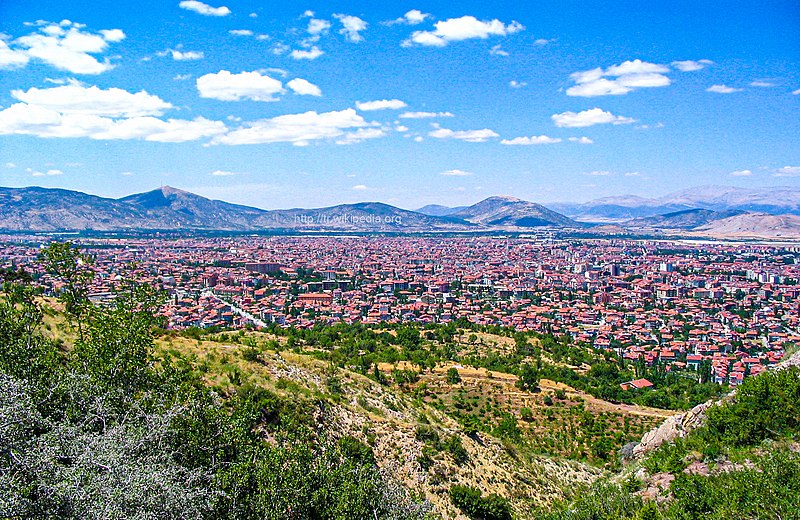
File:DaglardanIsparta.jpg · Wikimedia Commons · See Wikimedia Commons
Isparta
Sign in to saveAlso known as Isparta City
Isparta is a city in western Turkey. It is the seat of Isparta Province and Isparta District. Its population is 247,580 (2022). Its elevation is 1035 m. It is known as the "City of Roses". Isparta is well-connected to other parts of Turkey via roads. Antalya lies 130 km to the south and Eskişehir is 350 km to the north. Süleyman Demirel University has introduced thousands of youths from varied backgrounds to the city's mostly conservative fabric in recent years. The city’s football team, Isparta 32 Spor, was founded in 1976 in Isparta. The club’s colors are green and pink, and the te
OverviewAI-generated
Isparta is a city and municipality in Turkey, serving as the capital of Isparta Province. It is located in the Akdeniz Bölgesi region at an elevation of approximately 1,035 meters above sea level. The city operates on Eastern European Time (UTC+03:00) and uses the local dialing code 0246.
With a population of 258,375, Isparta has an urban population of 245,784 and a rural population of 243,020. The postal code for the area is 32000. The city is twinned with Comrat, Genk, and Hamadan.
Synthesized by Vinony from 52 facts across 7 sources: Wikidata, Open Meteo, Openweathermap, OpenStreetMap, GeoNames, Vinony graph, Geo. Generated from structured data (not the Wikipedia text) and checked against those facts — may still contain errors.
Weather now
cached 9h ago7-day forecast
via Open-Meteo
Place details
- Locality
- Isparta Merkez
- Region
- Isparta
- Country
- Türkiye
- Population
- 172,334
- Timezone
- Europe/Istanbul
via OpenStreetMap · GeoNames
Key facts
- Turkey place.type
- municipality
- Turkey place.name
- Isparta
- Turkey place.image_skyline
- DaglardanIsparta.jpg
- Turkey place.image_caption
- Isparta seen from a mountain
- Turkey place.image_logo
- Isparta Belediyesi logo.svg
- Turkey place.province
- Isparta
- Turkey place.district
- Isparta
- Turkey place.leader_party
- AK Party
- Turkey place.leader_name
- Şükrü Başdeğirmen
- Turkey place.elevation_m
- 1035
- Turkey place.population_total
- 247580
- Turkey place.population_as_of
- 2022
- Turkey place.postal_code
- 32000
- Turkey place.area_code
- 0246
via Wikipedia infobox
Wikidata facts
- Instance of
- district of Turkey
- Official name
- Isparta
- Country
- Turkey
- Located in
- Isparta Province
- Population
- 247580
- Elevation
- 1035
- Time zone
- UTC+03:00
- Capital of
- Isparta Province
- Official website
- isparta.bel.tr
- Image
- DaglardanIsparta.jpg
- Dialing code
- 0246
Show 13 more facts
- twinned administrative body
- Hamadan
- Commons category
- Isparta
- topic's main category
- Category:Isparta
- postal code
- 32000
- Commons gallery
- Isparta
- category of associated people
- Category:People from Isparta
- social media followers
- 9000
- urban population
- 245784
- rural population
- 21198
- native label
- Isparta
- described by source
- Encyclopædia Britannica 11th edition
- P12749
- August 7
- maintained by WikiProject
- WikiProject Cities
via Wikidata · CC0
Travel guide
Understand
Isparta in antiquity was Baris (Σπάρτη). It stands at an altitude of 1065 m, chilly in winter, but the climate and volcanic soil suits roses. In 1887 many refugees fled here from Bulgaria, especially from Kazanlak, when the decaying Ottoman Empire was yet again trounced in war by expanding Russia. They brought with them the secret of preparing Attar of Rose perfume, and a stock of rose cultivars. This is now the city's main industry: even with the advent of synthetics, this oil remains the basis for rose-scented perfumes, and a valuable byproduct of its extraction is rose water. Petals are harvested at dawn May to June before the sun's warmth opens the buds and releases the oil, a labour-intensive task as 100 kg of petals yields only 25 g of oil. The oil is sold in bulk to the perfume manufacturers with none on sale locally to tourists (and the pure oil is irritant) but there are plenty of rose water products.
The city was badly damaged by an earthquake in 1914. A few mosques were repaired but almost everything else was re-built anew. Isparta is therefore a modern town and doesn't have an old quarter.
Visitor information is available online from the Turkish Tourism Ministry.
Get around
The town sights are all within walking distance. You need your own wheels for outlying sights.
See
thumb | 300px | Near the carpet museum Isparta Museum near the railway station has been "temporarily closed" since about the outbreak of the Trojan Wars. or Grand Mosque is the city's oldest, built in 1429. It was wrecked in the earthquake of 1914 and restored in 1922. Further renovation from 2022 has plonked an underground car park entrance in front of it. Firdevs-Bey Mosque is from 1561. It's 200 m north of Kutlubey Mosque, at Mimar Sinan Cd 24. Cankaya Museum is shown on maps northwest edge of town but is a hoax, it's just a pumpkin patch.
Do
thumb | 300px | Rose oil is the city's main industry Hamams - traditional Turkish baths - are found in a dozen locations. One of the most central is Karaağaç on Firdevs Cd, 500 m south of the railway station, open daily 09:00-01:00. Football: Isparta 32 SK play soccer in TFF 2 Lig, the third tier. Their home ground Atatürk Stadium (capacity 4300) is 500 m southwest of the railway station. The town's other club Ispartaspor folded in 2014.
Buy
Lots of small supermarkets, Bim is the main chain, mostly open daily 09:00-21:00.
Eat
Most eating places are north of the centre, in the streets near Barida Hotels. The old bus station stood here so it's a question how many will survive now that clientele has gone. A smaller group is southwest of the railway station at the foot of Istasyon Cd.
Drink
Near the intersection of Atatürk Cd and Istasyon Cd are Barcelona, Huni Cafe Bar and Beygir Pub.
Sleep
thumb | 300px | Eğirdir Castle
Connect
Isparta and its approach roads have 4G from all Turkish carriers. As of Nov 2024, 5G has not rolled out in Turkey.
Go next
Akşehir is best known as the home of Nasruddin Hoca. Burdur has a good museum. Konya, origin of the "dancing dervishes", has fine Seljuk architecture. Antalya is a large lively beach resort.
Travel guide from Wikivoyage (CC BY-SA 4.0)
~9 min read
Encyclopedic overview
13 sectionsContents
- History
- Roman era
- Notable flight crashes
- Titular see
- Economy
- Climate
- Sights
- Notable people
- Mayors of Isparta
- Twin towns – sister cities
- See also
- References
- Sources and external links
Isparta is a city in western Turkey. It is the seat of Isparta Province and Isparta District. Its population is 247,580 (2022). Its elevation is 1035 m. It is known as the "City of Roses". Isparta is well-connected to other parts of Turkey via roads. Antalya lies 130 km to the south and Eskişehir is 350 km to the north. Süleyman Demirel University has introduced thousands of youths from varied backgrounds to the city's mostly conservative fabric in recent years. The city’s football team, Isparta 32 Spor, was founded in 1976 in Isparta. The club’s colors are green and pink, and the team plays its home matches at the 4,345-seat Isparta Atatürk City Stadium. It currently competes in the TFF Second League.
== History == thumb| Men, the local god. Statue in Hellenistic style, Roman period, +/- 2nd century AD in Isparta Museum ===Roman era=== Isparta is a Turkish spelling of Greek Sparta, by prothesis declustering. Isparta was said to correspond to the ancient city of Baris, which is a namesake and was part of the Roman province of Pisidia. A later theory has it instead as the Eastern Roman fortress Saporda; in Muslim sources it appears as Sabarta. GE Bean characterized the situation thus: "These perpetually shifting conceptions leave the reader quite bewildered." Modern scholars locate Baris near Kılıç, in Keçiborlu district, Isparta province. At an early stage it became a Christian bishopric, a suffragan of the Metropolitan see of Antioch of Pisidia, the capital of the province. The names of two of its bishops are known with certainty: Heraclius participated in the First Council of Nicaea in 325 and Leo in the Second Council of Nicaea in 787. In addition, Paulus was at the Council of Constantinople (869) and Stephanus was at the Council of Constantinople (879), but one or both of these may have been of the Baris in the Roman province of Hellespontus. Like most sees in Asia Minor, it faded away. 1071: Conquered by the Seljuk Turks. Late 13th century: Becomes part of the Hamidids. 1381: Isparta is sold to the Ottoman sultan Murad I by the Hamidid Emir. Late 19th century: Muslim refugees from the Balkans settle around Isparta. The Bulgarian refugees brought the knowledge of kazanlik rosewater production with them, leading to Isparta's nickname: city of roses. 1914: According to the 1914 Ottoman population statistics, the district of Isparta had a total population of 54.465, consisting of 46.698 Muslims, 6.648 Greeks and 1.119 Armenians. 1923: The Greek inhabitants of the area were forced to move to Greece under the Greco-Turkish population exchange. ===Notable flight crashes=== On 19 September 1976, Turkish Airlines Flight 452, a Boeing 727 aircraft, crashed on a hill in Isparta, also known Mount Karatepe, killing all 154 passengers and crew. On 30 November 2007, Atlasjet Flight 4203 crashed on approach to Isparta Süleyman Demirel Airport, killing all 57 passengers and crew. ==Titular see== No longer a residential bishopric, 'Baris in Pisidia' is today listed by the Catholic Church as a titular bishopric, nominal suffragan of Nicomedia, since the diocese was nominally restored in 1933: Latin adjective Baren(us) in Pisidia (Latin). It has been vacant for decades, having had the following incumbents, so far of the fitting Episcopal (lowest) rank: Alfred Bertram Leverman (1948.04.24 – 1953.07.27) as Auxiliary Bishop of Halifax (Canada) (1948.04.24 – 1953.07.27); later Bishop of Saint John, New Brunswick (Canada) (1953.07.27 – 1968.09.07), emeritate as Titular Bishop of Altava (1968.09.07 – death 1972.04.28) José de Almeida Batista Pereira (1953.12.22 – 1955.11.07) as Auxiliary Bishop of Niterói (Brazil) (1953.12.22 – 1955.11.07), Bishop of Sete Lagoas (Brazil) (1955.11.07 – 1964.04.02), Bishop of Guaxupé (Brazil) (1964.04.02 – retired 1976.01.16); died 2009 António Cardoso Cunha (1956.03.09 – 1967.01.10), first as Auxiliary Bishop of Beja (Portugal) (1956.03.09 – 1965), then as Coadjutor Bishop of Vila Real (Portugal) (1965 – 1967.01.10), next succeeded as Bishop of Vila Real (1967.01.10 – retired 1991.01.19), died 2004. == Economy == thumb|Lake Kovada National Park, a popular tourism destination in Isparta Province
Excerpted from Wikipedia’s “Isparta” article, available under the CC BY-SA 4.0 licence.
Gallery (16)
On the map
3 mapped locations
Available in 69 languages
- Español
- Français
- Deutsch
- 中文
- 日本語
- Русский
- Português
- Italiano
- العربية
- Armenian
- Asturian
- azb
- Azerbaijani
- Bahasa Indonesia
- Basque
- be_x_old
- Belarusian
- Breton
Show 50 more
- Bulgarian
- Catalan
- Cebuano
- Chechen
- Czech
- Danish
- Egyptian Arabic
- Esperanto
- Georgian
- Gilaki
- Greek
- Hebrew
- Hungarian
- Kazakh
- Kinyarwanda
- Latvian
- Lithuanian
- Malay
- Mazanderani
- Minangkabau
- Nederlands
- Norwegian
- Norwegian Nynorsk
- Ossetic
- Polski
- Romanian
- Scots
- Serbian
- Serbian (Latin)
- simple
- Slovak
- Svenska
- Swahili
- Tajik
- Talysh
- Tatar
- Tiếng Việt
- Türkçe
- Turkmen
- Udmurt
- Ukrainian
- Urdu
- Waray
- Western Mari
- Western Panjabi
- Wu Chinese
- Zaza
- zh_min_nan
- فارسی
- 한국어
via Wikidata sitelinks · CC0