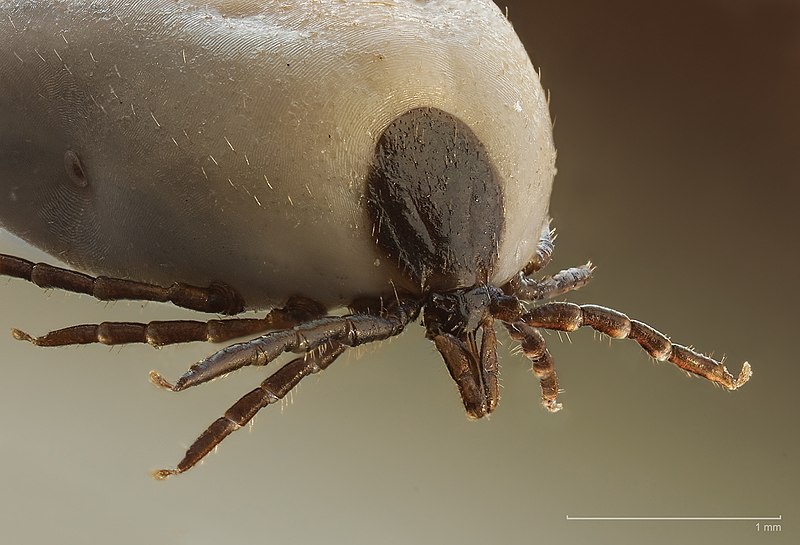
File:Ixodus_ricinus_5x.jpg · Wikimedia Commons · See Wikimedia Commons
Ixodida
Sign in to saveAlso known as Ixodoidea, ticks
Ticks are parasitic arachnids of the order Ixodida. They are part of the mite superorder Parasitiformes. Adult ticks are approximately 3 to 5 mm in length depending on age, sex, and species, but can become larger when engorged. Ticks are external parasites, living by feeding on the blood of mammals, birds, and sometimes reptiles and amphibians. The timing of the origin of ticks is uncertain, though the oldest known tick fossils are around 100 million years old, and come from the Cretaceous period. Ticks are widely distributed around the world, especially in warm, humid climates.
Ixodida is the scientific order that includes ticks, small parasitic arachnids about 3 to 5 mm long that feed on the blood of mammals, birds, and sometimes other animals. Ticks matter because they are widespread around the world, particularly in warm and humid environments, and have existed for at least 100 million years as persistent external parasites.
AI-generated from the Wikipedia summary — may contain errors.
Species
Ixodida
ORDER
- KingdomAnimalia
- PhylumArthropoda
- ClassArachnida
- OrderIxodida
蜱(拼音:pí,注音:ㄆㄧˊ,音同「皮」),又名蜱虫、壁蝨、扁蝨、草爬子,是一種體形極小的蛛形綱蜱蟎亞綱蜱總科的節肢動物寄生物,僅約火柴棒頭大小。不吸血时,有米粒大小,吸饱血液后,有指甲盖大。宿主包括哺乳類、鳥類、爬蟲類和兩棲類動物,大多以吸食血液為生,叮咬的同時會造成刺傷處的發炎。蜱在叮刺吸血时多无痛感,但由于螯肢、口下板同时刺入宿主皮肤,可造成局部充血、水肿、急性炎症反应,还可引起继发性感染。蜱還會帶來傳染病,如萊姆病、Q热、科罗拉多蜱热(Colorado tick fever)、兔熱病(Tularemia)、蜱传回归热(relapsing fever)、巴贝西虫病(Babesiosis)、埃里希氏体病(Ehrlichiosis)、蜱媒脑炎(Tick-borne meningoencephalitis)、牛无形体病(Anaplasmosis)、犬黄疸病(Jaundice)等。萊姆病是由伯氏疏螺旋體(Borrelia burgdorferi)所感染。 蜱虫主要栖息在草地、树林中,因此外出游玩时最好在暴露的皮肤上喷涂防蚊液,尽量避免在野外长时间坐卧。注意做好个人防护,穿紧口、浅色、光滑的长袖衣服。蜱虫常会附着在人体的头皮、腰部、腋窝、腹股沟及脚踝下方等部位。
via GBIF
Research
34,454 papers- Ticks (Ixodida) associated with bats (Chiroptera): an updated list with new records for Brazil.Parasitology research · 2023Lourenço EC, Famadas KM, Gomes LAC et al.DOI: 10.1007/s00436-023-07935-y
- Emerging tickborne viruses vectored by Amblyomma americanum (Ixodida: Ixodidae): Heartland and Bourbon viruses.ReviewJournal of medical entomology · 2023Dupuis AP 2nd, Lange RE, Ciota ATDOI: 10.1093/jme/tjad060
- Introduction of the ectoparasite Rhipicephalus pulchellus (Ixodida: Ixodidae) into Connecticut with a human traveler from Tanzania, and a review of its importation records into the United States.ReviewJournal of medical entomology · 2023Stafford KC 3rd, Molaei G, Williams SC et al.DOI: 10.1093/jme/tjad109
- Anomalous phenology of Ixodes scapularis (Ixodida: Ixodidae) in Mississippi.Journal of medical entomology · 2023Goddard J, Sims S, Robbins RG et al.DOI: 10.1093/jme/tjad081
- Soft and hard ticks (Parasitiformes: Ixodida) on humans: A review of Brazilian biomes and the impact of environmental change.ReviewActa tropica · 2022Nogueira BCF, Campos AK, Muñoz-Leal S et al.DOI: 10.1016/j.actatropica.2022.106598
- Southeast Asian ticks (Acari: Ixodida): a historical perspective.ReviewParasitology research · 2007Petney TN, Kolonin GV, Robbins RGDOI: 10.1007/s00436-007-0687-4
- Ticks and Tick-Borne Diseases of Colorado, Including New State Records for Argas radiatus (Ixodida: Argasidae) and Ixodes brunneus (Ixodida: Ixodidae).ReviewJournal of medical entomology · 2021Hutcheson HJ, Mertins JW, Kondratieff BC et al.DOI: 10.1093/jme/tjaa232
- Ixodes scapularis (Ixodida: Ixodidae) Parasitizing an Unlikely Host: Big Brown Bats, Eptesicus fuscus (Chiroptera: Vespertilionidae), in New York State, USA.Journal of medical entomology · 2022Occi JL, Campbell VM, Fonseca DM et al.DOI: 10.1093/jme/tjab174
via PubMed
Wikidata facts
- Instance of
- taxon
- Subclass of
- hematophage
- Parent taxon
- Parasitiformes
- Image
- Ticks Dönitz, Dermacentor rhinocerinus (w).jpg
Show 9 more facts
- taxon name
- Ixodida
- taxon rank
- order
- topic's main category
- Category:Ticks
- Commons category
- Ixodida
- Commons gallery
- Tick
- taxon common name
- klopi
- exact match
- wordnet-rdf.princeton.edu/wn30/01776313-n
- studied by
- acarology
- start time
- 99000000-0
Sources (3)
via Wikidata · CC0
~31 min read
Encyclopedic overview
25 sectionsContents
- Biology
- Taxonomy and phylogeny
- Anatomy and physiology
- Ixodidae
- Argasidae
- Nuttalliellidae
- Diet and feeding
- Range and habitat
- Ecology
- Life cycle
- Ixodidae
- One-host ticks
- Two-host ticks
- Three-host ticks
- Argasidae
- Nuttalliellidae
- Relationship with humans
- Tick-borne disease
- Population control measures
- In the arts
- See also
- Notes
- References
- Further reading
- External links
Ticks are parasitic arachnids of the order Ixodida. They are part of the mite superorder Parasitiformes. Adult ticks are approximately 3 to 5 mm in length depending on age, sex, and species, but can become larger when engorged. Ticks are external parasites, living by feeding on the blood of mammals, birds, and sometimes reptiles and amphibians. The timing of the origin of ticks is uncertain, though the oldest known tick fossils are around 100 million years old, and come from the Cretaceous period. Ticks are widely distributed around the world, especially in warm, humid climates.
Ticks belong to two major families: the Ixodidae, or hard ticks, and the Argasidae, or soft ticks. Nuttalliella, a genus of tick from southern Africa, is the only living member of the family Nuttalliellidae, which represents the most primitive living lineage of ticks. Adults have ovoid/pear-shaped bodies (idiosomas) which become engorged with blood when they feed, and eight legs. Their cephalothorax and abdomen are completely fused. In addition to having a hard shield on their dorsal surfaces, known as the scutum, hard ticks have a beak-like structure at the front containing the mouthparts, whereas soft ticks have their mouthparts on the underside of their bodies. Ticks locate potential hosts by sensing odor, body heat, moisture, and/or vibrations in the environment.
Excerpted from Wikipedia’s “Ixodida” article, available under the CC BY-SA 4.0 licence.
Gallery (42)
Available in 91 languages
- Español
- Français
- Deutsch
- 中文
- 日本語
- Русский
- Português
- Italiano
- العربية
- हिन्दी
- Afrikaans
- Albanian
- Aramaic
- Armenian
- Aymara
- azb
- Azerbaijani
- Bahasa Indonesia
Show 72 more
- Bangla
- Basque
- bat_smg
- Bosnian
- Breton
- Bulgarian
- Catalan
- Cebuano
- Cornish
- Corsican
- Croatian
- Czech
- Danish
- eml
- Estonian
- Filipino
- Galician
- Greek
- Guarani
- Haitian Creole
- Hebrew
- Hungarian
- Icelandic
- Ido
- Interlingua
- Irish
- Kabyle
- Kannada
- Kashmiri
- Kashubian
- Kurdish
- Latin
- Latvian
- lbe
- Low German
- Luxembourgish
- Malagasy
- Malay
- Malayalam
- Marathi
- Nederlands
- Nepali
- Northern Frisian
- Norwegian
- Pashto
- Polski
- Quechua
- Romanian
- Sardinian
- Scottish Gaelic
- Serbian
- Serbian (Latin)
- Shona
- Sicilian
- Sindhi
- Sinhala
- Slovak
- Slovenian
- Somali
- Svenska
- Tamil
- Tiếng Việt
- Türkçe
- Ukrainian
- Walloon
- Waray
- Welsh
- Wu Chinese
- Zaza
- zh_yue
- فارسی
- 한국어
via Wikidata sitelinks · CC0