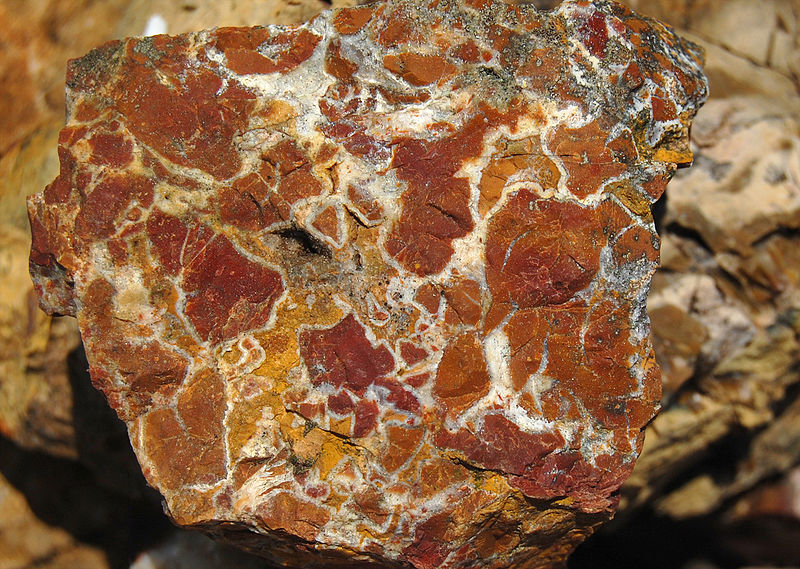
File:Jasper_outcrop_in_the_Bucegi_Mountains.jpg · Wikimedia Commons · See Wikimedia Commons
jasper
Sign in to saveJasper, an aggregate of microgranular quartz and/or cryptocrystalline chalcedony and other mineral phases, is an opaque, impure variety of silica, usually red, yellow, brown or green in color; and rarely blue. The common red color is due to iron(III) inclusions. Jasper breaks with a smooth surface and is used for ornamentation or as a gemstone. It can be highly polished and is used for items such as vases, seals, and snuff boxes. The density of jasper is typically 2.5 to 2.9 g/cm3. Jaspillite is a banded-iron-formation rock that often has distinctive bands of jasper.
Jasper is a colorful, opaque stone made primarily of quartz that breaks smoothly and can be polished to a shine, making it useful for decorative objects and jewelry. Its practical value lies in its durability and attractive appearance—qualities that have made it a material of choice for ornamental items like vases and gemstones throughout history.
AI-generated from the Wikipedia summary — may contain errors.
Key facts
- Mineral.name
- Jasper
- Mineral.boxbgcolor
- 732b1c
- Mineral.boxtextcolor
- FFFFFF
- Mineral.image
- Jasper outcrop in the Bucegi Mountains.jpg
- Mineral.imagesize
- 280px
- Mineral.caption
- Jasper outcrop, Bucegi Mountains, Romania
- Mineral.category
- Aggregate rock (impure chalcedony variety)
- Mineral.formula
- SiO2 (with varying impurities)
- Mineral.system
- Hexagonal
- Mineral.colour
- Most commonly red, but may be yellow, brown, green or (rarely) blue
- Mineral.habit
- Massive
- Mineral.cleavage
- Indiscernible
- Mineral.fracture
- Conchoidal
- Mineral.mohs
- 6.5–7
- Mineral.luster
- Vitreous
- Mineral.diaphaneity
- Opaque
- Mineral.gravity
- 2.5–2.9
- Mineral.refractive
- 1.54–2.65
via Wikipedia infobox
Wikidata facts
- Instance of
- mineral variety
- Subclass of
- chalcedony
- Part of
- Priestly breastplate
- Image
- Unpolished jasper.jpg
Show 3 more facts
- Commons category
- Jasper
- Mohs' hardness
- 7
- color
- black
Sources (2)
via Wikidata · CC0
~10 min read
Encyclopedic overview
9 sectionsContents
- Etymology and history
- Types
- Banded iron formations
- Picture jaspers<span class="anchor" id="picture"></span>
- Basanite<span class="anchor" id="basanite"></span> and other types of touchstone
- Gallery
- Footnotes
- References
- External links
Jasper, an aggregate of microgranular quartz and/or cryptocrystalline chalcedony and other mineral phases, is an opaque, impure variety of silica, usually red, yellow, brown or green in color; and rarely blue. The common red color is due to iron(III) inclusions. Jasper breaks with a smooth surface and is used for ornamentation or as a gemstone. It can be highly polished and is used for items such as vases, seals, and snuff boxes. The density of jasper is typically 2.5 to 2.9 g/cm3. Jaspillite is a banded-iron-formation rock that often has distinctive bands of jasper.
==Etymology and history== upright|thumb|Movable Egyptian ring in green jasper and gold, from 664 to 322 BC or later (Late Period), the Walters Art Museum thumb|upright|left|Amulet of scarlet jasper, provenance unknown, [[Royal Pump Room, Harrogate]] thumb|upright|left|Relief|Low-relief sphinx pendant, red jasper, pearl and enamel, French, circa 1870 The name means "spotted or speckled stone," and is derived via Old French (variant of Anglo-Norman jaspe) and Latin (nom. ) from Greek iaspis (feminine noun), from an Afroasiatic language (cf. Hebrew '' , Akkadian yashupu). This Semitic etymology is believed to be unrelated to that of the English given name Jasper, which is of Persian origin, though the Persian word for the mineral jasper is also yashum (یَشم).
Excerpted from Wikipedia’s “jasper” article, available under the CC BY-SA 4.0 licence.
Gallery (26)
Available in 59 languages
- Español
- Français
- Deutsch
- 中文
- 日本語
- Русский
- Português
- Italiano
- العربية
- Aragonese
- Armenian
- Azerbaijani
- Bahasa Indonesia
- Basque
- be_x_old
- Belarusian
- Bulgarian
- Catalan
Show 40 more
- Crimean Tatar
- Czech
- Esperanto
- Estonian
- Finnish
- Galician
- Georgian
- Hebrew
- Icelandic
- Ido
- Kannada
- Kashubian
- Kazakh
- Kyrgyz
- Latin
- Latvian
- Lithuanian
- Macedonian
- Malagasy
- nah
- Nederlands
- Norwegian
- Norwegian Nynorsk
- Polski
- Romanian
- Serbian
- simple
- Slovak
- Slovenian
- Svenska
- Tiếng Việt
- Türkçe
- Ukrainian
- Uyghur
- Uzbek
- Western Panjabi
- zh_yue
- فارسی
- ไทย
- 한국어
via Wikidata sitelinks · CC0