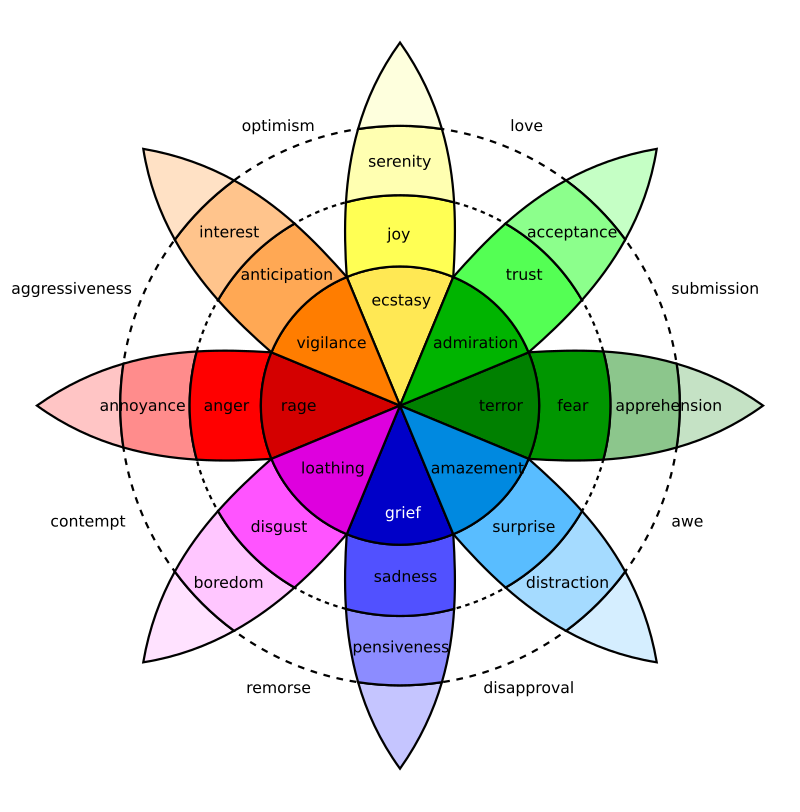
File:Plutchik-wheel.svg · Wikimedia Commons · See Wikimedia Commons
jealousy
Sign in to saveJealousy generally refers to the thoughts or feelings of insecurity, fear, and concern over a relative lack of possessions or safety.
Jealousy is when you feel insecure, fearful, or worried because you have less of something than someone else does, or because you're concerned about losing what you have. It matters because these feelings can significantly affect how you relate to others and make decisions in your relationships and life.
AI-generated from the Wikipedia summary — may contain errors.
Research
1,682 papers- Captagone & Morbid Jealousy.ReviewPsychopharmacology bulletin · 2023Shalaby AS, Badr Nassar OM, Bahanan AO et al.
- Pathological jealousy from forensic psychiatric perspective.ReviewPsychiatria polska · 2018Cynkier PDOI: 10.12740/PP/OnlineFirst/79840
- Jealousy as a Driving Force for Murder.ReviewPsychoanalytic review · 2018Evzonas NDOI: 10.1521/prev.2018.105.3.257
- Pathological Jealousy: An Interactive Condition.ReviewPsychiatry · 2016Seeman MVDOI: 10.1080/00332747.2016.1175838
- Jealousy: the pathology of passion.ReviewThe British journal of psychiatry : the journal of mental science · 1991Mullen PEDOI: 10.1192/bjp.158.5.593
- Jealousy: self-inflicted agony and ruin.International review of psychiatry (Abingdon, England) · 2023van Peer WDOI: 10.1080/09540261.2023.2168521
- [Jealousy].ReviewRevue medicale suisse · 2006Kiefer B
- Social Media Friendship Jealousy.Evolutionary psychology : an international journal of evolutionary approaches to psychology and behavior · 2024Vaillancourt T, Brittain H, Eriksson M et al.DOI: 10.1177/14747049231225738
via PubMed
Wikidata facts
- Subclass of
- defensive pessimism
- Image
- Young Romance.jpg
Show 5 more facts
- Commons category
- Jealousy
- topic's main category
- Category:Jealousy
- opposite of
- compersion
- on focus list of Wikimedia project
- Wikipedia:Vital articles/Level/4
- described by source
- Encyclopædia Britannica 11th edition
Sources (7)
via Wikidata · CC0
~27 min read
Encyclopedic overview
19 sectionsContents
- Etymology
- Theories
- Scientific examples
- Comparison with envy
- In psychology
- In sociology
- Romantic jealousy
- Communicative responses
- Sexual jealousy
- Contemporary views on gender-based differences
- In animals
- Applications
- In fiction, film, and art
- In religion
- See also
- References
- Notes
- Further reading
- External links
Jealousy generally refers to the thoughts or feelings of insecurity, fear, and concern over a relative lack of possessions or safety.
Jealousy can consist of one or more emotions such as anger, resentment, inadequacy, helplessness or disgust. In its original meaning, jealousy is distinct from envy, though the two terms have popularly become synonymous in the English language, with jealousy now also taking on the definition originally used for envy alone. These two emotions are often confused with each other, since they tend to appear in the same situation. thumb|A jealousy scene shown on the Đông Hồ painting|Dong Ho painting of [[Vietnam]]
Excerpted from Wikipedia’s “jealousy” article, available under the CC BY-SA 4.0 licence.
Gallery (17)
Available in 68 languages
- Español
- Français
- Deutsch
- 中文
- 日本語
- Русский
- Português
- Italiano
- العربية
- हिन्दी
- Afrikaans
- Albanian
- Armenian
- Asturian
- Azerbaijani
- Bahasa Indonesia
- Basque
- Belarusian
Show 49 more
- Bosnian
- Breton
- Bulgarian
- Catalan
- Central Kurdish
- Chuvash
- Croatian
- Czech
- Danish
- Esperanto
- Estonian
- Filipino
- Finnish
- Galician
- Greek
- Hungarian
- Ido
- Kabyle
- Kannada
- Latin
- Lombard
- Macedonian
- Malay
- Marathi
- Mongolian
- Nederlands
- Norwegian
- Occitan
- Polski
- Punjabi
- Romanian
- Serbian
- Serbian (Latin)
- Sicilian
- simple
- Sindhi
- Slovak
- Slovenian
- Svenska
- Swahili
- Tajik
- Tiếng Việt
- Ukrainian
- Urdu
- Wu Chinese
- zh_yue
- Zulu
- فارسی
- 한국어
via Wikidata sitelinks · CC0