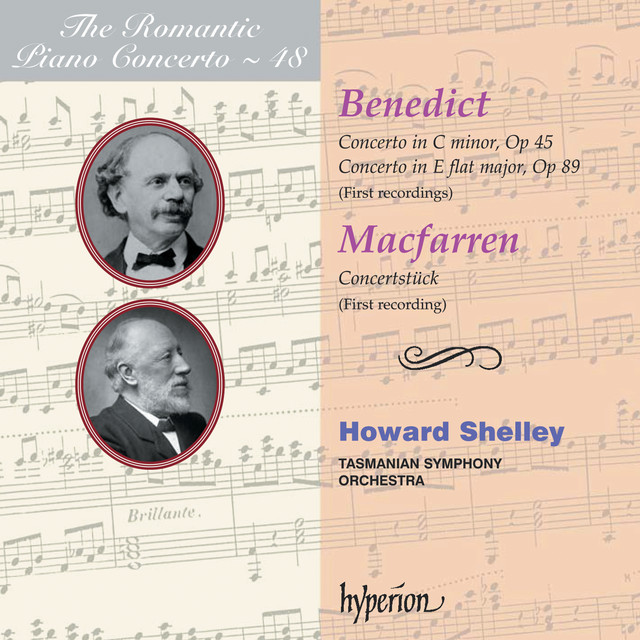
Julius Benedict · Spotify · Courtesy of Spotify
Julius Benedict
Sign in to saveAlso known as Sir Julius Benedict
German-born composer and conductor (1804–1885)
Person · Open Library
- Born
- 1804
- Died
- 1885
- Works
- 19
Top works
- [A collection of newspaper clippings concerning Jenny Lind formed by Jules Benedict, who accompanied her during her tour of the United States, in 1850.]
- The lily of Killarney
- Songs, duets, trios, recitatives, choruses, &c. in the new grand romantic opera of The gipsy's warning
- A year and a day
- Songs, duets, trios, recitatives, chorusses, &c. in the new grand romantic opera of The gipsy's warning
via Open Library + Wikidata
Listeners · Last.fm
- Listeners
- 2,092
- Total plays
- 7,734
Tags
Sir Julius Benedict (27 November 1804 – 5 June 1885), was a German-born composer and conductor, resident in England for most of his career. Benedict was born in Stuttgart, the son of a Jewish banker, and learnt composition from Johann Nepomuk Hummel at Weimar and Carl Maria von Weber at Dresden; it was Weber who introduced him in Vienna to Beethoven on 5 October 1823. In the same year he was appointed Kapellmeister of the Kärnthnerthor theatre at Vienna <a href="https://www.last.fm/music/Julius
Wikidata facts
- Instance of
- human
- Given name
- Julius
- Family name
- Benedict
- Gender
- male
- Citizenship
- United Kingdom of Great Britain and Ireland
- Place of birth
- Stuttgart
- Place of death
- London
- Occupation
- pianist
- Position held
- chapelmaster
- Languages spoken
- English language
- Award
- Knight Bachelor
- Student of
- Carl Maria von Weber
- Genre
- opera
- Instrument
- piano
- Image
- Sir Julius Benedict.jpg
Show 9 more facts
- place of burial
- Kensal Green Cemetery
- Commons category
- Sir Julius Benedict
- date of birth
- 1804-11-27
- date of death
- 1885-06-05
- name in native language
- Julius Benedict
- start of work period
- 1824-00-00
- writing language
- English language
- P12749
- Johanna Wolf
Sources (2)
via Wikidata · CC0
Works in European collections
12 objects attributed to Julius Benedict, held across European museums, libraries & archives · via Europeana

La capinera/(Benedict)

Carnival of Venice: aria with variations, I. part/Jules Benedict

La capinera: Canzone/(I. Benedict)

The moon hath raised her lamp above : "Lily of Killarney"; duet / (Benedict)

The Egyptian and the bird/Edward Oxenford - Sir Julius Benedict

Carnival of Venice: aria with variations, II part/Jules Benedict

Carnival of Venice/(Benedict)
By the sad sea waves. Arr - Don Mus.Ms. 2366 : V, pf; F
The gypsy's warning, Ouvertüre a grand romantic opera : performed with immense success at The Theatre Royal, Drury Lane
Untitled
Untitled
Untitled