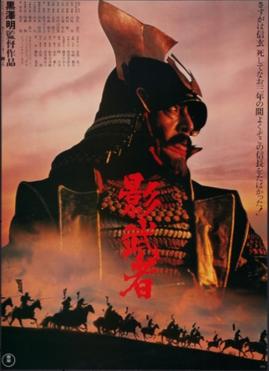
File:Kagemushatheatricalposter.jpg · Wikimedia Commons · See Wikimedia Commons
Kagemusha
Sign in to saveAlso known as Shadow Warrior
is a 1980 Japanese epic jidaigeki film directed by Akira Kurosawa. It is set in the Sengoku period of Japanese history and tells the story of a lower-class petty thief who is taught to impersonate the dying daimyō Takeda Shingen to dissuade opposing lords from attacking the newly vulnerable clan. Kagemusha is the Japanese term for a political decoy, literally meaning "shadow warrior". The film ends with the climactic 1575 Battle of Nagashino.
OverviewAI-generated
Kagemusha is a 1980 Japanese drama and war film directed, written, and edited by Akira Kurosawa. The cast includes Tatsuya Nakadai, Kaori Momoi, Takashi Shimura, and Tsutomu Yamazaki. Shin'ichirō Ikebe composed the music, while Takao Saito served as director of photography and Yoshirō Muraki as production designer. Francis Ford Coppola, George Lucas, and Tomoyuki Tanaka were among the producers. The film was distributed by Toho and Netflix.
The movie received the Palme d'Or and the César Award for Best Foreign Film. It was also nominated for the Academy Award for Best International Feature Film and Best Production Design. Review scores include 7.6/10, 84/100, and 89%. The runtime is listed as 179, 180, or 162 minutes depending on the source.
Synthesized by Vinony from 43 facts across 6 sources: Wikidata, TMDb, Internet Archive, IMDb, Vinony collections, Vinony graph. Generated from structured data (not the Wikipedia text) and checked against those facts — may still contain errors.
Film · TMDB
7.8Akira Kurosawa's lauded feudal epic presents the tale of a petty thief who is recruited to impersonate Shingen, an aging warlord, in order to avoid attacks by competing clans. When Shingen dies, his generals reluctantly agree to have the impostor take over as the powerful ruler. He soon begins to appreciate life as Shingen, but his commitment to the role is tested when he must lead his troops into battle against the forces of a rival warlord.
Cast
- Tatsuya Nakadai as Shingen Takeda / Kagemusha
- Tsutomu Yamazaki as Nobukado Takeda
- Kenichi Hagiwara as Katsuyori Takeda
- Jinpachi Nezu as Sohachiro Tsuchiya
- Hideji Ōtaki as Masakage Yamagata
- Daisuke Ryū as Nobunaga Oda
Themes
- japan
- samurai
- army
- emperor
- warlord
- battle
- impersonation
- doppelgänger
- jidaigeki
- edo period
This product uses the TMDB API but is not endorsed or certified by TMDB.
Key facts
- Film.name
- Kagemusha
- Film.image
- Kagemushatheatricalposter.jpg
- Film.caption
- Theatrical poster
- Film.director
- Akira Kurosawa
- Film.starring
- Tatsuya Nakadai
- Film.music
- Shin'ichirō Ikebe
- Film.editing
- Akira Kurosawa (uncredited)
- Film.runtime
- 180 minutes
- Film.language
- Japanese
- Film.gross
- $33 million ()
via Wikipedia infobox
Wikidata facts
- Instance of
- film
- Award
- Palme d'Or
- Genre
- war film
- Country of origin
- Japan
- Original language
- Japanese
- Director
- Akira Kurosawa
- Screenwriter
- Akira Kurosawa
- Composer
- Shin'ichirō Ikebe
- Producer
- Tomoyuki Tanaka
- Cinematographer
- Takao Saito
- Narrative location
- Japan
- Filming location
- Japan
- Duration
- 179
- FilmAffinity ID
- 532261
- Distribution format
- video on demand
Show 9 more facts
- film editor
- Akira Kurosawa
- title
- 影武者
- executive producer
- Akira Kurosawa
- distributed by
- Netflix
- production designer
- Yoshirō Muraki
- review score
- 89%
- characters
- Uesugi Kenshin
- assessment
- Bechdel test
- publication date
- 1980-10-17
Sources (15)
via Wikidata · CC0
~12 min read
Encyclopedic overview
12 sectionsContents
- Plot
- Cast
- Production
- Release
- Reception
- Box office
- Critical response
- Accolades
- See also
- References
- Bibliography
- External links
is a 1980 Japanese epic jidaigeki film directed by Akira Kurosawa. It is set in the Sengoku period of Japanese history and tells the story of a lower-class petty thief who is taught to impersonate the dying daimyō Takeda Shingen to dissuade opposing lords from attacking the newly vulnerable clan. Kagemusha is the Japanese term for a political decoy, literally meaning "shadow warrior". The film ends with the climactic 1575 Battle of Nagashino.
Kagemusha was released to critical acclaim. The film won the Palme d'Or at the 1980 Cannes Film Festival (tied with All That Jazz). It was also nominated for the Academy Award for Best Foreign Language Film and received other honours. In 2009 the film was voted at No. 59 on the list of The Greatest Japanese Films of All Time by Japanese film magazine Kinema Junpo.
Excerpted from Wikipedia’s “Kagemusha” article, available under the CC BY-SA 4.0 licence.