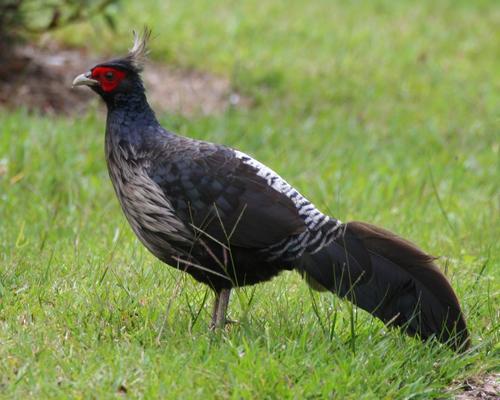
(c) Caleb Slemmons, some rights reserved (CC BY-NC) · cc-by-nc
Kalij Pheasant
Sign in to saveAlso known as White-crested Kalij pheasant, Lophura leucomelanos
species of bird
OverviewAI-generated
The Kalij Pheasant, scientifically named *Lophura leucomelanos*, is a species classified within the class Aves. It has a recorded mass of 975 and a litter size of 7.3. The egg incubation period for this species is 21.
According to the IUCN Red List, the Kalij Pheasant holds a status of Least Concern as of 2024. The species has been documented in 2989 observations on iNaturalist.
Synthesized by Vinony from 14 facts across 4 sources: Wikidata, iNaturalist, IUCN Red List, Vinony graph. Generated from structured data (not the Wikipedia text) and checked against those facts — may still contain errors.
Species
Least ConcernKalij Pheasant
species
via IUCN
Wikidata facts
- Instance of
- taxon
- Parent taxon
- Lophura
- Mass
- 795
- Image
- Kalij Pheasant Lingadhar Uttarakhand India 02.12.2014.jpg
Show 9 more facts
- taxon rank
- species
- IUCN conservation status
- Least Concern
- Commons category
- Lophura leucomelanos
- taxon name
- Lophura leucomelanos
- Commons gallery
- Lophura leucomelanos
- taxon common name
- faisão-calije
- litter size
- 7.3
- egg incubation period
- 21
- endemic to
- Pakhui Tiger Reserve
via Wikidata · CC0
~5 min read
Encyclopedic overview
The kalij pheasant (Lophura leucomelanos), or simply kalij, is a pheasant found in forests and thickets, especially in the Himalayan foothills, from Nepal, Pakistan to western Thailand. Males are rather variable depending on the subspecies involved, but all have at least partially glossy bluish-black plumage, while females are overall brownish. Both sexes have a bare red face and greyish legs (the latter separating it from the red-legged silver pheasant). It is generally widespread, though three of its eastern subspecies (L. l. oatesi, L. l. lineata, and L. l. crawfurdi) are considered threatened and L. l. moffitti is virtually unknown in the wild.
The name is also spelled kaleege in old texts, such as Game Birds of India and Asia by Frank Finn, though no longer in his Indian Sporting Birds. The species was introduced to Hawaii in 1962 as a gamebird. On 21 October 2021, the Government of Jammu and Kashmir declared the kalij pheasant as bird of the Union Territory of Jammu and Kashmir.
Excerpted from Wikipedia’s “Kalij Pheasant” article, available under the CC BY-SA 4.0 licence.